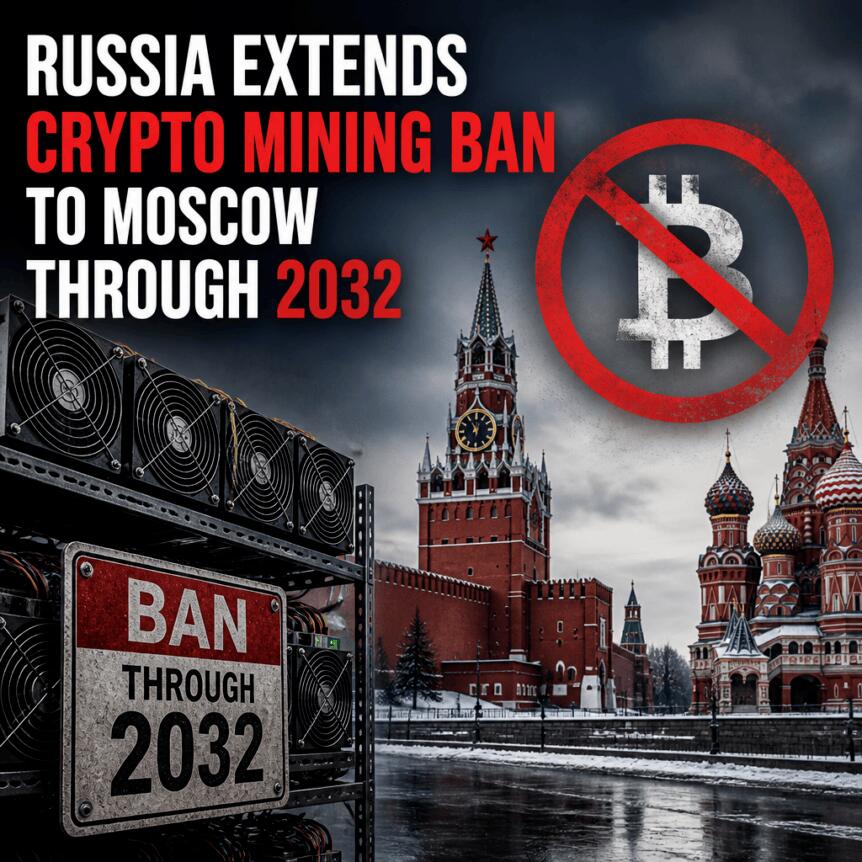
Russia is tightening its cryptocurrency mining policy again, extending restrictions beyond the regions it targeted earlier and adding Moscow and nearby areas to a long-running ban schedule. A new government resolution takes effect on Aug. 15, 2026, with the prohibition set to run through Dec. 31, 2032.
The update is set out in Resolution No. 936, signed by Prime Minister Mikhail Mishustin on July 25, 2026, according to records published on Pravo.ru. It revises an earlier mining restriction order from December 2024 and updates the list of places where mining activities are limited due to local electricity concerns.
Key takeaways
- Resolution No. 936 introduces a mining ban for Moscow, the Moscow Region, and parts of Russia’s Kursk Region, beginning Aug. 15, 2026.
- The restrictions will remain in force through Dec. 31, 2032, effectively creating a multi-year compliance horizon for operators.
- The rules follow earlier regional bans launched in December 2024 and other orders that began in 2026 across select parts of Buryatia and Zabaykalsky Krai.
- Officials have previously justified the approach by citing rising electricity demand and the power grid pressure associated with growing data-center loads.
Moscow and Kursk move into the restricted zone
Under the amended framework, the restricted geography expands to include Moscow, the Moscow Region, and additional territories listed within Russia’s Kursk Region. The rules also cover eight municipal districts and the city of Lgov in that region, broadening the affected footprint beyond the original set of localities.
The stated objective remains consistent with earlier restrictions: to limit cryptocurrency mining in areas considered to be facing strain on electricity supply. For miners and infrastructure providers, the practical impact is straightforward—new or continued mining operations in the designated areas may need to pause or restructure well before the Aug. 15, 2026 start date to avoid enforcement risks.
Resolution No. 936 revises the December 2024 order
Resolution No. 936 was signed on July 25, 2026 and amends an earlier prohibition order issued in December 2024. According to Pravo.ru, the change is not a one-off ban: it updates the list of jurisdictions where mining restrictions apply and extends the same restriction concept to additional regions.
That matters for market participants because Russia’s approach is being refined through successive legal instruments rather than replaced wholesale. In practice, operators are being pushed to manage regulatory uncertainty through long planning windows and contingency plans, especially in data-center-heavy regions where power allocation decisions can determine feasibility.
Why authorities linked the bans to power demand
In an earlier statement covering the Moscow Region’s rationale, the energy ministry said the ban was needed because of growing electricity demand. As reported by TASS, the ministry estimated that Moscow and the Moscow Region have 65 data centers connected to the power grid, with a combined capacity of 734 megawatts (MW). The same reporting cited 19 data centers in the Moscow Region with 233 MW of capacity.
Even though the mining restrictions are aimed at cryptocurrency operations, the logic used by officials is tied to the overall electricity system—particularly the growing load from digital infrastructure. For miners, that creates an indirect but significant link between crypto activity and broader regional power planning: where electricity is already earmarked for data centers and other high-consumption uses, regulators may treat mining as additional pressure that the grid cannot easily absorb.
Not the first wave: bans already planned in other regions
This latest expansion builds on restrictions introduced earlier in other parts of Russia. The earlier framework referenced by Pravo.ru points to mining restrictions being introduced in several regions in a prior phase, including parts of Buryatia and Zabaykalsky Krai.
As indicated in the published records, the bans in those areas are scheduled to run from April 1, 2026 through March 15, 2031. That staggered timing creates a rolling pattern: some jurisdictions begin restrictions in 2026 while others—like Moscow—enter a later phase starting Aug. 15, 2026, but continuing for longer overall through 2032.
Investors and operators watching Russia’s policy direction should note the implication: rather than lifting restrictions once an initial window expires, the government is instead layering in additional territories and sustaining multi-year prohibitions. That tends to shift mining activity away from restricted power grids and toward jurisdictions not covered by the latest legal orders—or toward arrangements that can demonstrate compliance with local limits.
For the next phase, the key question is how enforcement will work in the newly included jurisdictions, and whether regulators will continue expanding the restricted map beyond Moscow and Kursk or refine exemptions for specific infrastructure arrangements. Miners with assets near the updated boundaries should monitor local implementation details closely as Aug. 15, 2026 approaches.