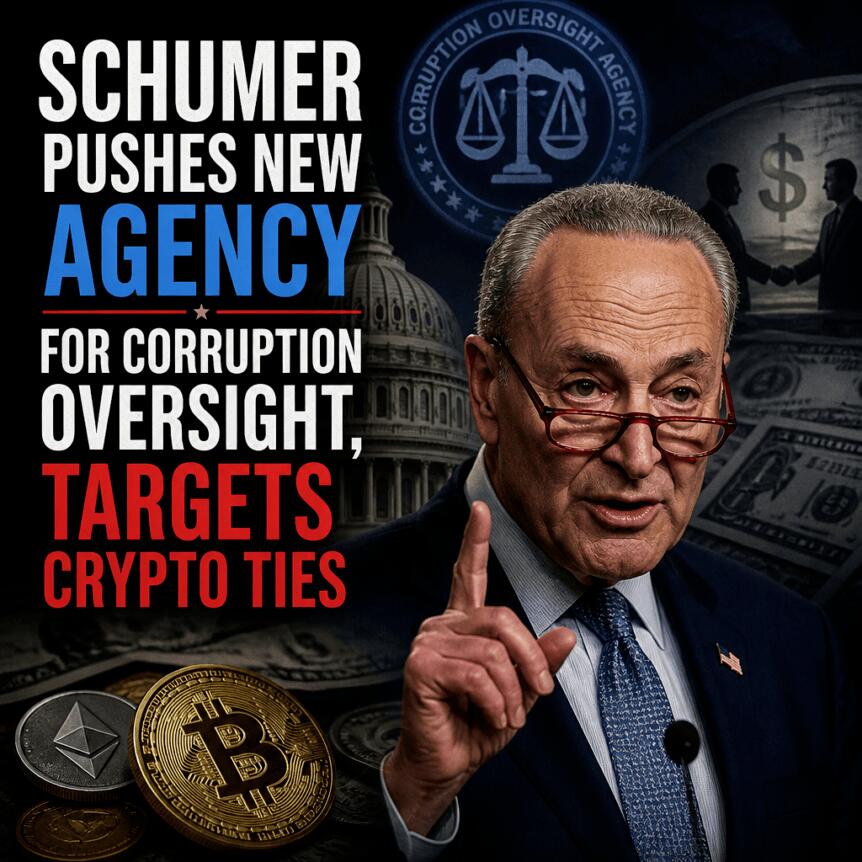
Senate Minority Leader Chuck Schumer has introduced new federal legislation aimed at creating an “Anti-Corruption Bureau” with the power to investigate, enforce, and prevent executive-branch corruption. The proposal also folds into a wider political fight over cryptocurrency ethics and market-structure reform, as Schumer’s remarks directly referenced President Donald Trump’s financial ties to crypto.
According to Schumer’s office, the bill—called the Anti-Corruption Bureau Creation Act—would establish a new agency designed to replace what he described as a fragmented system of oversight bodies. Schumer and cosponsors presented the effort as a targeted response to conflicts of interest they say stem from public office and lucrative crypto-related investments.
Key takeaways
- Schumer introduced the Anti-Corruption Bureau Creation Act, proposing a dedicated US agency to investigate, enforce, and prevent executive-branch corruption.
- The bill’s rationale ties to alleged Trump-linked financial gains, including references to crypto exposure mentioned in Schumer’s Thursday notice.
- Schumer’s proposal would consolidate multiple ethics and oversight functions, grouping entities including the Federal Election Commission and other government ethics offices “under one roof.”
- Supporters position the bureau as a “real teeth” enforcement mechanism, while passage could still face hurdles in the House and Senate—and a potential veto by Trump.
- The timing overlaps with ongoing uncertainty around the Senate’s handling of the Digital Asset Market Clarity (CLARITY) Act, a major market-structure effort backed by many in the industry.
A new enforcement-focused anti-corruption bureau
In a Thursday press notice, Schumer said he introduced the Anti-Corruption Bureau Creation Act. He described the agency as one with enforcement authority, designed to “investigate, enforce, and prevent executive branch corruption.” The legislation also sets out “Congress’ findings” that Schumer claims include disclosures about Trump’s earnings from investments and additional crypto exposure connected to foreign governments through a family fund, as referenced in Schumer’s notice.
Schumer framed the proposal as an institutional fix. In remarks shared through a Public Citizen forum about the bill, he characterized the bureau as having “real teeth” and argued it would help harmonize enforcement across institutions that currently operate with overlapping or inconsistent authority.
The bill’s structure, as described in connection with the forum, calls for a bipartisan group of seven members to be confirmed by the Senate. It also includes mechanisms intended to allow private citizens and state authorities to seek recovery of funds they allege were stolen through corruption, according to descriptions tied to the proposal.
How crypto ethics enters the political equation
For Democrats weighing support for comprehensive crypto market structure legislation, President Trump’s business ties have become a central flashpoint. Many lawmakers, despite White House agreement to certain ethics provisions in the Digital Asset Market Clarity (CLARITY) Act, have argued that the offered safeguards do not fully address potential conflicts of interest.
Earlier coverage from Cointelegraph noted that debates around the CLARITY Act have kept ethics provisions at the center of discussions, with lawmakers saying the measures fall short. Schumer’s new anti-corruption bill adds a separate enforcement pathway to that same broader argument: that oversight should be strengthened to prevent public office from translating into private financial benefit, including in crypto-related business interests.
Consolidating enforcement and ethics offices
A notable feature of the anti-corruption proposal is its intent to gather multiple oversight functions under one organizational umbrella. As described in the coverage, the legislation would place the US Federal Election Commission, the Office of Government Ethics, and the Office of Special Counsel “under one roof” within the new bureau.
Supporters argue the consolidation would reduce the gaps they believe exist across current watchdog systems. Schumer’s messaging emphasized replacing “a broken patchwork of watchdogs” with a single agency capable of acting “anywhere, anytime corruption strikes.” Critics of the current system—particularly those focused on ethics enforcement—often point to jurisdictional complexity and uneven prioritization across agencies; this bill attempts to address that by reorganizing responsibilities rather than relying solely on incremental reforms.
Cointelegraph reported that it reached out to the White House for comment but did not receive an immediate response regarding the proposal.
Cosponsors, vote math, and what happens next
The bill was introduced by Schumer and has cosponsors including Senators Andy Kim, Alex Padilla, and Jeff Merkley. Passage would require Republican support in the House and Senate, where the party holds a slim majority.
Even if it advances before 2028, the president would have veto power. If Trump vetoed the legislation, Congress would need a two-thirds majority in both chambers to override it, according to the rules typically governing federal veto overrides.
The timing is also important because the Senate is approaching a break. As described in the coverage, the Senate had just over a week left before lawmakers planned to leave for a month-long state work period. That looming calendar could affect the speed at which both ethics-related and market-structure measures move in the upper chamber.
CLARITY Act uncertainty persists alongside the anti-corruption push
While Schumer’s anti-corruption proposal targets executive-branch conduct, it arrives in the midst of unresolved negotiations around the CLARITY Act, which many see as a key step toward a clearer US framework for digital assets.
As of Thursday, the Senate had not scheduled a vote on the CLARITY Act, despite pushes from Republican lawmakers and industry stakeholders. Cointelegraph previously highlighted that ethics provisions remain a sticking point for some Democrats, and this week’s status underscores how procedural timing may be just as decisive as policy design.
According to remarks attributed in the coverage to former SEC official John Reed Stark, after a public forum hosted by Senators Richard Blumenthal and Chris Van Hollen, it was unclear whether lawmakers would move the CLARITY Act during the available window. The same report cited statements from Coinbase CEO Brian Armstrong referring to the bill nearing a critical stage, alongside continued advocacy from Senator Cynthia Lummis for a vote.
The political sequence matters for market participants: if crypto market structure legislation is delayed by calendar constraints, lawmakers may re-focus on broader political disputes about ethics and enforcement, potentially reshaping what “safe enough” looks like for legislators and regulators. Conversely, if the CLARITY Act advances, it could clarify the legislative pathway for industry—while leaving ethics and anti-corruption reforms to run in parallel.
For now, investors and builders should watch two developments closely: whether the Senate schedules and votes on the CLARITY Act before its break, and whether Schumer’s anti-corruption bureau proposal gains traction early enough to overcome House and Senate vote hurdles and any eventual veto risk.