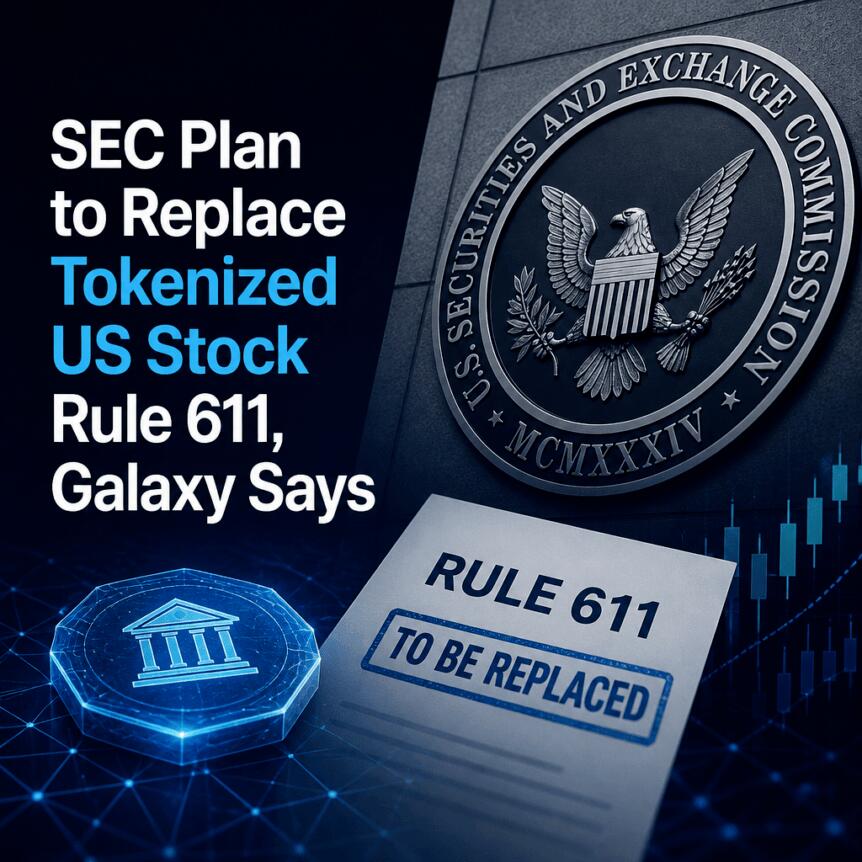
The U.S. Securities and Exchange Commission has proposed to rescind two longstanding National Market System (NMS) provisions that govern how trading venues protect displayed prices and prevent “trade-throughs.” If finalized, the changes could materially alter the regulatory constraints facing tokenized-stock platforms, particularly systems that use automated market makers (AMMs) or other decentralized trading mechanisms.
In a notice of proposed rulemaking issued on Thursday, the SEC said it would remove Rule 611, which generally prohibits trading on one exchange at a worse price when a better price is available on another, and Rule 610(e), which restricts exchanges from displaying certain bids that are not synchronized with better-priced quotations elsewhere. The proposal has 60 days for public comment, setting up a new compliance question for market participants exploring tokenized equities.
Key takeaways
- The SEC proposes rescinding NMS Rules 611 (trade-through protections) and 610(e) (limits on certain displayed bids), changing the baseline for cross-venue price protection.
- Automated market makers and similar pooling-based execution models may face fewer structural constraints if the trade-through framework is removed.
- The SEC indicates it could replace the removed provisions with a broader “best execution” approach, shifting compliance from price-protection rules to execution-quality standards.
- Tokenized-stock trading plans may need to be reassessed for regulatory alignment, especially where execution logic cannot reliably mirror centralized quote-by-quote comparisons.
What the SEC is proposing to change in NMS rules
At the core of the proposal are two rules designed to enforce pricing competition across U.S. equity markets. Rule 611 is intended to prevent “trade-throughs,” a condition where an order executed on one trading venue would occur at a price inferior to a better price displayed on another venue. Rule 610(e) further restricts how exchanges present bids, aiming to avoid scenarios where an exchange displays a bid price that could be inconsistent with more favorable available quotations elsewhere.
By proposing to rescind both provisions, the SEC is effectively questioning whether these specific mechanisms remain appropriate as market infrastructure evolves—particularly as digital-asset technologies are increasingly considered for securities trading use cases. The proposal also lands in an environment where the SEC has signaled interest in updating how U.S. capital markets can accommodate blockchain-enabled settlement and trading.
The compliance significance is immediate: trade-through and quotation-display regimes are not merely technical rules. They define what constitutes acceptable routing, quoting, and execution across venues and therefore shape how exchanges, ATS operators, broker-dealers, and any tokenized-stock venue architecture must behave to avoid violations.
Why tokenized equities face structural constraints
Commentary from industry research has pointed to a central problem with applying the existing NMS framework to tokenized equities that rely on AMMs. According to Galaxy head of research Alex Thorn, AMMs execute trades against whatever pool price is available at the time of execution, which can conflict with trade-through protections that are based on the existence of a better quote elsewhere.
Thorn’s concern is that an AMM model may not be able to “stop a trade” simply because a superior price exists at another venue. In that scenario, a pool could execute at a price that is worse than the best available displayed quotation elsewhere, triggering trade-through concerns under the current rules. He also argued that continuously fluctuating AMM pricing makes compliance difficult under a framework intended to ensure investors receive the best available price across platforms.
Institutionally, the key point is not whether tokenized-stock execution can be engineered to meet every rule, but whether the rules’ structural assumptions match the execution process. Trade-through standards are tightly linked to quote comparison across venues; AMM execution is tied to liquidity mechanisms inside a trading function. That mismatch can create persistent legal and operational risk—even where the end goal is price improvement or efficient execution.
If the SEC rescinds Rule 611 and Rule 610(e), market operators and compliance teams would likely revisit whether the remaining NMS and securities-market regulation still imposes constraints that functionally replicate trade-through protections through other requirements.
From trade-through rules to “best execution” compliance
The SEC has not yet finalized the replacement approach, but Thorn suggested the agency may substitute the rescinded framework with a “best execution” model. In practice, a best-execution standard focuses on whether an order is handled in a manner reasonably designed to achieve the most favorable terms for the customer under the circumstances, which can be implemented through policies, procedures, routing decisions, and execution monitoring.
That shift could matter for tokenized equities because best-execution duties may be more adaptable to different execution designs than rigid cross-venue trade-through prohibitions. However, a best-execution approach would still require detailed documentation and controls to demonstrate that execution quality objectives are met.
For compliance and legal teams, this implies a re-framing of risk. Under trade-through rules, the compliance question can become a binary comparison of displayed quotations versus execution prices. Under best execution, the focus can move toward a reasonableness inquiry supported by surveillance, metrics, and audit trails—areas where institutional expectations around governance are typically higher.
There is also an unresolved policy question: even if the SEC eliminates specific quotation-display and trade-through constraints, broader exchange and broker-dealer obligations—including those related to order handling, market integrity, and customer protections—may still constrain how tokenized equities can be offered and executed in the U.S. market structure.
Regulatory context and the comment process
The proposal is open for public comment for 60 days. After that period, the SEC will review submissions and may modify the proposal in response to the record developed through industry, investor, and market-structure feedback.
The timing is notable given broader SEC efforts toward clearer rules for digital assets in U.S. markets. The agency has framed parts of its work under “Project Crypto,” launched in August 2025, aimed at clarifying how digital-asset technologies could be integrated into existing regulatory frameworks.
Separately, Cointelegraph previously reported that the SEC was set to release a plan intended to allow an innovation exemption for tokenized stock trading, but that the plan was postponed after exchange officials raised concerns about execution. While the rescission of NMS trade-through rules is a different regulatory lever than an innovation-exemption pathway, both developments reinforce the same theme: the SEC is actively adjusting regulatory scaffolding to address how modern execution models may fit into established market rules.
For institutions and regulated firms, these developments also intersect with compliance frameworks beyond NMS rules. Tokenized equities proposals and implementations typically implicate licensing and supervisory responsibilities, disclosure requirements, AML/KYC considerations where applicable to counterparties and intermediaries, and cross-border questions if digital asset infrastructure or counterparties involve foreign components. Although the SEC’s rescission proposal centers on market-structure rules, implementation decisions by regulated entities can still trigger downstream compliance requirements.
Closing perspective
Whether rescinding Rules 611 and 610(e) becomes final, the SEC’s proposal signals a willingness to revisit how price-protection rules should apply as securities trading infrastructure evolves. Market participants should monitor the comment record for how the SEC intends to operationalize any “best execution” substitution, and how regulators expect tokenized-stock execution models to demonstrate compliance in practice.