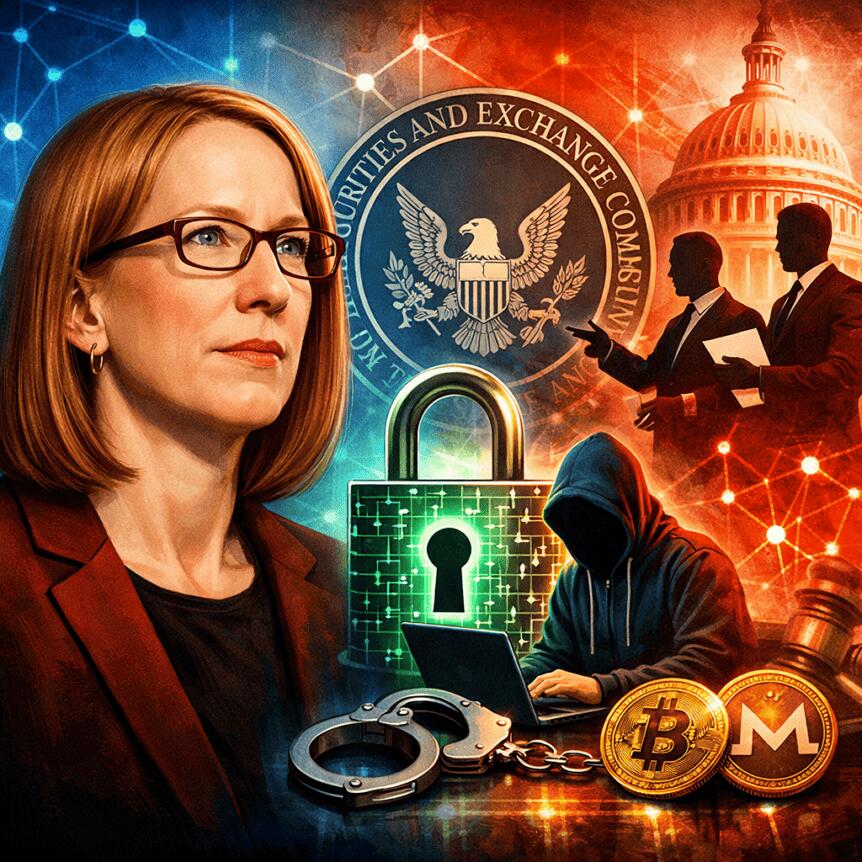
U.S. Securities and Exchange Commission (SEC) Commissioner Hester Peirce has flagged a growing undervaluation of financial privacy within U.S. regulation, urging policymakers to move away from treating privacy-preserving technologies with suspicion. Speaking at Georgetown Law, Peirce framed privacy-enhancing technologies as legitimate components of the modern financial ecosystem, not solely as tools associated with illicit activity.
According to a transcript published on the SEC’s website, Peirce argued that safeguarding financial privacy does not stand in opposition to national security objectives. “Empowering government to identify, pursue, and punish the bad guys is important to the security of the nation and its people, but so too is empowering people to protect information about their lives, including their financial lives,” she said.
Peirce emphasized that privacy technologies can help individuals shield themselves from hackers, scammers, and other malicious actors, and should not be construed as an opening for broader surveillance. She also urged developers building privacy-enhancing technologies to engage with the SEC’s Crypto Task Force, particularly on tools that could support Know Your Customer (KYC) and Anti-Money Laundering (AML) compliance requirements.
Key takeaways
- Privacy-preserving technologies are legitimate components of financial infrastructure and are not inherently tied to illicit activity.
- Protecting financial privacy does not conflict with national security objectives; both privacy protections and enforcement capabilities are necessary.
- Regulators are seeking constructive engagement with developers to align privacy innovations with KYC/AML obligations through the SEC Crypto Task Force.
- Global regulatory dynamics are evolving: the European Union is advancing MiCA and 2027 AML rules that could curb anonymous accounts and privacy-preserving cryptocurrencies.
- Industry activity in on-chain privacy tools—ranging from privacy-focused assets to private payment primitives for institutions—continues to shape compliance, licensing, and risk management considerations for firms operating in crypto markets.
Privacy in the regulatory mainstream and cross-border considerations
Peirce’s remarks situate privacy-enhancing technologies at the center of financial infrastructure discussions rather than at the periphery of enforcement. By highlighting that privacy and security can be complementary rather than mutually exclusive, she signals a regulatory posture that seeks to balance technology innovation with risk controls. The SEC’s framing appears to encourage a collaborative approach: privacy tools should not be viewed as antagonistic to regulatory objectives but as potential enablers of safer, more resilient markets when designed with compliance in mind.
Regulatory momentum and the EU policy landscape
The conversation about privacy in crypto is not limited to the United States. In the European Union, policymakers are integrating privacy considerations into a broader regulatory framework that aims to harmonize market integrity with consumer protections. MiCA (Markets in Crypto-Assets Regulation) and related AML policy developments are central to how privacy-preserving assets and tools will be treated across EU member states. Proposals under consideration could restrict anonymous accounts and limit support for privacy-focused cryptocurrencies, underscoring the cross-border regulatory risk for projects and institutions that rely on shielded transaction data or user anonymity features.
Legal experts warn that maintaining access to privacy-oriented digital assets remains a contentious and ongoing negotiation. Anja Blaj, a legal consultant at the European Crypto Initiative, described the ongoing struggle as a “constant battle” between the crypto industry and regulators over privacy policy and enforcement. This tension underscores the diverging regulatory trajectories that global firms must navigate when operating in multiple jurisdictions.
Industry developments and practical implications for compliance
Beyond policy debates, the market has seen tangible product developments aimed at enabling privacy without sacrificing onramp and oversight capabilities. For example, privacy-focused blockchain experiments and assets have attracted attention as firms seek to shield treasury movements, payment flows, or strategic trading data from competitors while preserving necessary auditability. In parallel, platforms have introduced privacy-enhanced features for institutional use, such as private payments or shielded transaction layers, designed to support regulated, compliant on-chain activity.
These developments illustrate a broader trend: institutions are pursuing privacy-aware architectures to reduce exposure to data leakage and profiling while remaining subject to KYC/AML, sanction screening, and licensing requirements. The implications for exchanges, custodians, banks, and other financial services providers include heightened emphasis on governance, data minimization, cryptographic risk assessments, and robust regulatory reporting capabilities. In this context, privacy technologies must be evaluated through the lens of risk management, policy alignment, and enforcement readiness.
Engagement, compliance, and the path forward
Peirce’s call for dialogue with the SEC Crypto Task Force points to a practical path for integrating privacy innovation with established compliance regimes. The task force serves as a channel for assessing how privacy-preserving tools can support or constrain KYC/AML objectives, licensing standards, and supervisory expectations. For crypto firms and financial institutions, this signals a need to document privacy-by-design approaches, establish auditable controls for data minimization and access, and maintain transparent governance around cryptographic privacy features.
Looking ahead, the regulatory landscape will continue to shape both product innovation and risk management. While privacy technologies can enhance user protections and resilience against crime, they also invite careful scrutiny to ensure that anonymity does not undermine anti-fraud measures or cross-border enforcement. For policymakers, the challenge lies in harmonizing privacy protections with the realities of global finance, while for market participants, the focus remains on building compliant, auditable privacy-enabled solutions that align with evolving licensing and oversight frameworks.
What comes next will hinge on ongoing rulemaking, enforcement actions, and collaborative efforts between regulators and industry players. Observers should monitor developments in MiCA and EU AML policy, the SEC’s ongoing Crypto Task Force initiatives, and cross-border regulatory formations that could influence the design and deployment of privacy-enhancing technologies in crypto markets.