SkyAI, the US-listed company formerly known as Sharps Technology, has exited its Solana (SOL) treasury position and is now using its cash balance to fund a sizable share-and-warrant repurchase tender offer. The shift marks a clear break from the strategy it adopted about a year ago—accumulating SOL as part of its corporate treasury policy.
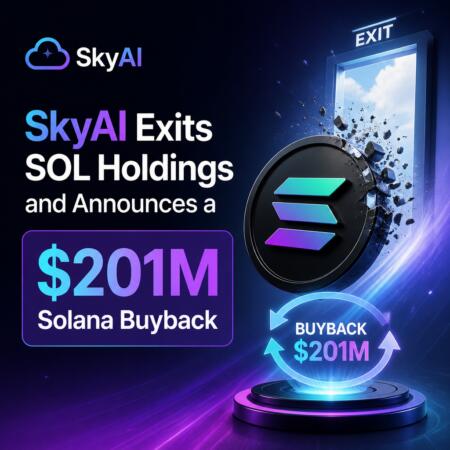
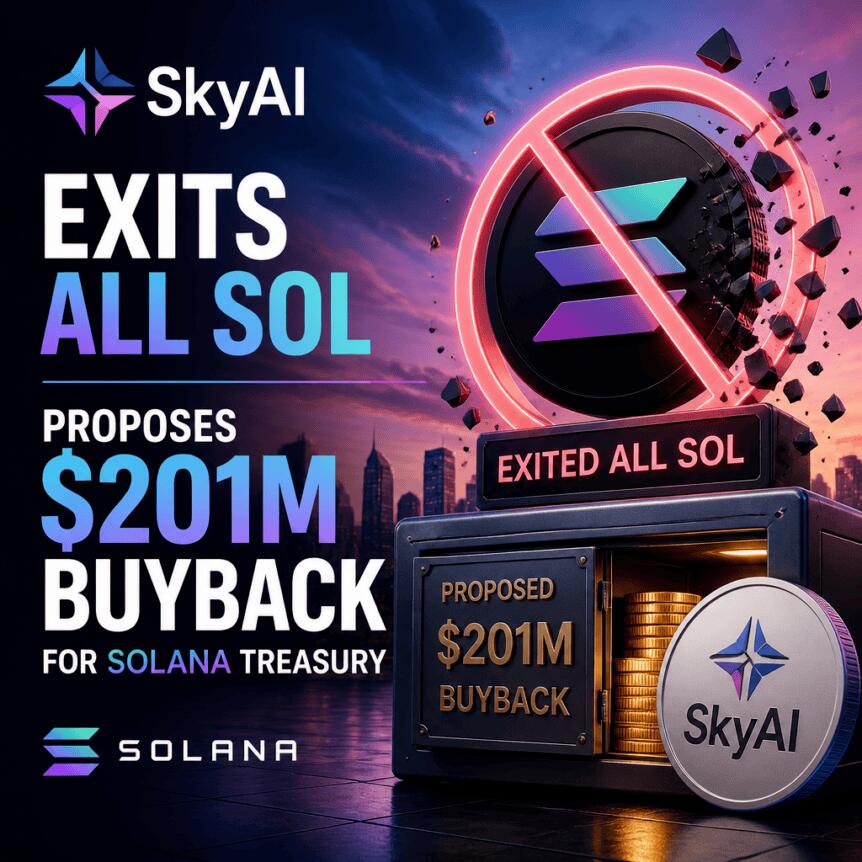
According to a filing submitted to the US Securities and Exchange Commission on Monday, SkyAI sold its entire SOL holdings and held about $223.8 million in cash as of Oct. 16. The company then launched a tender offer to repurchase up to $201.3 million of shares and warrants at a fixed price, funded entirely by cash on hand.
Key takeaways
- SkyAI fully liquidated its SOL treasury and reported $223.8 million in cash as of Oct. 16, per an SEC filing.
- The new tender offer targets repurchases of up to $201.3 million in shares and warrants, funded only with existing cash.
- The company says the tender offer is no longer linked to SOL’s price—an earlier condition it had discussed when announcing the buyback.
- SkyAI previously built its SOL position after raising more than $400 million through a private placement in 2025.
A cash-funded exit from SOL
SkyAI’s latest SEC disclosure states that the company has sold its entire Solana holdings. After that liquidation, it reported cash of approximately $223.8 million as of Oct. 16. The move effectively removes SOL exposure from the company’s balance sheet and replaces it with fiat liquidity—an important change for investors who track how crypto treasury strategies can amplify volatility.
The tender offer is designed to let eligible holders sell their securities directly back to SkyAI at a fixed price. In the offer structure, the company plans to repurchase up to 95% of each class of its outstanding shares and warrants. By specifying a fixed price and funding the repurchase solely through cash, SkyAI aims to create a more predictable outcome for participants.
Tender offer details—and what changed
SkyAI said the tender offer is “no longer tied” to SOL’s price. That matters because the company previously announced the buyback with an option that was dependent on SOL’s market behavior, according to the article context. By decoupling the tender offer from SOL pricing, SkyAI is signaling that its capital return decision is now based on corporate liquidity rather than token-market conditions.
The tender offer’s cash funding comes directly from the company’s post-liquidation position. After selling its SOL holdings, SkyAI states it will use the cash it held as of Oct. 16 to finance repurchases, reducing the likelihood that the repurchase plan could be disrupted by further crypto drawdowns or token price swings.
From SOL accumulation to repurchases
SkyAI’s crypto treasury strategy began in August 2025, following a private placement that raised more than $400 million. Soon after, the company acquired more than 2 million SOL—an approach meant to align a treasury strategy with the Solana ecosystem.
By the end of 2025, SkyAI held approximately 2.08 million SOL, with a reported cost basis of $403.1 million (about $194 per token). The same disclosures valued the holdings at $250.1 million, implying roughly $153 million in unrealized losses at that time.
The company’s decision to fully exit SOL after building that position reflects a pattern seen across several Solana treasury-oriented public companies. In February 2026, Cointelegraph reported that publicly traded Solana treasury firms were facing more than $1.5 billion in combined unrealized losses as falling token prices weighed on both their crypto assets and related equity valuations.
That environment helps explain why the strategy proved difficult for investors to underwrite. When companies hold large token positions as treasury assets, equity markets often treat those holdings as a proxy for the token’s performance—meaning token declines can rapidly translate into accounting losses and investor pressure, even if the underlying corporate business continues operating.
What SkyAI says it will keep building
Despite liquidating its SOL position, SkyAI says it intends to continue developing a financial platform that combines stablecoin infrastructure on Solana with artificial intelligence. In other words, the company appears to be separating its long-term product plan from the short-term risk of holding a large SOL treasury exposure.
This distinction may be important for readers trying to assess what the exit actually signals. It does not necessarily imply abandonment of Solana as a technology stack; rather, it suggests SkyAI is re-evaluating whether it wants to carry SOL on its balance sheet to support that vision—especially after experiencing significant unrealized losses during the period when SOL’s price was lower relative to the cost basis of its holdings.
CoinGecko data referenced in the original reporting indicates SOL later recovered from a June low of around $62 and was trading near $104 as of Monday. Even with that rebound, SkyAI’s action shows that the company was willing to realize losses and move to cash rather than continue holding SOL through potential future volatility.
On the equity side, SkyAI’s stock closed Monday at $2.79, up 5.3% on the day, according to Yahoo Finance data. The shares had gained roughly 65% over the prior month but were still down about 41% year over year, underscoring the broader uncertainty investors have had around the company’s strategy and the market’s pricing of its assets.
Why investors should watch the next steps
SkyAI’s repurchase tender offer is likely to be one of the most immediate drivers of attention for shareholders and warrant holders. Because the offer includes a cap—repurchasing up to 95% of each class—market participants will watch participation levels and how the fixed-price structure plays out in practice.
Going forward, investors should also monitor whether SkyAI’s stablecoin and AI-related roadmap progresses independently of its Solana treasury exposure, and whether other Solana treasury companies respond similarly to the balancing act between crypto upside and the equity volatility created by large token holdings.