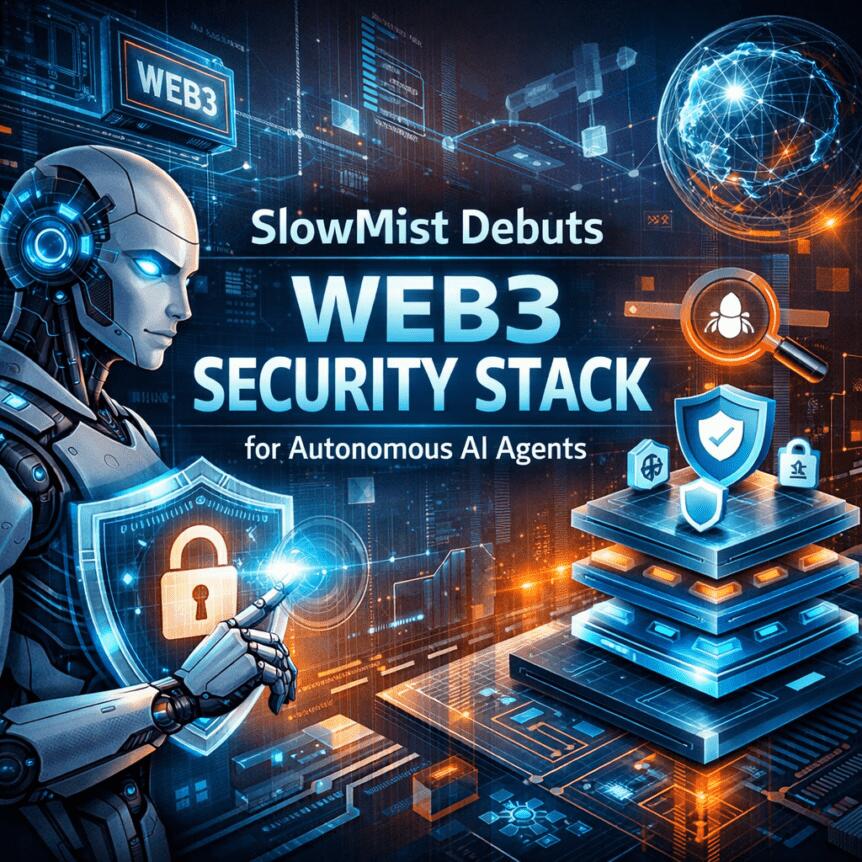
SlowMist has unveiled a five-layer security framework intended to help crypto firms navigate the mounting risks tied to AI and Web3 agents performing on-chain actions. In a midweek blog post, the cybersecurity company described a holistic approach that blends governance controls, an AI development security solution (ADSS), and a set of execution-layer tools to create a closed-loop process: checks before execution, constraints during execution, and a structured review after actions complete. By design, the system seeks to defend against prompts injection, supply-chain poisoning, and data leaks, while preserving the efficiency and speed that autonomous agents can deliver for trading, wallet interactions, and other on-chain workflows.
Key takeaways
- The framework fuses governance via ADSS with execution-layer tools—OpenClaw, MistEye Skill, MistTrack Skill, and MistAgent—to create a phased workflow that anticipates risk at every stage of decision and action.
- It targets core attack vectors such as prompt injection, supply-chain poisoning, data leaks, and asset loss arising from unauthorized AI actions or agent exploits.
- ADSS establishes auditable security standards, including AI agent permission constraints, real-time threat checks for external interactions, and stronger on-chain risk detection.
- SlowMist positions the framework against a backdrop of rising autonomous trading tools in crypto, citing no-code AI agents from several platforms and cross-chain execution on Base and Solana.
- Officials say the aim is to convert scattered security actions into a repeatable, executable, auditable, and sustainable process that can scale with AI-driven automation.
Market context: The push to formalize security for autonomous agents aligns with a broader market shift toward programmatic trading and automated on-chain interactions. As liquidity and risk sentiment shift in response to macro developments and regulatory signals, firms seek standardized, auditable controls that can reduce operational risk without throttling AI-driven efficiency. The emergence of no-code AI trading interfaces and cross-chain execution capabilities adds urgency to governance frameworks that can scale across Layer-1 and Layer-2 ecosystems.
Why it matters
For users and investors, the SlowMist framework offers a blueprint for safeguarding assets as AI agents increasingly operate across wallets and decentralized protocols. The five-layer approach, anchored by ADSS, promises a transparent trail of permission settings, risk checks, and post-action reviews that can be audited by internal security teams or external auditors. This could improve trust in automated workflows, especially in volatile market conditions where rapid execution is both a strength and a risk.
For builders and protocol teams, the framework underscores the need for integrated security into product design rather than relying on ad hoc safeguards. By codifying a closed-loop model—checks before execution, constraints during execution, and post-action review—developers can embed risk controls into AI agents without sacrificing performance. In practice, this means developers might implement standardized permission schemas, real-time external interaction checks, and on-chain anomaly detection as core components of any AI-enabled automation feature.
In a broader sense, the initiative reflects how the crypto and AI sectors are intertwining governance with execution. As autonomous agents become more capable, there is a parallel demand for auditable standards that can reassure users, exchanges, and regulators. The industry conversation around AI-enabled automation has grown alongside headlines about the growing value and potential of AI technologies, including coverage on OpenAI’s market trajectory and speculation about a trillion-dollar IPO, which highlights the high stakes involved in AI-enabled innovation. For context, related coverage has explored the business value and regulatory considerations of AI-driven platforms (see related coverage linking to ongoing discussions about AI-driven economic potential).
What to watch next
- Adoption of the five-layer framework by crypto firms implementing AI agents and autonomous trading tools.
- Public audits, case studies, or user reports detailing how ADSS and the accompanying tools performed in practice.
- Updates to the execution-layer tools (OpenClaw, MistEye Skill, MistTrack Skill, MistAgent) and any interoperability efforts with major networks like Base and Solana.
- Regulatory guidance or standards developments that address governance and security for autonomous on-chain actions.
Sources & verification
- SlowMist’s blog post: Comprehensive security solution for AI and Web3 agents — https://slowmist.medium.com/comprehensive-security-solution-for-ai-and-web3-agents-9d56ce85f619
- AI agents article: AI agents crypto wallets safe risks — https://cointelegraph.com/news/ai-agents-crypto-wallets-safe-risks
- Nansen autonomous trading tools on Base and Solana — https://cointelegraph.com/news/nansen-autonomous-ai-crypto-trading-base-solana
- OpenAI trillion-dollar IPO discussion — https://cointelegraph.com/news/openai-ipo-1t-valuation-late-2026-report
Five-layer security framework for AI and Web3 actions
SlowMist’s auditable approach centers on a structured, end-to-end cycle designed to tame risk without throttling AI-driven advantage. At the core is the ADSS governance solution, a control plane that sits alongside a set of execution tools collectively described as the digital fortress. The governance layer is not merely a policy document; it is an operational framework that imposes permission constraints on AI agents, enabling administrators to specify who can do what, when, and under which conditions. Real-time threat checks monitor external interactions as actions unfold, and the system’s on-chain risk detection capabilities provide visibility into anomalous patterns that might indicate unauthorized behavior or compromised inputs.
In tandem with ADSS, SlowMist deploys a quartet of execution-layer components—OpenClaw, MistEye Skill, MistTrack Skill, and MistAgent. While the article detailing the framework does not exhaustively enumerate every function, the naming suggests a clear division of labor: OpenClaw potentially handles permissioned access and command execution paths, MistEye Skill may observe and interpret agent activity, MistTrack Skill could monitor execution traces for anomalies, and MistAgent might be the autonomous control layer that interfaces with on-chain actions. The overall architecture is intended to be a closed-loop system: a checks-before-execution phase curtails potentially unsafe instructions, constraints during execution limit the range of permissible actions, and a post-action review captures data for audits and future improvements.
The security fortress aims to counter a spectrum of risks that increasingly concern operators of autonomous systems. Prompt injection stands as a primary worry; AI agents can be steered to perform unintended actions if adversarial inputs are crafted to manipulate prompts. Supply-chain poisoning also looms large, where trusted software components or data feeds could be subverted to introduce backdoors or misleading behavior. Data leaks risk exposure of sensitive keys, strategies, or user data, while unauthorized operations threaten asset safety and compliance. SlowMist emphasizes that the framework is designed to mitigate these threats while preserving the speed and efficiency that automated agents deliver for trading and other on-chain tasks.
Industry context matters here. Crypto firms have been testing autonomous tools for trading and execution, with examples of no-code AI trading agents expanding access to individual traders and institutions alike. The referenced no-code solutions, including those from Nansen and other platforms, illustrate a trend toward user-friendly automation that can operate across networks such as Base and Solana. While these advancements lower barriers to entry, they also elevate the importance of robust governance and risk controls. The ADSS-driven approach provides a vocabulary and a blueprint for organizations aiming to deploy AI-powered automation with auditable safety nets, rather than relying on bespoke, one-off safeguards. In parallel discussions about the broader AI ecosystem, ongoing analyses of market potential and regulatory considerations continue to shape how autonomous tools are developed and deployed.