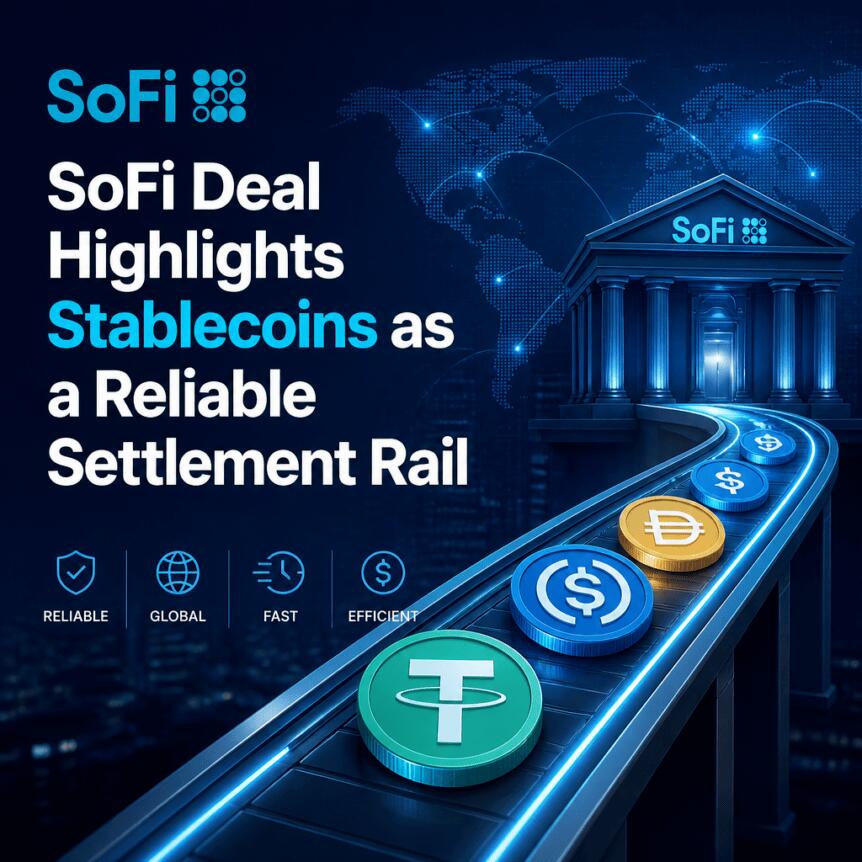
Stablecoins are finding a practical use case in payments: not necessarily to change how consumers pay with their cards, but to alter the settlement rail banks use behind the scenes. The latest example comes from SoFi, which says it has begun settling debit and credit card transactions with Mastercard using its SoFiUSD stablecoin.
According to a SoFi spokesperson, the bank is migrating its entire card program—expected to process more than $25 billion in annualized volume—to this blockchain-based settlement approach. Importantly, the bank does not expect the change to remove intermediaries from card payments. Instead, it replaces part of the transaction settlement process with an alternative rail designed to complete obligations faster.
Key takeaways
- SoFi is moving settlement of its debit and credit card transactions to Mastercard using its SoFiUSD stablecoin, while card usage for customers remains unchanged.
- SoFi expects its card program to reach more than $25 billion in annualized processing volume as it migrates the system.
- Payments experts argue this is not “disintermediation” in the card networks’ core operations—Visa/Mastercard and banks still calculate obligations and manage interactions.
- Faster blockchain settlement may reduce timing and some capital friction, but does not automatically guarantee cheaper payments end-to-end due to conversion, compliance, and integration costs.
- Dollar stablecoins can move quickly, but completing payments in local currencies may still require access to domestic liquidity and banking rails.
SoFi’s onchain card settlement shift
SoFi’s update is part of a broader trend in which stablecoins are tested and deployed as settlement mechanisms rather than as consumer-facing payment tools. The bank says it has begun settling debit and credit card transactions with Mastercard using its SoFiUSD stablecoin and is migrating its full card program to the same system.
From the perspective of cardholders, the change is largely invisible. The spokesperson told Cointelegraph that SoFi customers will continue using debit and credit cards normally, while the settlement process is moved onchain to enable faster completion between participants.
That distinction matters for how investors and builders interpret “adoption.” The stablecoin is operating in the plumbing of payments—where obligations between financial institutions are settled—rather than replacing consumer interfaces.
Not a clean break from Visa, Mastercard, or banks
Stablecoin settlement can sound like a direct challenge to traditional intermediaries, but the current card deployments appear to follow a more incremental path. A Federal Reserve note published in March suggested stablecoins could change the economics of payments without necessarily eliminating banks, and the latest industry commentary aligns with that view.
Cointelegraph spoke with Martins Benkitis, co-founder and CEO of emerging-markets liquidity provider Gravity Team. He argued that this stage should not be described as disintermediation: “I wouldn’t call it disintermediation at this stage,” he said. “Visa and Mastercard are still there. The banks are still there. The network is still calculating the obligations, managing the transaction and deciding how participants interact with it.”
In other words, stablecoins are being used to complement existing payment infrastructure, particularly at the settlement layer. That may still meaningfully increase stablecoin usage even if merchants and consumers never interact with the technology directly.
Benkitis added that if stablecoins become a major part of payments, businesses may not care where the stablecoin exists in the process as long as settlement availability matches operational needs. “They’ll care that settlement is available when they need it and that the money arrives,” he said.
The promise: smoother settlement and less capital friction
While cards remain intermediated, faster settlement is a key selling point. Varun Datta, a venture capitalist and founder of Truth Ventures, agreed that moving to continuous settlement can reduce delays and potentially cut the amount of capital financial firms must maintain across locations—an issue that can be especially acute when payments cross borders.
However, Datta cautioned that “speed” alone does not automatically translate into lower costs for end users. Payments still involve conversion steps, compliance requirements, systems integration, and stablecoin-management overhead. In his view, it is not enough to demonstrate operational improvement onchain; the industry needs evidence that these changes reduce total costs and improve liquidity management at scale.
Datta said he would want to see proof of lower end-to-end payment costs before concluding that the economic case is fully established. That framing is significant because many real-world payment projects live or die on unit economics—particularly if costs merely shift from settlement timing to operational complexity elsewhere.
Liquidity doesn’t disappear—especially across currencies
Another practical limitation emerges when stablecoin settlement eventually has to translate into local currency payments. Benkitis emphasized that while dollar-denominated stablecoins can move between balance sheets quickly, completing payments in emerging markets can remain more complex.
His concern is tied to local liquidity and the banking ecosystem that ultimately delivers the payment in the relevant currency. In markets where local currency liquidity is thinner, fewer banks may handle flows, and access to domestic banking rails remains necessary. “The stablecoin gets the value there quickly,” Benkitis said. “You still need the local liquidity to finish the payment.”
This is where the “rail change” narrative can diverge from adoption expectations. Onchain speed may improve settlement between participants, but it does not automatically solve downstream currency conversion, liquidity sourcing, or integration constraints in every geography.
Broader momentum: Visa’s parallel stablecoin efforts
SoFi’s move follows similar experimentation from card-network infrastructure. In April, Visa said its stablecoin settlement pilot had reached a $7 billion annualized run rate after expanding support to nine blockchains, describing blockchain settlement as a “viable complement to traditional settlement rails.” Visa also characterized its approach as an addition to existing settlement methods rather than a replacement of the broader ecosystem.
Taken together, these developments suggest a shared industry view: stablecoins are being tested where they can improve the settlement mechanics of large payment networks without requiring immediate removal of core participants.
Readers should watch whether these pilots expand beyond the largest corridors and what happens when stablecoin settlement meets local-currency liquidity constraints—if the industry can demonstrate not just faster settlement, but reliably lower total operating costs across geographies, stablecoin settlement could move from “complement” to a more durable part of the payments stack.