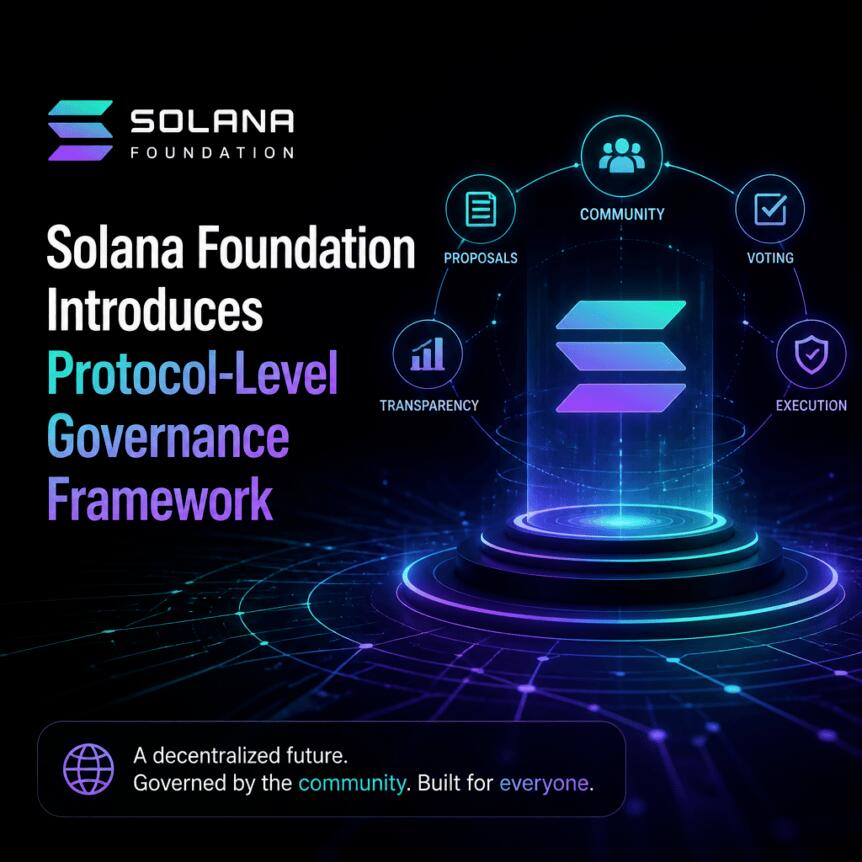
The Solana Foundation has unveiled a new protocol-level governance framework designed to let validators propose and vote on core changes directly onchain, using stake-weighted voting to reflect community preferences. The initiative, called Solana Governance Proposals (SGPs), aims to make major protocol decisions more transparent and reduce reliance on centralized coordination, while keeping the technical drafting of upgrades separate.
As the Foundation and related documentation explain, an SGP is meant to capture a stake-weighted “directional” choice from the ecosystem—distinct from the detailed technical work typically represented through Solana Improvement Documents (SIMDs). In other words, SGPs are positioned as a governance signal, not a replacement for the engineering process behind protocol features.
Key takeaways
- Solana Foundation launched SGPs, a governance standard for proposing and voting on protocol decisions onchain.
- Voting is stake-weighted, with voting power tied to delegated SOL.
- Validators need at least 15% support from actively staked SOL for a proposal to advance to a formal onchain vote.
- Delegators can override validator votes by submitting their own vote on the same proposal.
- SGPs and SIMDs are kept separate: SGPs signal community direction; SIMDs handle the technical upgrade details.
How Solana Governance Proposals work
SGPs were introduced through a framework intended to standardize how governance decisions are submitted and ratified for the Solana blockchain. According to the Foundation’s announcement on X [SolanaFndn on X], the process enables validators to submit core protocol proposals and vote on them onchain.
The stake-weighted nature of voting is central to the design. The Foundation’s accompanying GitHub repository [solana-governance-proposals on GitHub] describes SGPs as “stake-weighted directional” decisions that reflect what the community wants, emphasizing that the framework does not focus on the specific engineering detail of how to build a feature.
This separation of governance intent from implementation is a recurring theme in the documentation. It is also one way the Foundation attempts to preserve continuity for technical development: the community can express priority or direction through SGPs, while the actual proposal writing and protocol specification can remain in the SIMD process.
More broadly, stake-weighted governance mechanisms are not unique to Solana. The Foundation noted that similar approaches exist across other major networks, including Polkadot, Cosmos, Cardano, Tezos, and Avalanche.
Thresholds and eligibility for proposals
To qualify for a formal onchain vote, an SGP must first meet a minimum support requirement: endorsements from validators representing at least 15% of actively staked SOL. The Foundation’s framework describes this as a filtering step to reduce the likelihood of low-quality proposals moving forward.
On the validator side, the documentation sets an operational rule for who can open governance proposals. Validators with 100,000 SOL delegated can submit a new governance proposal via SGP. Delegators—SOL holders who stake by delegating to validators—are then able to participate in the governance process through their delegated stake.
The governance model therefore depends on two layers: (1) validator eligibility to bring items into the system, and (2) staking participation that determines how much influence each delegator ultimately has.
Delegators can override validator votes
One of the most notable governance mechanics in the framework is the ability for delegators to override their validator’s position on a specific proposal. The documentation states that if delegators disagree with how their validator has voted, they can override the validator by submitting their own vote on the proposal—effectively changing the outcome based on the delegated stake’s voting preferences.
This feature changes the typical dynamic of validator-led governance. Instead of treating delegation as a fixed vote, delegators are given an explicit path to correct or adjust how influence is applied for each SGP, provided the underlying system supports delegator-submitted voting for that particular decision.
For participants, the practical implication is clear: users who stake SOL should pay attention not only to which validators they delegate to, but also to how their own participation in voting affects each governance item as it appears.
SGPs vs. SIMDs: keeping signals separate from execution
The Foundation explicitly frames governance-level proposals as SGPs while reserving smaller technical work as SIMD-focused efforts. In an articulation shared alongside the launch, the Foundation wrote that “SIMDs should focus on protocol changes, SGPs should be signals from the ecosystem.”
That distinction matters because it aims to prevent governance processes from becoming overly bogged down in engineering minutiae. In many decentralized networks, the challenge is balancing legitimacy and clarity: governance outcomes need to be expressive and understandable to stakeholders, while implementation details must be handled carefully by developers.
At the same time, the separation also leaves readers with an important question: how exactly the ecosystem transitions from a stake-weighted directional signal to a concrete protocol change. The Foundation’s framing suggests SIMDs remain the place where technical execution lives, but watchers will want to track how consistently SGP outcomes influence or map onto subsequent SIMDs over time.
Why Solana’s governance redesign matters now
Solana’s push comes alongside continued efforts to formalize supporting infrastructure for its ecosystem. Earlier in April, the Foundation introduced STRIDE—a security program for evaluating, monitoring, and escalating security across Solana projects—described in a separate announcement as a structured approach for handling security risks across Solana-based protocols [Cointelegraph coverage of STRIDE launch].
While STRIDE addresses security operations, the SGP framework targets governance at the protocol level. Together, they suggest the Foundation is working on multiple layers of the network’s resilience: governance processes for direction and decision-making on one hand, and security evaluation and response tooling on the other.
From an investor and user perspective, governance clarity is not just philosophical. Onchain frameworks can influence how quickly the ecosystem coordinates around upgrades, how disputes are handled, and whether stakeholders feel their preferences are accurately reflected in protocol decisions. With stake-weighted voting and delegator override capabilities, Solana’s new model also increases the likelihood that governance participation will be granular rather than fully outsourced to validators.
As SGPs roll out, readers should watch for whether proposals that meet the 15% threshold proceed smoothly, how often delegators override validator votes, and—most importantly—how consistently successful SGP outcomes translate into corresponding SIMDs and real protocol changes.