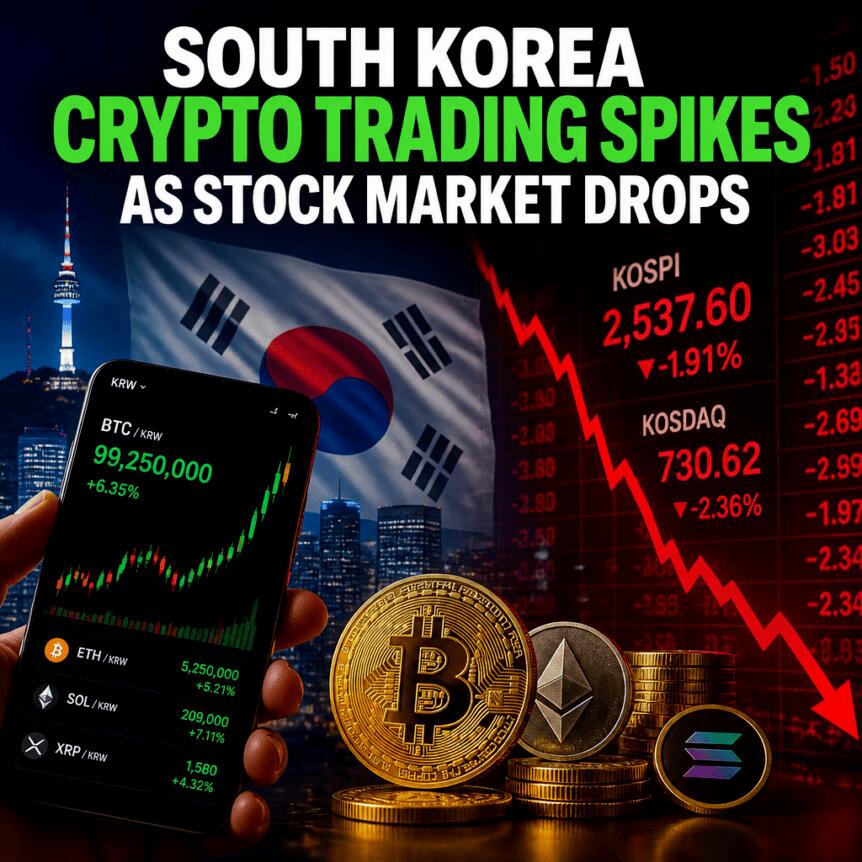
South Korean crypto markets saw a sharp burst in activity after the KOSPI suffered steep losses this week, highlighting how equity sell-offs can quickly redirect attention toward digital assets—and related products traded overseas. According to data from Upbit, trading between the Korean won and Tether (USDT) accelerated rapidly during the index’s decline.
Meanwhile, analysts are pointing to a different storyline in parallel: despite the macro pressure weighing on risk assets, Bitcoin has shown relative strength compared with large U.S. stock benchmarks. Bitwise’s latest research argues that the cryptocurrency’s performance is increasingly notable as financial conditions tighten.
Key takeaways
- Upbit KRW/USDT volume nearly hit 200 billion won (about 140 million USDT) on July 29, up from roughly 20 million USDT on July 25—about a 600% jump.
- Local analysis linked the surge to fund rotation away from Korean equities and toward crypto trading or stock-linked derivatives available through overseas venues.
- Prior KOSPI volatility showed a similar pattern: Upbit recorded a volume spike after a 10% one-day drop on July 14.
- Bitwise says Bitcoin has outperformed major U.S. mega-cap stocks and has remained comparatively “flat” since late June’s semiconductor peak.
KRW/USDT trading surges as equities slide
Upbit’s exchange data shows the most direct evidence of the equity-to-crypto link. Trading volume between KRW and USDT climbed rapidly between July 25 and July 29, according to the figures cited in reporting that referenced Upbit’s KRW/USDT market. On July 29, the volume approached 200 billion won (around 140 million USDT), compared with about 20 million USDT on July 25.
That surge arrived alongside a broader wave of downside momentum in South Korea’s KOSPI. The index’s sharp weekly decline—described in the coverage as close to 18% over the period—was tied to weakness in chip-related equities, particularly chip-maker stocks. The implication for investors is straightforward: when liquid, familiar markets begin to fall quickly, some participants look for alternatives that can be traded at any hour and can offer both spot exposure and leveraged strategies.
Local reporting cited analysis from Seoul Economic Daily suggesting that capital may have rotated out of stocks into crypto during the sell-off, or that traders sought access to derivatives tied to Korean equities through overseas exchange platforms. The same coverage also highlighted a possible preference for moving funds to overseas venues or personal wallets to trade perpetual equity futures.
“There is a possibility that demand increased for moving funds to overseas exchanges or personal wallets to trade perpetual stock futures,” said Cho Yoon-sung, a senior researcher at Tiger Research, according to the publication.
In other words, the KRW/USDT spike appears less like random day-trading noise and more like a measurable byproduct of stress in traditional markets. Traders can reposition quickly when the equity tape deteriorates—especially in environments where crypto already functions as a high-velocity risk market.
Stock sell-offs and “overseas” trading pathways
South Korea’s crypto ecosystem continues to be closely intertwined with how local investors express risk. The coverage emphasized that the country’s market remains highly active, with younger participants in particular showing a taste for leveraged products. That appetite tends to amplify volume responses when shocks hit adjacent assets like equities.
There is also a structural element: some investors may prefer to access certain equity-linked exposures through crypto-native derivatives offered by overseas platforms. When KOSPI volatility rises, the willingness to shift capital—either to trade crypto directly or to use perpetual contracts tied to equity themes—can increase.
What’s notable here is that the surge wasn’t entirely new behavior. Earlier in the month, Upbit reportedly registered a conspicuous volume spike after the KOSPI fell 10% in a single day on July 14, as described in earlier coverage referencing Yahoo Finance. That establishes a pattern: large, fast equity moves have previously coincided with elevated crypto trading activity.
Bitcoin’s resilience amid semiconductor pressure
While won-based volumes rose sharply in response to South Korean equity turmoil, analysts elsewhere were examining whether macro weakness would “spill over” into crypto performance. Andre Dragosch, European head of research at Bitwise, argued that Bitcoin has not behaved like a fragile extension of the semiconductor trade.
In commentary shared on social media and referenced by the reporting, Dragosch suggested that Bitcoin has been largely range-bound—“essentially flat”—since semiconductors peaked in late June. His framing is that the expected contagion from a semiconductor-driven risk repricing did not materialize in the way some market participants may have anticipated.
Bitwise’s broader analysis, released earlier in the week, reinforced that view through relative performance. The firm attributed what it called “remarkable outperformance” to Bitcoin versus a set of U.S. mega-cap stocks. In the coverage, Bitwise pointed to comparison benchmarks including large-cap tech exposure and even SpaceX (SpaceX was referenced as part of the comparison set in the text).
Bitwise’s argument went beyond simple relative returns. It linked Bitcoin’s strength to the possibility that the asset may already be pricing early signals of future monetary-policy easing—even while inflation remains a concern and near-term interest-rate hike risks persist. The firm also used the well-known “canary in the macro coal mine” metaphor to describe Bitcoin’s sensitivity to macro conditions.
Bitwise stated in its analysis that Bitcoin continues to show “remarkable outperformance and resilience” versus U.S. mega-cap stocks such as the Magnificent 7 and SpaceX (as cited in the coverage), calling the relative strength “all the more notable” amid tightening financial conditions.
For investors, this matters because it suggests crypto’s behavior is not simply being dictated by the same narrative driving equities. If Bitcoin’s relative strength persists, it may indicate that markets are treating Bitcoin less as an equity proxy and more as a separate macro instrument responding to different expectations—particularly around future policy.
What traders should watch next
The near-term question is whether the KOSPI-driven volume spike is a one-off reaction to a violent week, or a sign that equity volatility is again feeding crypto activity in South Korea. Traders should watch whether KRW/USDT volumes remain elevated through subsequent market days and whether Bitcoin’s outperformance versus U.S. mega-cap benchmarks holds as the macro narrative shifts.