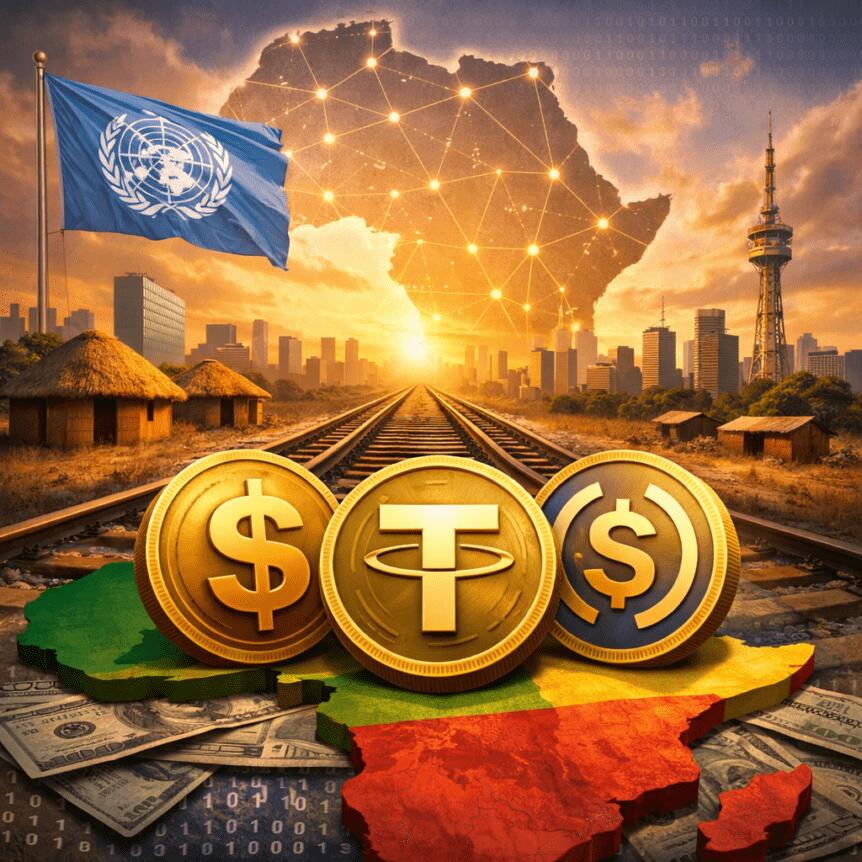
At the World Economic Forum in Davos, prominent African policy and finance voices highlighted a rapid shift in how people move value across borders. Vera Songwe, a former United Nations under-secretary-general and current chair of the Liquidity and Sustainability Facility, argued that stablecoins are increasingly used to cut remittance costs and speed up settlement times. In Africa, where traditional cross-border transfers can cost about $6 for every $100 sent, digital currencies are offering a cheaper, faster alternative and expanding financial access for both individuals and small businesses. Songwe’s comments were delivered during a Davos panel and underscored a broader momentum toward crypto-enabled inclusion on the continent. WEF Davos panel.
650 million people don’t have access to a bank account in Africa. With a smartphone you have access to stablecoins, so you can save in a currency that is not exposed to fluctuations of inflation and making you poor.”
Songwe noted that inflation has climbed above 20% in roughly a dozen to fifteen African countries since the COVID-19 pandemic, a backdrop that makes a store of value in more stable units appealing. In that context, stablecoins are presented not merely as a payments mechanism but as a potential hedge against local currency depreciation. The practical upshot, she argued, is that stablecoins enable households and small businesses to preserve value and transfer funds with far greater speed than traditional channels allow.
Her remarks reflected a broader trend: digital currencies are moving from novelty to everyday use in several markets where inflation and capital controls have intensified. In her estimate, around 650 million adults in Africa still lack bank accounts, but a smartphone can unlock access to stablecoins, offering a degree of financial resilience even where formal financial services remain out of reach. The regions showing the strongest activity include Egypt, Nigeria, Ethiopia and South Africa, where volatile inflation and policy constraints have helped stablecoins gain traction as a means of saving, paying suppliers, and moving money domestically and across borders. The emphasis appears to be on practical, lower-cost usage by small and medium-sized enterprises that rely on faster settlement cycles for vendor payments and cross-border trade.
Beyond remittances, the continent’s crypto narrative is being reshaped by government and regulatory attention. A September Chainalysis report positioned Sub-Saharan Africa among the world’s fastest-growing regions for crypto adoption, reporting on-chain value exceeding $205 billion from July 2024 to June 2025—year over year growth of about 52% and ranking third globally in adoption intensity. As adoption accelerates, several nations have moved to formalize or recalibrate their approaches to crypto activity, balancing potential benefits with risk controls.
On the policy front, Ghana moved decisively in December to regulate the sector, legalizing cryptocurrency trading by passing a Virtual Asset Service Providers bill and creating a formal regulatory framework for the industry. Bank of Ghana Governor Johnson Asiama framed the measure as a way to enable crypto activity while equipping authorities with tools to manage associated risks. Nigeria followed with governance steps in January to bring crypto activity into the tax net by requiring crypto service providers to link transactions to users’ tax identification numbers. The intent is to anchor regulation in identity-based reporting rather than relying solely on on-chain tracing. In South Africa, the central bank has warned that crypto assets and stablecoins represent emerging financial stability risks as local adoption continues to rise.
African countries advance crypto legislation
The regulatory arc in Africa illustrates a widening spectrum: from formal legalization and tax integration to prudent, risk-aware oversight. Ghana’s move represents one end of that spectrum, aiming to establish clear rules for exchanges and service providers. Nigeria’s identity and tax reporting requirements represent another approach, attempting to bring crypto markets into existing fiscal frameworks without stifling innovation. South Africa’s stance—recognizing stability risks—signals a willingness to monitor and study the impact of digital assets on banks and payment systems as the sector grows. These regulatory experiments coincide with ongoing research into how stablecoins and other crypto tools can influence financial inclusion, cross-border trade, and macro stability on the continent.
What to watch next
- Whether Ghana’s VASP framework is complemented by further guidance on consumer protections and AML/CFT standards.
- Nigeria’s enforcement of tax-ID linked transactions and how crypto service providers implement identity verification across use cases.
- South Africa’s ongoing assessments of crypto’s impact on financial stability and the potential design of supervisory regimes for stablecoins.
- Any cross-border payments pilots or regulatory sandboxes that test stablecoins for real-world remittances and SME payments.
What to watch next
- Regulators publish further guidance or amendments to existing crypto laws in Ghana, Nigeria, and South Africa.
- Public-private collaborations emerge to promote financial inclusion using stablecoins or crypto rails.
- Adoption metrics from central banks and market regulators begin to show how much of the on-chain value is driven by remittances versus investment or trading flows.
Sources & verification
- Vera Songwe’s remarks on stablecoins’ impact on remittances and inflation at the World Economic Forum in Davos (panel video link).
- Chainalysis report on Sub-Saharan Africa crypto adoption and the on-chain value metrics for July 2024–June 2025.
- Ghana’s Virtual Asset Service Providers bill and regulatory framework developments.
- Nigeria’s January crypto regulatory changes tying activity to tax identification numbers.
- South Africa’s central bank stance on crypto assets and stability risk considerations.
- Related coverage onVisa’s partnerships with stablecoins in Europe, the Middle East and Africa (linked in the original article).
Remittance costs, inflation, and Africa’s stablecoins
Africa’s remittance landscape is undergoing a meaningful shift as stablecoins move from niche usage to a broader financial tool. Songwe’s observations at Davos reflect a continent where the cost of sending money across borders has long been a barrier for families and small businesses. If a transfer of $100 could be settled in minutes rather than days, and with fees that can be significantly lower than traditional networks, the case for digital currencies as an everyday utility grows stronger. The data from Chainalysis reinforces this narrative, showing robust on-chain activity across Sub-Saharan Africa even as governments deliberate how best to regulate, tax, and supervise the new rails.
In markets marked by high inflation and capital controls, stablecoins have supplied a form of value retention and liquidity for users who otherwise face eroding purchasing power. The Ghanaian example demonstrates how a regulatory framework can be designed to unlock innovation while preserving financial stability. Nigeria’s approach—tying crypto activity to tax compliance—reflects a pragmatic attempt to integrate digital assets into the formal economy. South Africa’s caution signals that regulators are evaluating systemic risk as the crypto space expands.
As the continent continues to experiment with crypto-enabled remittances, policymakers face the task of balancing inclusion with risk management. The ongoing dialogue among investors, regulators, and users will likely shape the trajectory of crypto adoption in Africa for years to come, with potential implications for payment infrastructure, cross-border settlement, and the broader macroeconomic environment.
Disclosure: The information above is based on publicly available statements, reports, and regulatory actions. Readers should verify key claims independently.