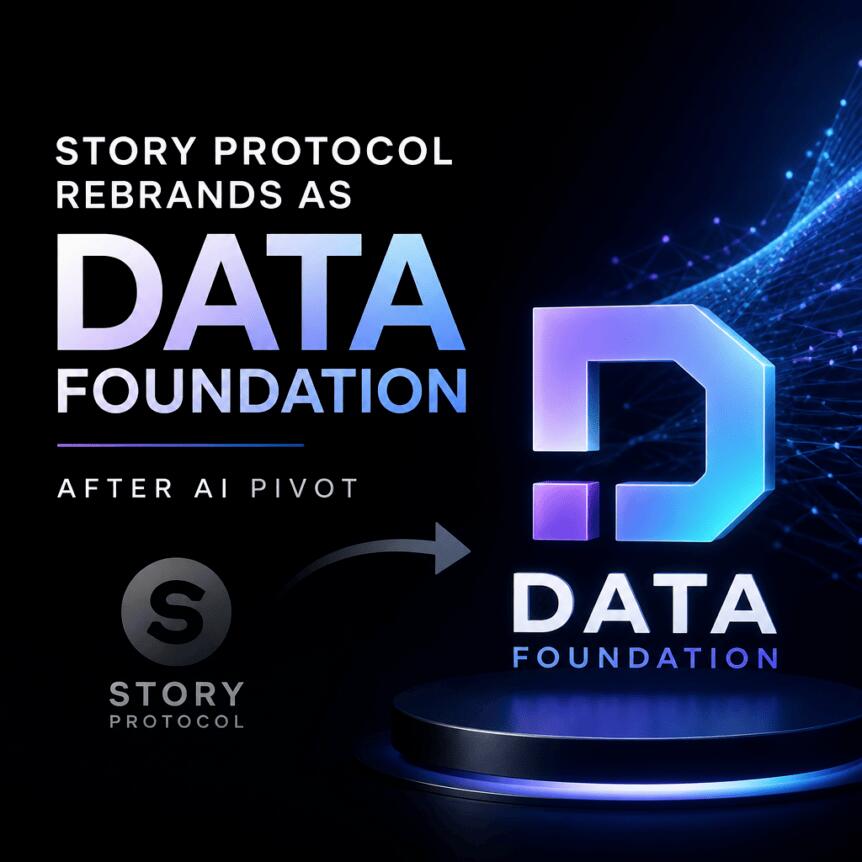
Story Protocol, a layer-1 blockchain originally positioned around intellectual property licensing, is reframing its mission around artificial intelligence. The project announced it is rebranding as the DATA Foundation, saying it will concentrate on building “essential infrastructure for training AI.”
In its announcement, the company argued that leading AI labs are reaching a data bottleneck: the open internet has been “effectively exhausted for scraping,” while remaining sources are either costly, tailored case-by-case, or lack clear legal documentation. In that environment, it says training systems struggle to source enough data at scale and to establish provenance and quality.
Key takeaways
- Story Protocol is rebranding as the DATA Foundation to focus on AI training data infrastructure rather than general IP licensing.
- Trace is being introduced as an on-chain registry intended to support data provenance and licensing for AI training datasets.
- Poseidon is described as the protocol’s processing layer for AI-related data workflows.
- Leadership is changing: Story president and product chief Andrea Muttoni will become CEO of the DATA Foundation, with Kled founder Avi Patel joining as chief data officer.
- Partnership intent is explicit, with Kled positioned as a key licensable data-set source that pays contributors for tasks used in training data creation.
A pivot from IP licensing to AI training infrastructure
Story’s original framing aimed to supply an “IP layer” for the internet using permissionless licensing. In a statement shared with Cointelegraph, Story president and product chief Andrea Muttoni said the company ran into a structural tension: major rights-holders—particularly those controlling music, games, and brands—guard their most valuable assets closely, while permissionless licensing can conflict with the control they want to maintain.
Muttoni said the team eventually identified a different opening in the AI data pipeline. According to him, Poseidon—an AI data-processing initiative Story incubated—showed “immediate traction” with major AI firms, and the project raised a $15 million seed round in July 2025.
The company’s thesis is that the next scarce input for AI training is not just data, but data that can be verified, legally licensed, and trusted at scale—particularly when scraping-based approaches face diminishing returns.
Trace: an on-chain registry for provenance and licensing
A central part of the DATA Foundation’s plan is an on-chain registry named Trace. The project says Trace is designed to record and make verifiable claims about AI training data provenance and licensing terms, with the goal of helping AI companies validate entire datasets.
Beyond recordkeeping, the company emphasizes that Trace should also allow contributors to enforce their terms. The implication for builders and institutions is straightforward: instead of treating licensing paperwork and provenance checks as disconnected processes, the DATA Foundation is positioning them as part of an auditable on-chain workflow.
Poseidon as the protocol’s processing layer
The DATA Foundation also points to Poseidon as the “processing layer” of the overall protocol. While the announcement focuses more on what Trace does for provenance and licensing, the project frames Poseidon as the engine that supports AI-related data operations.
This division of labor—processing via Poseidon and provenance via Trace—matters because the bottlenecks described by Story are not only about collecting information, but about being able to demonstrate where it came from, under what rights it was licensed, and whether it meets quality expectations. In that context, the processing and registry components are intended to work together as part of a single end-to-end stack.
Kled integration and the “flagship app” approach
In addition to developing its own infrastructure, Story says it is integrating with Kled, a provider of licensable AI training datasets. The company says Kled pays people for tasks including capturing videos of their surroundings or recording ambient audio—activities used to generate real-world signals for AI training.
Muttoni characterized Kled as the “flagship app” on DATA, suggesting that the foundation’s product strategy is likely to rely on an active supply side of contributors rather than depending solely on pre-collected datasets.
In terms of continuity, Muttoni told Cointelegraph that registered IP and data on the Story blockchain would remain. The transition to the DATA branding, he said, means the roadmap will shift toward building a full-stack framework for AI training data.
Leadership changes and what advisers add
The rebrand also comes with a reshuffle at the top. Muttoni will serve as CEO of the DATA Foundation, while Avi Patel—Kled founder—will join as chief data officer and adviser.
Story founder Seung-yoon Lee will become an adviser as well. In comments included with the announcement, Lee argued that the most valuable IP of this era is data that cannot be easily scraped—examples given include how a surgeon’s hands move, how robots grip objects, and how people speak and behave in everyday work and environments. He framed DATA as an end-to-end network intended to prove real-world data’s origin, license it, and pay people who contribute to its creation.
Why this pivot is arriving as crypto eyes AI
Story’s move fits a wider pattern in the crypto sector as projects seek new demand drivers amid shifting market conditions. The announcement cites that some crypto miners have pivoted toward running high-performance computers for AI workloads, helping support revenues in a bear market.
It also references broader industry activity: earlier coverage by Cointelegraph described Coinbase’s plan to launch a tool allowing consumer AI models to connect to an exchange account to make trades or execute strategies as it tries to expand beyond a pure trading platform. The story further notes that Forbes reported that Immutable—known for Web3 gaming—has been pivoting toward an AI marketing platform aimed at game publishers.
For investors and operators, the common thread is that AI infrastructure tends to be resource- and compliance-heavy: beyond compute, it depends on reliable inputs and defensible sourcing. DATA Foundation’s emphasis on provenance and licensing indicates that, at least in Story’s view, the market opportunity lies in making those inputs more verifiable and scalable.
Next, the most important questions are practical: how quickly Trace is adopted by AI firms and dataset contributors, and whether DATA’s approach can reduce the friction of proving licensing and provenance compared with current, mostly off-chain processes. Readers should also watch how Poseidon operationalizes the processing layer and what measurable traction the DATA Foundation reports as more real-world training data moves into its registry.