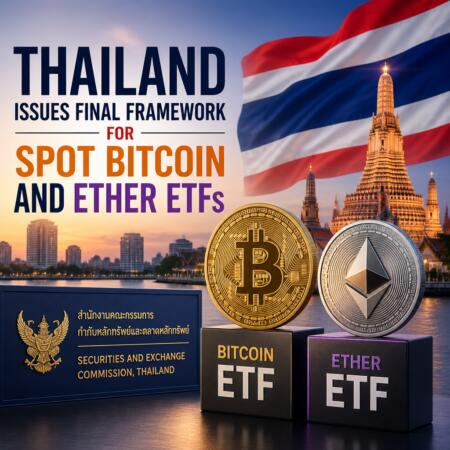
Thailand’s Securities and Exchange Commission (SEC) has moved closer to allowing spot Bitcoin and Ether exchange-traded funds (ETFs) in the country, shifting from a principles-based proposal to draft regulations and a revised approach to crypto custody.
In a notice released Monday, the regulator said it is seeking public feedback on two separate consultation papers: one lays out draft rules for Thai-listed spot crypto ETFs, and the other proposes qualification principles for foreign digital asset custodians used by mutual and private funds that invest in digital assets. Both consultations are open until Sept. 20. https://www.sec.or.th/EN/Pages/News_Detail.aspx?SECID=13237
Key takeaways
- Thai spot Bitcoin and Ether ETFs would be listed on the Stock Exchange of Thailand (SET) and each would track only one asset.
- Draft rules require ETFs to maintain an average net exposure of at least 80% of net asset value to their tracked cryptocurrency each accounting year.
- Thailand’s SEC is revising its custody framework after feedback on earlier custody concepts from the April consultation.
- For the initial phase, ETF structures are expected to rely primarily on onshore digital asset custodians, with qualified foreign custodians allowed only when necessary.
- Mutual and private funds may invest in Thai-domiciled crypto ETFs, while the regulator is not proposing alternative wrapper products tied to foreign crypto ETFs at launch.
Draft spot ETF rules for SET listings
The SEC’s draft regulations would allow passive ETFs tracking Bitcoin (BTC) or Ether (ETH)—the only two eligible crypto assets under the framework at this stage. According to the SEC, the ETF products would trade exclusively on the Stock Exchange of Thailand (SET).
Each proposed ETF would focus on a single cryptocurrency, and the draft rules include an exposure requirement designed to keep fund performance closely aligned with the underlying asset. Specifically, the ETF would need to maintain average net exposure of at least 80% of its net asset value to the tracked cryptocurrency over each accounting year.
The SEC’s approach also defines how these Thai-domiciled crypto ETFs could fit within the wider fund industry. The draft rules would permit mutual funds and private funds to invest in Thai-domiciled crypto ETFs, in addition to foreign crypto ETFs where these investments are already allowed, subject to existing investment limits.
What the SEC says changed after earlier feedback
The draft package comes after an earlier SEC consultation in April that set out broader principles for the overall ETF framework. In Monday’s update, the regulator said most respondents supported the proposed framework, but that feedback—particularly on custody arrangements—prompted changes to how the SEC planned to handle custodians.
That shift matters for investors and operators because custody is central to ETF risk controls. Where the framework requires certain custody standards, it affects which fund sponsors can participate, what infrastructure must be used, and how regulators believe investor assets should be protected.
The SEC’s revised direction is intended to reflect that feedback while still advancing a workable structure for Thai listed spot crypto exposure. https://www.sec.or.th/EN/Pages/News_Detail.aspx?SECID=12734
Revised custody standards: onshore-first, foreign only when needed
Alongside the ETF rulebook, Thailand’s SEC is revising its custody proposal. The regulator said the revised approach would retain onshore digital asset custodians as the primary providers during the initial phase for crypto ETFs.
In its statement, the SEC said: “Under the revised approach, crypto ETFs will continue to be primarily required to use onshore DA [digital asset] custodians, while the SEC may permit the use of qualified foreign DA custodians when necessary and appropriate in light of prevailing circumstances.” https://www.sec.or.th/EN/Pages/News_Detail.aspx?SECID=13237
For the separate custody consultation—focused on foreign digital asset custodians used by mutual and private funds—the SEC’s proposed conditions are more explicit. Foreign providers would need to be supervised by a regulatory authority with legal powers. They would also have to meet what the Thai SEC considers adequate regulatory and investor asset protection standards.
Put simply, Thailand is building a two-layer structure: ETFs at launch should largely use domestic custody capabilities, while foreign custody can be considered under defined circumstances for other digital-asset fund activity. That distinction is likely to influence timelines for product approvals, because custody capacity and regulatory oversight are often the gating issues in spot crypto ETF launches.
What’s allowed—and what’s not—in the early phase
The SEC’s draft regulations outline the ETF investment routes it intends to enable first. Mutual funds and private funds in Thailand would be able to invest in Thai-domiciled crypto ETFs and also in foreign crypto ETFs where already permitted, provided they stay within existing investment constraints.
However, the regulator’s initial rollout plan draws a line around certain indirect structures. In the first phase, the SEC would not allow alternative products tied to foreign crypto ETFs, including depositary receipts that track such foreign funds. For market participants, this suggests Thailand is aiming for a direct exposure model at launch rather than allowing more complex wrappers that could add extra layers of counterparty and structure risk.
Why Thailand’s ETF framework is gaining attention
Thailand’s SEC is not operating in isolation. The regulator’s ETF work sits within Thailand’s broader effort to position the country as a digital asset hub for institutions. The SEC’s framework is intended to channel spot Bitcoin and Ether access through regulated, exchange-traded vehicles—an approach that, if implemented effectively, could widen institutional participation beyond traditional crypto venues.
Investors watching the process should pay close attention to the custody consultations and how the SEC defines “necessary and appropriate” circumstances for foreign custodians. Those phrases could determine whether Thai sponsors face friction bringing international custody arrangements into the earliest approvals, or whether onshore custody capacity will be sufficient for the first wave of listings.
With both consultation papers open for public comment until Sept. 20, the next step for market participants is to examine how feedback may further refine custody rules, product eligibility, and the practical mechanics of ETF exposure on the SET—especially around the onshore-first stance that appears central to the SEC’s revised plan.