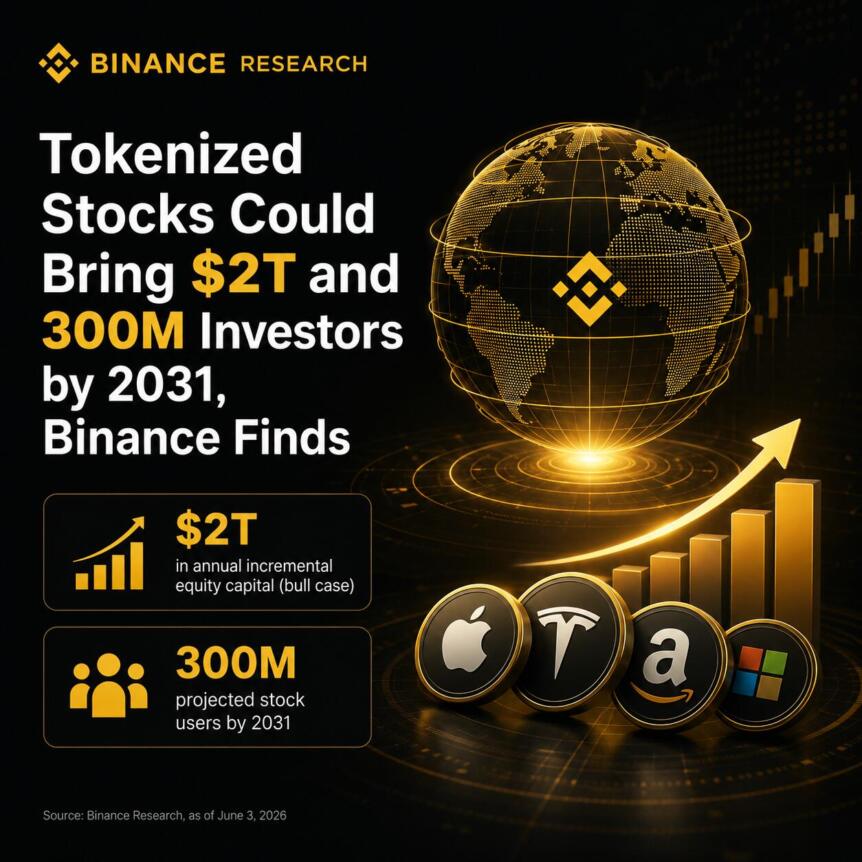
Binance research outlines the potential scale of tokenized equities
Binance Research, the analytics arm of Binance, has released a market commentary arguing that tokenized equities and fractional stock ownership facilitated by crypto exchanges could meaningfully expand global equity participation. In a base-case projection the report estimates crypto platforms could channel as much as US$2 trillion in additional capital and bring close to 300 million new investors into global equity markets by 2031. A bullish scenario sees annual incremental flows rising to US$5 trillion within five years.
Those figures, if realised, would represent a significant reconfiguration of access to the world’s largest equity pools. Binance’s analysis points to a persistent participation gap: most jurisdictions outside the United States have equity ownership rates well below 20 percent of the population, even though US-listed companies account for a large share of global market capitalisation. The report frames tokenization and fractionalisation as mechanisms that can lower entry barriers for investors in regions where traditional brokerage, custody and settlement frictions have limited participation.
Key findings and underlying drivers
Binance Research highlights several elements that could accelerate adoption of tokenized equities:
Market access and fractional ownership: Tokenized shares can be divided into fractional units, enabling investors with limited disposable income to buy exposure to high-priced US names. The report notes early demand concentrated in emerging markets, where brokerage access and local market infrastructure traditionally constrain retail participation.
Settlement using stablecoins: The commentary emphasises stablecoins as an attractive settlement layer for 24/7 cross-border equity exposure. Binance’s analysis suggests stablecoin-based off-ramps can reduce average transaction costs that are otherwise incurred in fiat conversions and bank correspondence, potentially making cross-border trading more cost-effective.
New product types and trading activity: The research points to growth in TradFi-linked perpetuals and other derivatives denominated in stablecoins, which have moved from negligible volumes to a measurable share of stablecoin trading. Such instruments may provide synthetics and leverage that appeal to a broad spectrum of crypto-native and new retail participants.
Context: why tokenization matters now
Tokenization is receiving renewed attention as exchanges expand product suites beyond spot crypto. For investors outside major financial centres, access to US-listed equities—often the most liquid and deep market—can be limited by account requirements, currency controls, and high brokerage fees. Tokenized stocks aim to address these frictions by combining blockchain-based recordkeeping, fractionalisation and crypto-native rails for settlement.
Industry observers point out that the technological feasibility of tokenized assets has improved, but adoption hinges on legal recognition, custody arrangements and interoperability with existing clearing and settlement systems. The pace at which regulators, custodians and exchanges align on standards will shape whether the projected capital flows materialise.
Implications for markets, infrastructure and regulators
If tokenized equities scale as Binance Research models, the effects could be wide-ranging:
Liquidity and price discovery: Increased participation from new retail cohorts could deepen liquidity for certain stocks, but could also fragment trading across on-chain and off-chain venues. Fragmentation may complicate consolidated market data and surveillance.
Settlement and counterparty risk: Relying on stablecoins for settlement introduces operational dependencies on crypto liquidity and the issuers of those coins. Proper custody, redemption processes and reserve transparency will be critical to limit settlement risk.
Regulatory and compliance challenges: Cross-border tokenized trading raises questions around securities law, investor protection, taxation and anti-money laundering controls. National regulators may differ on whether tokenized shares are treated as direct holdings, synthetic exposure or brokered products, which will affect onboarding and disclosure requirements.
Competition and business model shifts: Traditional brokers and custodians could face competition from exchanges offering integrated crypto-plus-equities accounts. That shift could squeeze fee margins in some markets while prompting incumbents to enhance digital, low-cost access options.
What to watch next
Several variables will determine the trajectory of tokenized equities:
Regulatory clarity: Jurisdictions that set clear rules for custody, transferability and investor protections will likely attract platforms and issuers.
Custody and interoperability standards: Industry-wide standards for reconciliation between tokenised ledgers and traditional registries will be important to reduce settlement mismatches.
Stablecoin regulation and market infrastructure: The role of stablecoins as a settlement medium will depend on regulatory acceptance, issuer transparency, and robust liquidity in cross-border corridors.
Conclusion
Binance Research’s estimates underscore the scale of the opportunity proponents see in tokenized equities: broader access to US markets for investors in underserved regions, lower transaction costs through crypto rails, and new product types built on fractional ownership. Realising that potential, however, will require coordinated progress on custody, legal recognition and market oversight. The coming months and years will be a test of whether tokenization can move from niche experiments to mainstream plumbing for global equity flows.