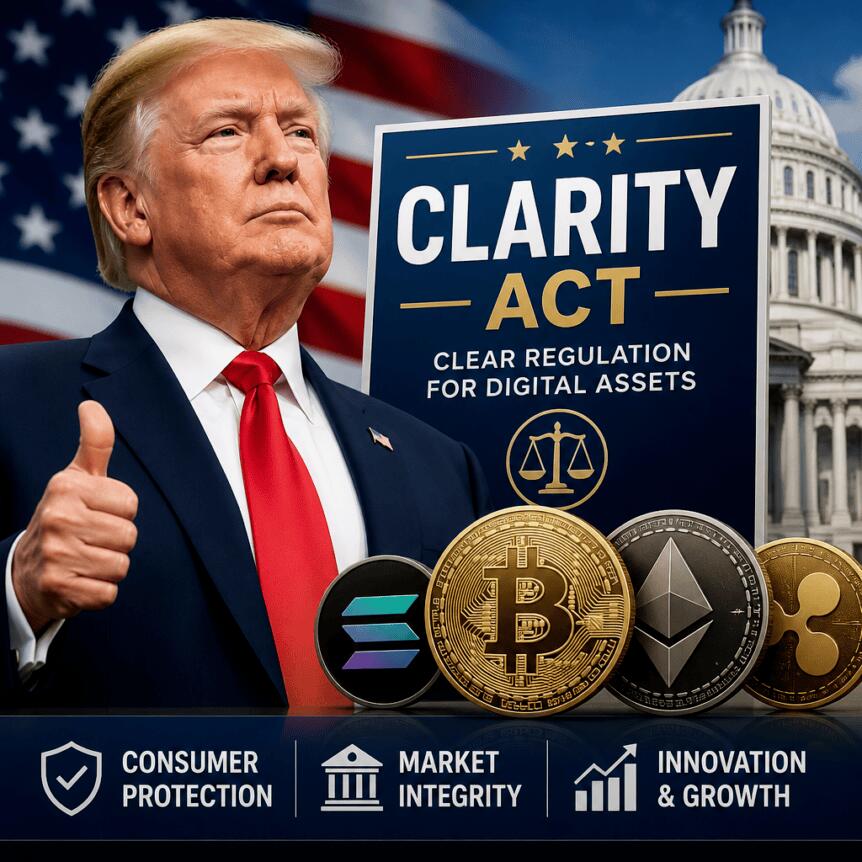
U.S. President Donald Trump renewed pressure for passage of the Digital Asset Market Clarity (CLARITY) Act as the Senate remains in recess, urging lawmakers to move quickly on a bill he framed as essential for keeping the United States competitive.
During a Wednesday press conference with prominent crypto executives—including Coinbase CEO Brian Armstrong and Gemini co-founders Cameron and Tyler Winklevoss—Trump said Congress should adopt “a fair version” of CLARITY, arguing the measure would help the U.S. stay “ahead of China.” The bill already cleared the House of Representatives in July 2025, but its momentum in the Senate has stalled for months amid concerns raised by market structure provisions related to tokenized equities, stablecoin-related rewards, and potential conflicts of interest involving the Trump family.
Key takeaways
- Trump pushed for a Senate advance of the CLARITY Act while lawmakers are out of session, emphasizing long-term competitiveness.
- Coinbase CEO Brian Armstrong argued the bill could provide “durable” U.S. crypto policy and suggested it may attract a large Senate coalition.
- Trump referenced former Sen. Lindsey Graham as a key early supporter and urged action in his honor.
- Industry comments came as the CFTC prepared for an Innovation Advisory Committee meeting before Congress returned.
- At the same time, the SEC has proposed a framework aimed at offering certain safe harbors in the absence of CLARITY.
Trump links CLARITY to competitiveness and legislative urgency
Trump’s remarks positioned CLARITY as both a regulatory and economic strategy. He told reporters that members of Congress should pass a version he described as “fair,” asserting it would help the U.S. remain competitive with China.
While the Senate is not currently in session, Trump used the moment to press for momentum. He also characterized support as broad, saying “Lot of Democrats support,” and described CLARITY as “very bipartisan.” The president’s framing suggests the White House is treating the bill as a priority item not only for crypto-focused constituencies, but for the broader political calculus around technology leadership.
Coinbase and Gemini executives emphasize potential durability
Brian Armstrong spoke after Trump and top U.S. regulators at the press event. Armstrong argued that CLARITY would make U.S. crypto policy “durable into the future,” implying that clearer rules could outlast short-term political shifts and help businesses plan beyond election cycles.
Armstrong also floated a potential path to Senate progress. He speculated the bill could garner “more than 60 votes” once the Senate addresses a cloture motion on Sept. 18—an important procedural step that can limit debate and allow a final vote on legislation. Even without claiming certainty, Armstrong’s estimate reflects an industry belief that the bill may be closer to a legislative breakthrough than critics suggest.
Why the Senate delay matters: provisions under scrutiny
CLARITY’s legislative trail provides key context for why the delay has become politically and technically significant. The House approved the bill in July 2025, but the Senate has not taken it up decisively for months. The stall has been tied to debates over specific components, including how tokenized equities would be treated, how stablecoin rewards could operate under the proposed structure, and whether the Trump family’s involvement creates conflicts of interest perceptions within the crypto industry.
These concerns matter for investors and market participants because they affect not just legal interpretation, but also product design and market structure. Rules shaping how digital assets are regulated can influence liquidity, custody practices, exchange operations, and the willingness of traditional finance firms to engage with tokenized markets.
Regulators move in parallel: CFTC planning and SEC proposals
Trump’s push came amid a busy regulatory backdrop. Industry executive remarks arrived one day before the CFTC was scheduled to hold an Innovation Advisory Committee meeting. CFTC Chair Michael Selig said the agency would explore how it can move forward on crypto regulation at the meeting, noting that Congress would not return for another month. The timing highlights a tension investors frequently face during legislative gridlock: while Congress debates market structure, agencies continue attempting to build practical frameworks through their own processes.
That parallel effort extends to the SEC as well. Earlier coverage noted that the Securities and Exchange Commission proposed crypto rules designed to offer companies a safe harbor from tokens being treated as “investment contracts,” along with exemptions related to token issuance. The implication is that, even if CLARITY remains stuck, regulated entities are still being offered potential pathways to compliance—though the approach is necessarily narrower and varies by agency authority.
Taken together, the developments suggest the U.S. regulatory landscape is moving forward on multiple tracks at once: one involving comprehensive legislation through CLARITY, and another involving agency rulemaking or proposed regulatory guidance in the interim.
What to watch next
Attention is likely to center on whether the Senate advances the cloture motion discussed by Armstrong for Sept. 18, and on how the SEC and CFTC continue building workable rules while Congress remains out of session. For market participants, the key question is whether CLARITY ultimately resolves the structural uncertainties that agencies are trying to address piecemeal.