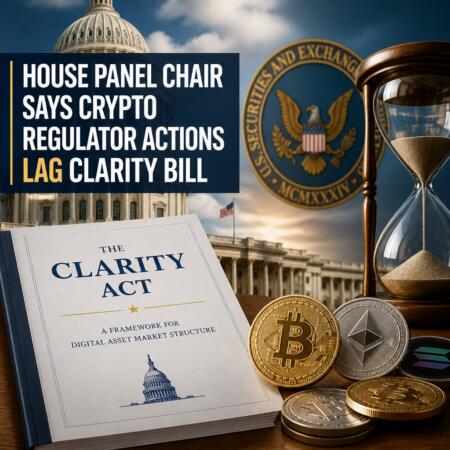
US President Donald Trump renewed his push for passage of the Digital Asset Market Clarity (CLARITY) Act as the Senate remains in recess, urging lawmakers to advance what he described as a “fair version” of the bill to keep the United States “ahead of China.” The proposal, which passed the House of Representatives in July 2025, has been stuck in the Senate for months amid disputes over how certain tokenized products and incentives should be treated, as well as concerns about potential conflicts of interest.
Speaking at a Wednesday press conference alongside leading crypto executives—including Coinbase CEO Brian Armstrong and Gemini co-founders Cameron and Tyler Winklevoss—Trump framed the effort as a competitiveness issue and linked it to broader US regulatory credibility. Armstrong, who spoke after Trump and heads of US regulatory agencies, argued that the bill would provide long-lasting policy certainty for the industry.
Key takeaways
- Trump urged Congress to pass a “fair version” of the CLARITY Act while the Senate is in recess, positioning the legislation as a way to maintain US leadership.
- CLARITY passed the House in July 2025 but remains stalled in the Senate amid concerns including tokenized equities, stablecoin rewards, and ethics-related conflict of interest questions.
- Coinbase CEO Brian Armstrong said the bill could gain “more than 60 votes” if the Senate addresses a cloture motion expected on Sept. 15.
- Sen. Ruben Gallego criticized the idea of presidentially driven “limits,” arguing regulatory thresholds must be set by Congress and the White House, not by the president unilaterally.
- Meanwhile, regulators appear to be moving without waiting for CLARITY—both the SEC’s proposed safe-harbor approach and upcoming CFTC discussions point to continued rulemaking activity.
Trump presses for CLARITY despite Senate recess
At the center of the Wednesday remarks was the CLARITY Act, a market-structure proposal that cleared the House in July 2025. Trump emphasized urgency, telling reporters that members of Congress should act to keep US policy “ahead of China.” His comments came after he previously pushed lawmakers toward CLARITY in July, shortly after the death of Senator Lindsey Graham, which Trump cited as a reason to advance the measure.
Trump’s call also referenced a belief that the bill is politically broad. After Armstrong’s remarks, Trump said it was “very bipartisan” and added that “Lot of Democrats support.”
Armstrong, responding to the president and regulatory leadership, argued the legislation would help make crypto rules durable over time. He characterized CLARITY as something that could remain effective for “decades and decades to come,” rather than producing short-lived regulatory patchwork.
Armstrong’s vote-count expectations and the Sept. 15 cloture clock
Armstrong’s remarks offered the most specific legislative pathway in the briefing. He suggested that CLARITY could ultimately command significant Senate support—speculating the bill could have “more than 60 votes”—if senators address the cloture motion scheduled for Sept. 15.
That framing matters for market participants because cloture is often the key procedural hurdle for bringing controversial legislation to the floor. If senators are willing to move through cloture, the bill’s prospects can change quickly from a stalled, committee-level dispute to a potentially binding floor vote.
Even so, the broader political question remains unresolved: the bill’s pace and potential amendments appear tightly linked to contested areas in the text.
What’s been holding CLARITY up
According to the coverage of the bill’s status, CLARITY has stalled in the Senate for months. The underlying reasons include concerns about tokenized equities, stablecoin rewards, and ethics provisions—particularly worries that the Trump family’s business interests could create conflicts of interest with aspects of the crypto industry.
Those ethics concerns resurfaced in response to Trump’s Wednesday framing. According to Senator Ruben Gallego, the debate should not be reduced to what the president thinks is “fair.” At the Wyoming Blockchain Symposium, Gallego said that limiting language or regulatory thresholds is not something the president should unilaterally determine.
“The president is agreeing to some limitation. It’s not his place to agree. It’s the place of the Congress, the Senate and then the White House […] the president doesn’t just get to decide what level of regulation he gets.“
Gallego’s position underscores a core tension around the bill: while industry leaders and the White House are pressing for certainty, critics argue the political negotiation must be grounded in legislative authority and ethics safeguards rather than executive preferences.
Trump has previously brought crypto executives to the White House, including a summit focused on regulation in March 2025 and a separate signing ceremony tied to legislation described in earlier coverage as the GENIUS stablecoin bill in July 2025.
Regulators keep moving as CLARITY waits
While CLARITY waits for Senate action, regulatory activity has not paused. The Wednesday press conference occurred one day before the Commodity Futures Trading Commission was scheduled to hold an Innovation Advisory Committee meeting. CFTC Chair Michael Selig said at the time that the agency would explore moving forward on crypto regulations at the meeting, noting that Congress would not return to session for another month.
At the same time, the Securities and Exchange Commission has been working on its own rulemaking direction. Earlier coverage described the SEC as proposing crypto rules designed to provide companies a safe harbor from tokens being treated as “investment contracts,” along with certain exemptions for token issuance. The timing suggests that, even if CLARITY stalls, regulators may still pursue workable compliance pathways through separate legal theories and regulatory frameworks.
For investors and exchanges, the key takeaway is that policy uncertainty may not be resolved by CLARITY alone in the near term. Instead, the US regulatory landscape could evolve through overlapping approaches: market-structure legislation moving procedurally in Congress, and agency rulemaking continuing through SEC and CFTC initiatives.
In practical terms, that means market participants may need to plan for both possibilities at once—preparing compliance strategies that can function under existing frameworks while watching how CLARITY’s stalled provisions could be amended to address the disputes currently slowing the Senate.
With a Sept. 15 procedural step potentially shaping CLARITY’s legislative momentum, and regulators scheduled to continue acting independently, the coming weeks will likely show whether Washington can align on a unified framework—or whether the US ends up with parallel, partially overlapping rule tracks until Congress finally settles the core disagreements.