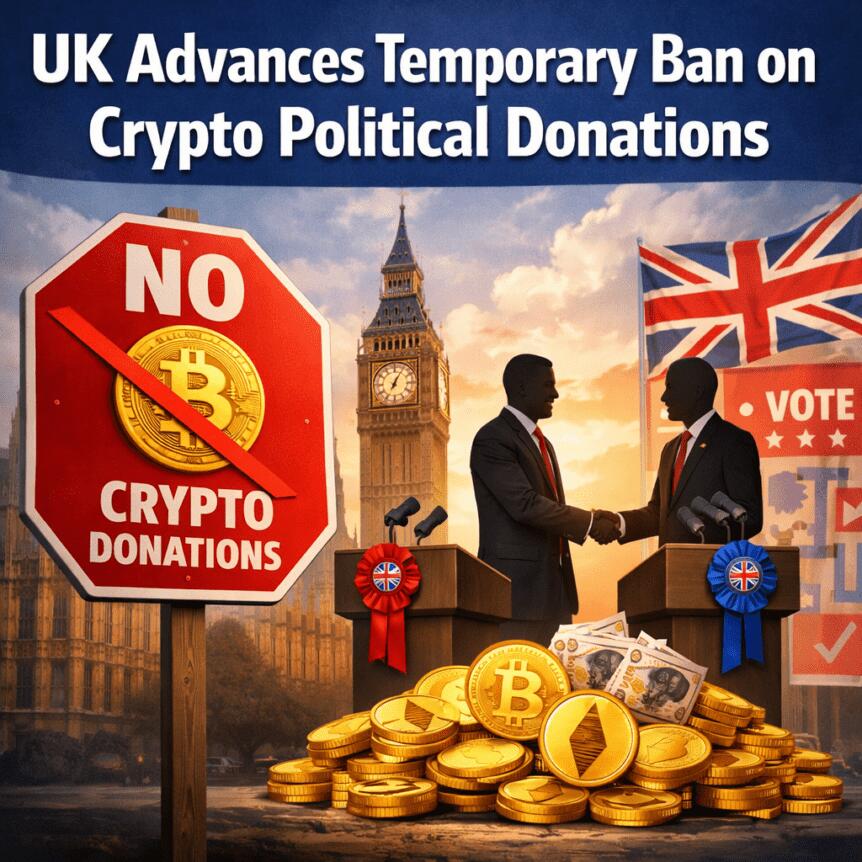
The UK government is accelerating plans to impose a temporary ban on political donations made via cryptocurrencies, tying the move to findings from the independent Rycroft Review that examined foreign interference in elections and political processes.
Prime Minister Keir Starmer signaled the government’s intent during a recent Prime Minister’s Question Time, stating that the administration would act decisively to protect democracy and include a moratorium on all political donations conducted through crypto assets. The pledge reflects cross-party concerns that crypto payments could be exploited by foreign actors to influence UK politics, a risk underscored by the independent inquiry.
Under the proposed policy, crypto donations would be prohibited until the government and regulators establish a robust framework capable of ensuring traceability and preventing illicit funding. A separate government statement outlined that the moratorium would apply until the regulatory environment is deemed sufficiently strong to support transparent, accountable fundraising in elections.
Key takeaways
- The UK moves to suspend crypto-based political donations pending a robust regulatory regime aimed at preventing untraceable funds and foreign interference.
- The change is being pursued as part of amendments to the Representation of the People Bill, with retrospective effect from March 25.
- The legislation is at the committee stage in the House of Commons and must pass both Houses and receive royal assent to become law.
- Enforcement includes a 30-day window for political parties and regulated actors to return any unlawful crypto donations once the law takes effect.
- Reform UK, which has publicly accepted crypto donations, illustrates the shifting political dynamics around crypto contributions in the UK.
Rationale, risk, and political momentum
The move follows the Rycroft Review, an independent inquiry that scrutinized foreign financial influence and interference risks in the UK’s electoral architecture. While not the law itself, the review has become a blueprint for where policymakers believe tighter controls are warranted. In public remarks, Starmer framed the moratorium as part of a broader effort to shield democratic processes from covert funding channels. The government’s stance is that crypto donations, if left unregulated, could provide a vehicle for opaque contributions and foreign actors to sway political outcomes.
Observers note that the policy signals a broader shift in how UK politics may handle digital assets in the fundraising space. While crypto markets continue to evolve rapidly, lawmakers are signaling that fundraising mechanisms, disclosures, and enforcement capabilities must keep pace to preserve electoral integrity. The government’s position is that once a robust regulatory environment is in place, the ban would be lifted only after appropriate assurances about transparency and enforcement are satisfied by Parliament and the Electoral Commission.
Legislative path and practical implications
Implementing the moratorium requires amendments to the Representation of the People Bill. The government indicated that changes would take retrospective effect from March 25, aligning with the timeline of the inquiry and the current parliamentary session. The bill is presently at the committee stage in the House of Commons, meaning it must pass through both the Commons and the Lords before reaching royal assent, after which it could become law.
Once in force, the rule would impose a 30-day window for political parties, candidates, and MPs to return any crypto donations deemed unlawful during the interim period. After the window closes, enforcement actions could follow for breaches discovered under the new regime. This phased approach aims to deter crypto-based contributions that lack clear traceability or originate from prohibited sources, while giving political actors time to adjust and comply with the updated requirements.
Crucially, the ban is described as not being lifted until the regulatory framework is judged robust enough to sustain confidence and transparency in donations conducted through digital assets. That implies a potentially lengthy period before any relaxation, contingent on the development and rollout of effective compliance standards, verification processes, and enforcement mechanisms overseen by the Electoral Commission and relevant regulators.
Context, parties, and potential market impact
The policy landscape around crypto donations in the UK has already seen notable developments. Reform UK, for example, was reported to be the first major party to publicly accept crypto donations, with its leadership announcing an intention to accept Bitcoin and other digital assets from eligible donors. The new moratorium framework could complicate such fundraising arrangements, particularly if the donor pool and regulatory expectations become more tightly defined and enforced.
For investors and market participants, the unfolding policy debate underscores how regulatory risk is evolving alongside the crypto sector. While the moratorium targets political fundraising rather than broader market activity, it reflects a broader emphasis on governance, transparency, and anti-fraud controls in digital asset use. Market watchers will be watching not only the trajectory of the Representation of the People Bill, but also how regulators operationalize new rules, such as enhanced monitoring of crypto contributions, heightened disclosures, and potential cross-border compliance requirements.
The timeline remains to be seen. With the next general election due by August 15, 2029, the length of any enforced pause will partly hinge on parliamentary pace and the readiness of the Electoral Commission to administer and enforce the new regime. The case also sits within a wider international dialogue about how democracies regulate crypto philanthropy and campaign funding, a field that is rapidly evolving as lawmakers weigh both security concerns and the potential benefits of digital assets for fundraising.
As the bill advances through Parliament, observers should monitor three critical developments: the precise scope of the ban (whether it applies to all crypto donations or only certain types of gifts), the design and timeline of the regulatory regime that would allow the ban to be lifted, and how enforcement will be operationalized in practice across different political parties and candidates.
In the near term, the government’s priority is to safeguard election integrity while building a credible framework for digital fundraising. Whether the proposed measures will withstand political and legal scrutiny, and how quickly regulators can implement the necessary safeguards, will shape the trajectory of crypto donations in UK politics for the years ahead.
Readers should stay attentive to parliamentary proceedings around the Representation of the People Bill, as well as official statements from the Electoral Commission and the government on the timing and conditions for any potential exemption or lifting of the moratorium. The ongoing debate will likely influence how political campaigns, donors, and crypto firms approach fundraising and compliance in the United Kingdom.
The next phase of the policy process will reveal how aggressively the UK plans to police crypto-backed political giving and whether the regulatory approach can provide a clear, enforceable path for campaign finance in the digital asset era.