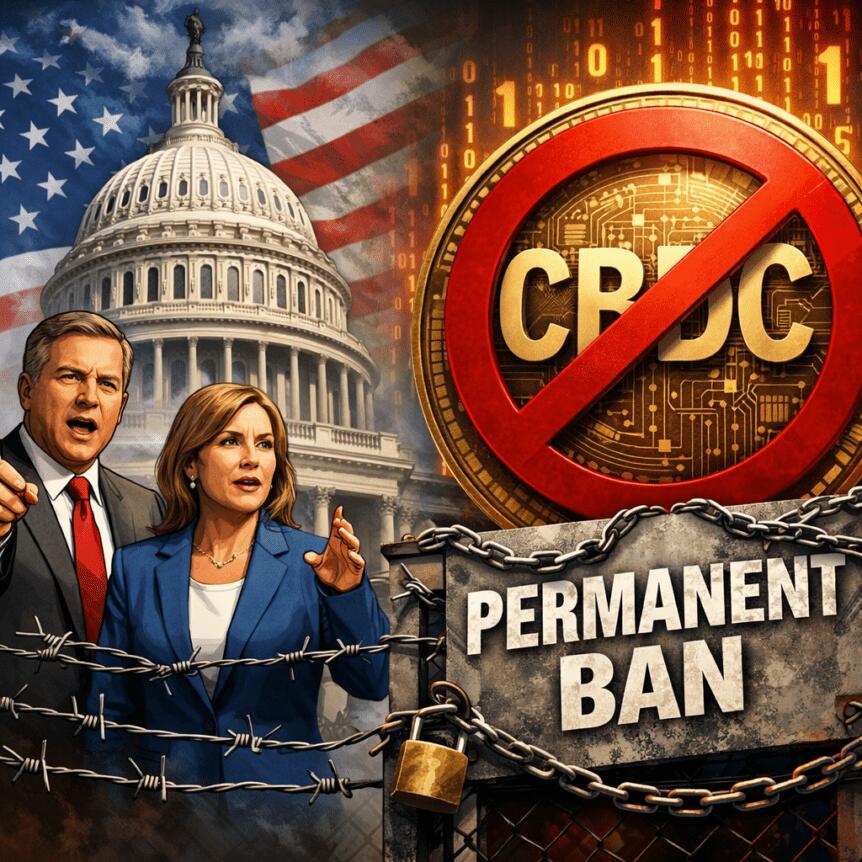
A coalition of U.S. lawmakers is rallying to prevent the United States from issuing a Central Bank Digital Currency (CBDC) in any form, arguing that even a temporary pause would not suffice to protect civil liberties or financial freedom. In a Friday letter addressed to House Speaker Mike Johnson and Senate Majority Leader John Thune, Rep. Michael Cloud stated, “We write to you to express the dire need to prohibit a Central Bank Digital Currency from ever happening in the United States,” a sentiment shared by 28 colleagues. The push arrives as the Senate Committee on Banking, Housing, and Urban Affairs released a 300-page measure, the 21st Century ROAD to Housing Act (HR 6644), which includes an amendment that would bar the Federal Reserve from issuing a CBDC until 2031. Supporters of a hard ban insist that merely delaying the policy would leave Americans exposed to potential surveillance and centralized control over their finances.
Key takeaways
- A group of 29 lawmakers is pressing for a permanent prohibition on any U.S. CBDC, arguing that a temporary block would be ineffective in safeguarding civil liberties and financial freedom.
- The 21st Century ROAD to Housing Act (HR 6644) embeds a CBDC prohibition and would prevent Federal Reserve issuance until 2031, signaling a broad legislative attempt to shape digital-currency policy for years to come.
- The Anti-CBDC Surveillance State Act (HR 1919) has cleared the House but awaits Senate consideration, and critics say the amended version in HR 6644 dilutes the hardline language of HR 1919.
- A separate measure, the No CBDC Act (S 464) introduced by Senator Mike Lee, seeks a federal ban but remains stalled in Congress, highlighting the partisan and procedural hurdles to CBDC legislation.
- Lawmakers contend that a CBDC would amount to “unconstitutional financial surveillance” and grant the Federal Reserve sweeping, unelected power over Americans’ finances, framing the debate as a civil-liberties issue as well as a monetary-policy question.
In the letter, the lawmakers criticized the amended legislation as a “watered-down version” of HR 1919, which had aimed for a stronger prohibition on a CBDC and would have prevented the Fed from pursuing such a technology altogether. They urged restoring the stricter language, arguing that the current compromise fails to address the privacy and civil liberties concerns that accompany a government-backed digital currency. The discussion is not merely academic: the CBDC question intersects with broader debates over crypto regulation, monetary sovereignty, and the role of the Federal Reserve in a rapidly digitizing financial system.
Market context
Market context: The CBDC policy debate sits at the nexus of traditional monetary policy and the evolving regulation of digital assets. As lawmakers tilt toward a permanent ban, market participants monitor legislative developments for potential repercussions on the broader crypto ecosystem, including privacy protections, data governance, and the competitive landscape for private digital assets. While the Fed continues to study CBDC implications, there is no imminent launch timeline, and congressional action remains the primary driver of policy direction in this area.
Why it matters
The push to outlaw CBDCs permanently touches several core questions for users, investors, and builders in the digital-asset space. First, it signals a legislative preference for preserving financial privacy and limiting centralized governmental access to citizens’ transactional data. By framing a CBDC as a potential tool for surveillance and control, proponents are attempting to curb a future where monetary policy is exercised through a programmable currency issued by a non-elected institution.
Second, the development process around HR 6644 and related bills reveals the procedural path that digital-currency policy can take in the United States. The House has already moved pieces of this debate forward, with HR 1919 passing the chamber, while the Senate’s timetable remains uncertain. The persistence of the No CBDC Act in the Senate underscores that any possible shift toward a U.S. CBDC would require broad bipartisan consensus, a challenging feat given the powerful concerns raised by the anti-CBDC coalition.
Finally, the discourse has implications for U.S. competitiveness in global financial technology leadership. Advocates view CBDCs as a state-backed instrument of monetary resilience and efficiency, while opponents argue that control over the monetary system should remain with accountable institutions and that individuals’ financial privacy must remain protected. The outcome of these debates will influence how digital-payment rails evolve, how private-sector digital-assets are regulated, and how much privacy protections remain central to the design of future financial infrastructure.
What to watch next
- The fate of HR 6644’s CBDC-prohibition language in the Senate, and whether a companion bill gains traction on that side of the Capitol.
- The status of HR 1919 in Congress and whether lawmakers press to restore its stronger anti-CBDC provisions.
- Whether S 464 (No CBDC Act) advances in the Senate or faces procedural obstacles that stall its consideration.
- Any formal Fed commentary or reports that would shed light on the central bank’s own assessment of a CBDC and its potential timelines.
- New political alignments or lobbying efforts around digital currencies as the regulatory environment continues to evolve.
Sources & verification
- 21st Century ROAD to Housing Act (HR 6644) text and Senate Committee release detailing the CBDC prohibition until 2031 — https://www.congress.gov/
- Anti-CBDC Surveillance State Act (HR 1919) – Congressional text and status — https://www.congress.gov/
- No CBDC Act (S 464) – Senator Mike Lee’s bill status — https://www.congress.gov/
- Letter from Representative Michael Cloud to Speaker Johnson (includes reference to the CBDC ban) — https://x.com/RepRalphNorman/status/2030087980589670463?s=20
- Cointelegraph reporting on the CBDC discussion and related proposed legislation — https://cointelegraph.com/news/fed-blocked-issuing-cbdc-until-2030-proposed-bill
What the debate means for the future of digital money
The ongoing debate over a U.S. CBDC encapsulates a broader question about how a digital-dollar framework would fit within the American constitutional framework and the global financial system. Proponents argue that a CBDC could modernize payments, bolster financial inclusion, and enable more efficient monetary policy transmission. Critics worry about privacy, potential surveillance, and the concentration of monetary control in a government-run framework. The current legislative discussion signals that, for now, the balance of power on this issue will be contested terrain for policymakers and industry alike.
What to watch next
- Monitor updates on HR 6644’s progress through the Senate and any changes to the CBDC-prohibition clause before a potential floor vote.
- Track the status of HR 1919 and whether the House will push for a stricter version to meet broader concerns about surveillance and civil liberties.
- Follow S 464 for movement in the Senate and potential compromises that could shape a future CBDC policy framework.
Why it matters
For policymakers, the CBDC debate tests the boundaries between innovation, privacy, and state power. For investors and builders in the digital-asset space, the outcome will influence regulation trajectories, funding climates, and the pace at which new, private-sector financial technologies can scale. The current discourse underscores that digital money is as much a political and constitutional issue as it is a technological one, with potential consequences for how people pay, save, and participate in the financial system in the years ahead.
What to watch next
- Legislative calendars for the Senate: any schedule announcements for votes on HR 6644, HR 1919, or S 464.
- Official Fed communications or white papers that could clarify the central bank’s stance on CBDC design and privacy protections.
- Public statements from lawmakers who signed the Cloud letter assessing the risk-benefit balance of a U.S. CBDC.
Sources & verification
- The 21st Century ROAD to Housing Act (HR 6644) — Senate Committee release detailing the proposed CBDC prohibition until 2031.
- Anti-CBDC Surveillance State Act (HR 1919) — Congressional page showing its passage in the House and status in the Senate.
- No CBDC Act (S 464) — Senate version of the CBDC prohibition proposal introduced by Senator Mike Lee.
- Letter from Rep. Michael Cloud (with reference to the CBDC prohibition) — Ralph Norman’s tweet linked in the article.
- Cointelegraph coverage on the CBDC debate and related proposed legislation — official reporting cited in the discussion.
CBDC debate reshapes US digital currency policy
A coalition of lawmakers is pressing to embolden a permanent ban on a U.S. CBDC, arguing that even a temporary pause would fail to protect constitutional rights or financial privacy. In a Friday letter to House Speaker Mike Johnson and Senate Majority Leader John Thune, Rep. Michael Cloud framed the issue as a confrontation over the future of American monetary sovereignty, asserting that “a Central Bank Digital Currency must be prohibited permanently.” The letter, signed by 28 fellow lawmakers, comes as the Senate Committee on Banking, Housing, and Urban Affairs released HR 6644, a sprawling 300-page bill designed to address a range of housing and financial policy topics, including a CBDC prohibition that would bar the Federal Reserve from issuing a digital dollar until 2031. The emphasis is clear: for this group, the risk of a CBDC is a civil-liberties and privacy risk that cannot be permitted to mature.
Advocates note that the amendment in HR 6644 represents a robust stance in contrast to earlier proposals that merely paused CBDC development. They argue that the language should be tightened further, pointing to the Anti-CBDC Surveillance State Act (HR 1919), which lawmakers say the amended version appears to dilute. HR 1919 had advanced through the House but requires Senate approval to become law. In parallel, Senator Mike Lee’s No CBDC Act (S 464) has been introduced as a standalone measure to prohibit federal issuance of a CBDC, though it has faced procedural hurdles and has yet to gain significant momentum in the upper chamber. The dynamic underscores a broader rift over the appropriate balance between innovation and oversight in digital-money policy.
The letter also contends that the Federal Reserve’s authority would be dangerously expanded under a CBDC framework, invoking concerns about “unconstitutional financial surveillance” and the concentration of monetary control in a centralized, unelected body. While supporters of digitized public money argue that CBDCs could streamline payments, reduce friction in government programs, and bolster financial inclusion, opponents emphasize privacy rights and the risk of government overreach. The debate is not occurring in a vacuum: it intersects with ongoing discussions about how the United States should regulate private digital assets and who should set the rules governing the digital economy. The stance taken by Cloud and his colleagues reflects a broader insistence that policy should not move forward without explicit protections for civil liberties and constitutional governance.
Meanwhile, the policy landscape remains unsettled. The No CBDC Act and HR 1919 issues illustrate the challenges of achieving cross-chamber consensus. The bill that would block the Fed from pursuing a CBDC until 2031 is part of a larger package that prioritizes consumer privacy, security, and the limits of centralized authority over money. In the background, broader crypto and blockchain initiatives continue to influence the flavor of policy discussions, even as lawmakers warning about “digital surveillance” build support for restrictive measures. Observers will be watching how these proposals interact with the Fed’s ongoing research into digital money and how market participants adjust as the legislative process unfolds. The ultimate outcome could shape not only the feasibility of a U.S. CBDC but also the competitive balance between public and private digital-currency initiatives for years to come.