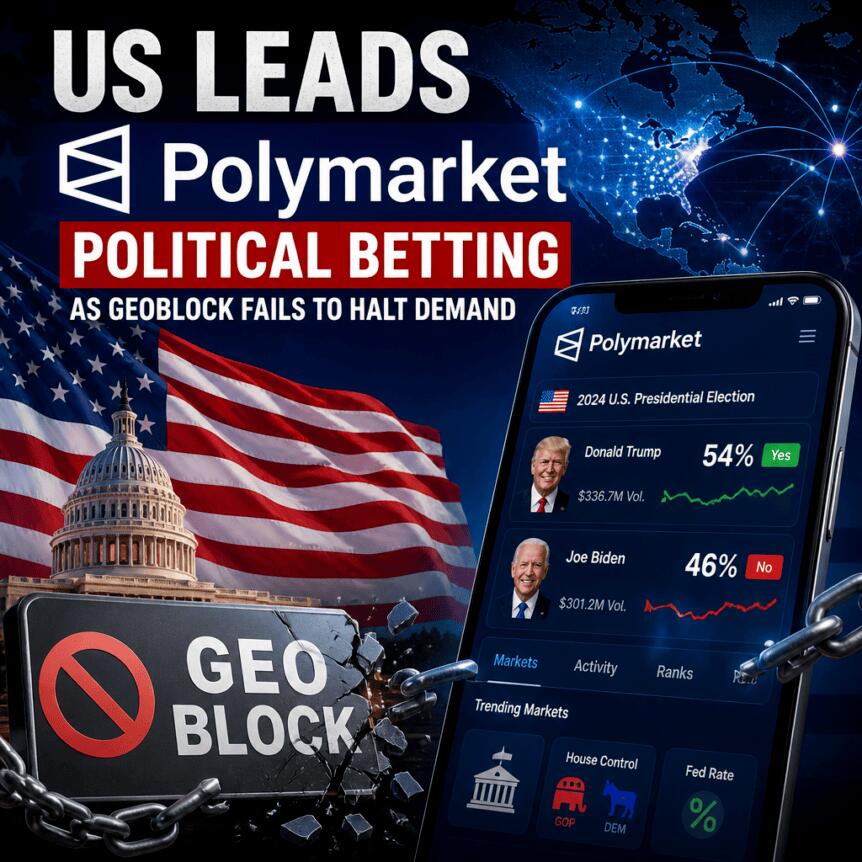
US users remain the most active force behind Polymarket’s political prediction markets, even after the platform moved to geoblock Americans from its global, decentralized service. New analysis from blockchain research firm Allium finds that the United States is the largest single country for political contracts on Polymarket when measured by trading volume and wallet participation—suggesting the demand simply shifted outside formal US oversight.
The findings add another layer to the regulatory and compliance challenges surrounding Polymarket, which has already faced scrutiny from US authorities and was compelled to restrict access under a settlement with the Commodity Futures Trading Commission (CFTC) in 2022.
Key takeaways
- Allium’s report ranks the US as Polymarket’s biggest political market by both contracts traded and wallet count.
- Despite access restrictions, the study argues that US demand did not disappear—it moved offshore.
- US traders appear more drawn to foreign conflict-related markets, with Iran-war themes dominating the top US markets by volume.
- Election-focused markets attract less US participation on the global Polymarket, where such markets are comparatively more prominent on Kalshi and Polymarket US.
- Independent research has previously estimated a large share of Polymarket activity originates from the US, even with geoblocking and VPN countermeasures.
US activity persists after Polymarket’s geoblock
Allium’s analysis, published on Thursday, estimates that US-based users form the largest single political crowd on Polymarket across all countries it tracks. The report emphasizes that this is based on tagged wallets—specifically, the 6% of wallets Allium could associate with a country—so the figures are directional rather than definitive.
Still, Allium frames the result as a clear outcome of Polymarket’s restrictions. Blocking access, the firm argues, did not stop US participation; instead, it concentrated it into a way that makes the US look even larger by volume within the offshore-access model.
“Blocking access did not end US participation; it made the US the largest single political market on Polymarket by volume,” the report said. “The demand is still there, now offshore and beyond US oversight.”
This is an important distinction for investors and market participants watching the political prediction market space: the restriction regime may be affecting where and how US users participate, but it has not eliminated US influence over global outcome bets.
Foreign conflict markets draw more US bets than elections
Allium’s breakdown suggests that US participants disproportionately favor foreign conflict-related topics. In the report’s assessment, five of the top 12 markets for US users by notional volume relate to the Iran war.
At the same time, US interest in election-related markets appears comparatively weaker on Polymarket’s global platform. Allium notes that election markets are a category that is allowed on Kalshi and Polymarket US—meaning the global audience’s incentives and the market landscape may differ from what US users most actively trade.
“US money pours into foreign wars, lately Iran, and largely skips the elections the global crowd trades,” said Allium.
For readers tracking adoption and behavior in prediction markets, the takeaway is not just who is trading, but what they are trading. If US demand continues to show up most strongly in geopolitical risk and away from election positioning, that may shape how liquidity, volatility, and information demand evolve across the different platforms.
Polymarket US vs. the global platform: restrictions and regulatory pressure
Allium’s report also clarifies an often-confused distinction: Polymarket US is a US-regulated platform launched in December and offers a narrower selection of markets. The research discussed here concerns the global Polymarket environment, where access was curtailed for US users.
Polymarket was forced to cut off US users from its global platform as part of a $1.4 million settlement with the CFTC in 2022. That enforcement backdrop has continued to cast a spotlight on how prediction market operators handle jurisdictional boundaries and user verification.
Cointelegraph previously reported that US policy makers and regulators have raised concerns about Polymarket, including issues connected to its marketing and compliance approach. Those broader concerns remain relevant in light of Allium’s findings that US involvement has not gone away—only changed form.
Evidence from other researchers: US share remains large
Allium’s results align with an earlier study by Rutgers University statistician Harry Crane. In a June publication, Crane estimated that 30% of Polymarket trading volume comes from the US, despite Polymarket blocking US-based IP addresses and VPNs that can be used to bypass geofencing.
Crane’s analysis estimated that US-based traders sent between $10.6 billion and $26.7 billion through Polymarket between May 2025 and April 2026. The researcher tied activity to likely US participants by comparing trade timing and the specific markets where trades occurred.
There have also been reports that Polymarket has moved to clamp down on VPN usage by blocking certain IP addresses associated with VPN services, reinforcing the idea that the company is actively attempting to reduce circumvention. However, the existence of US-heavy participation in outcome bets—whether directly or via offshore access—suggests countermeasures may not be fully effective.
Where Polymarket is blocked and where it is “close only”
Geographic restrictions are not limited to the United States. Polymarket is completely blocked in more than 34 countries, with Spain cited as the latest example where authorities took action as a “precautionary measure” while investigating whether the companies are operating without necessary licensing.
In an additional tier, four countries—including Singapore, Thailand, Taiwan, and Poland—operate under “close only” rules. In those jurisdictions, users can close existing positions but cannot open new trades.
Polymarket also maintains restricted regions within countries, according to published information: Ontario in Canada, and Crimea, Donetsk, and Luhansk in Ukraine, where Polymarket is blocked locally but remains accessible elsewhere in the same nation.
These layers of access—complete blocks, close-only allowances, and region-level restrictions—highlight how uneven enforcement and licensing frameworks can be across jurisdictions. For traders, it means the practical reach of a prediction market can remain broader than what top-line policy statements might suggest.
Going forward, the key question is how Polymarket will adapt its geoblocking and compliance tooling as scrutiny grows. Readers should watch whether enforcement tightens enough to materially change participation patterns—or whether US influence continues to reappear offshore in ways that keep global political markets effectively driven by the same demand.