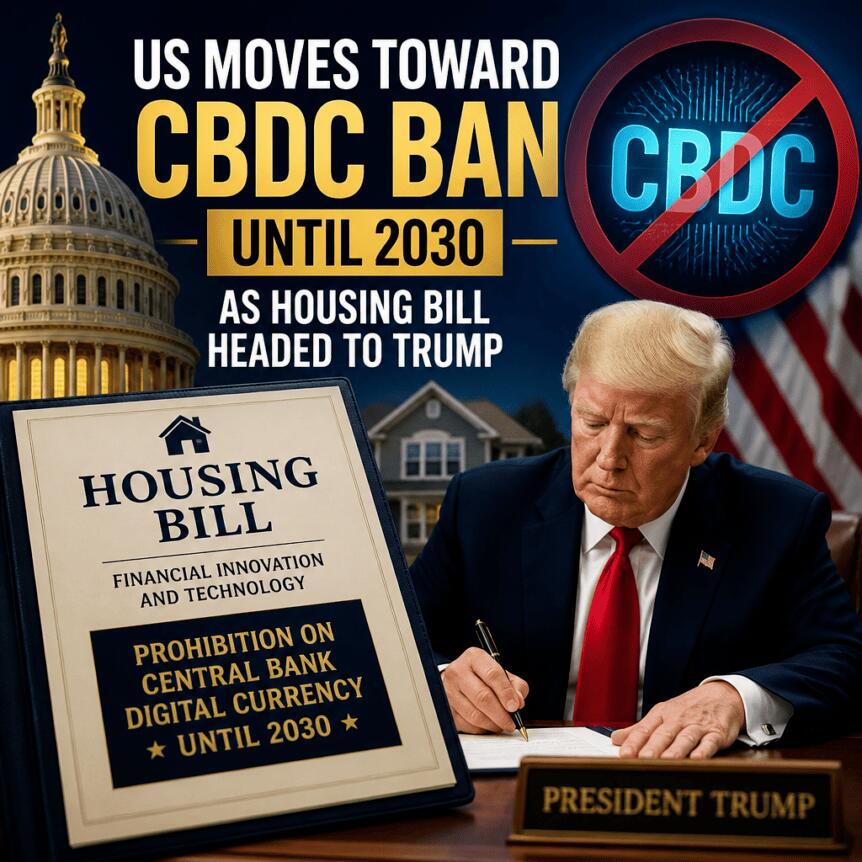
The U.S. House has passed the 21st Century ROAD to Housing Act, a sweeping housing package that also contains a prohibition on central bank digital currencies (CBDCs) through the end of 2030. The vote, 358-32, sets up final approval by President Donald Trump after the bill cleared the Senate the prior day.
Supporters framed the measure as a way to prevent the Federal Reserve from issuing or creating a CBDC-like digital asset, while crypto advocates have argued the restriction protects decentralization-focused technology from being repurposed into a centrally controlled financial system. The bill now moves to the White House, where Trump has signaled support and is expected to sign it.
Key takeaways
- The House approved the 21st Century ROAD to Housing Act by a wide margin (358-32), following a Senate passage of the same bill.
- The legislation blocks the Federal Reserve from issuing or creating a CBDC—or a “substantially similar” digital asset—until Dec. 31, 2030.
- A carve-out allows certain dollar-denominated crypto stablecoins that are “open, permissionless and private.”
- Republicans have pushed CBDC restrictions for years, reviving earlier language linked to the Anti-CBDC Surveillance State Act.
- With this bill moving off the congressional agenda, attention may shift toward other major crypto-related legislation, including the CLARITY Act.
Housing bill carries a CBDC restriction through 2030
According to the House Clerk’s office, the House vote on Tuesday sent the 21st Century ROAD to Housing Act to the President’s desk. The Senate had already approved the bill the day before in an 85-5 vote, per prior coverage from Cointelegraph. The fast track underscores how the CBDC language became a central point of negotiation alongside housing affordability priorities.
The clause at the center of the crypto debate would bar the Federal Reserve—directly or indirectly—from “issuing or creat[ing] a central bank digital currency or any digital asset that is substantially similar” to a CBDC. The limitation is scheduled to end on Dec. 31, 2030.
In remarks carried by the Senate Banking Committee, Chairman Tim Scott described the bill as a win for families and said he expects President Trump to sign it into law. (The statement was attributed to the Senate Banking Committee’s announcements.)
What “substantially similar” could mean for future digital money
The practical impact of the restriction hinges on how lawmakers and regulators interpret the phrase “substantially similar.” Even without naming specific technologies, the language is broad enough to cover more than a straightforward CBDC rollout—potentially catching digital-asset initiatives that share core characteristics with a CBDC, even if they are branded differently.
For investors and builders, that uncertainty matters because central-bank and government-backed payment experiments can shape liquidity flows, compliance expectations, and institutional adoption. A legislative pause through 2030 may reduce the likelihood of a CBDC becoming an immediate policy priority, but it does not eliminate regulatory interest in tokenized settlement or digital payment infrastructure. Markets typically watch not only whether a CBDC is authorized, but also whether comparable projects emerge in alternative forms.
At the same time, crypto proponents have positioned the ban as a safeguard against attempts to translate decentralized ledger concepts into government-controlled rails. By putting the restriction into a housing bill, the measure also signals that CBDC opposition has become politically durable enough to be included in unrelated legislation.
Stablecoin carve-out introduces a notable exception
While the bill curtails CBDC activity, it also includes an exception for certain stablecoins. The legislation permits “dollar-denominated currency” that is described as open, permissionless, and private.
That carve-out is likely to influence how compliance teams and product developers think about stablecoin eligibility under future policy constraints. Rather than a blanket prohibition on dollar-pegged digital assets, the language focuses on accessibility and privacy characteristics—terms that could determine whether particular stablecoin models are viewed as within the exception or outside it.
For market participants, this split—CBDCs broadly constrained while select stablecoins are explicitly accommodated—may preserve room for continued growth of private-sector dollar digital assets. It also suggests lawmakers were seeking a balance: limiting central bank authority over retail-facing digital money while avoiding an outright conflict with existing stablecoin ecosystems.
Legislation revives earlier CBDC ban efforts; attention shifts to CLARITY
The CBDC restriction is not entirely new. The bill’s language revived concepts associated with Republican Representative Tom Emmer’s Anti-CBDC Surveillance State Act. That earlier proposal was introduced in June 2025 and reportedly passed the House in July of that year, but it did not progress in the Senate.
According to prior reporting from Cointelegraph, lawmakers had reached a deal on the housing package after House and Senate leadership previously disagreed on multiple aspects of the bill. The CBDC ban remained in the evolving text, and it was included in the version the Senate passed in March before being carried forward into the final compromise.
With the housing bill now on its way to the President, congressional bandwidth may be redirected to other crypto policy priorities—particularly the Senate’s crypto market structure bill known as the CLARITY Act. Earlier this year, lawmakers and stakeholders held months of discussions involving crypto and banking lobbyists, but progress has reportedly faced resistance.
In separate coverage, Cointelegraph noted that Galaxy Digital lowered its estimate for CLARITY Act passage odds to 60% earlier this month as the congressional calendar tightens. That downgrade reflects the broader reality that even with strong interest from parts of the industry and some lawmakers, time and political leverage can become binding constraints as the August recess and November midterm elections approach.
Now that a major CBDC restriction has advanced, political attention may sharpen around whether CLARITY can move before competing legislative priorities take over—and whether any new compromises will be required to bridge remaining disagreement.
For readers tracking U.S. crypto policy, the next key question is how regulators and market participants interpret the stablecoin carve-out and the breadth of the “substantially similar” language regarding CBDC-adjacent initiatives—especially as Congress approaches the later stages of its 2030-related policy horizon.