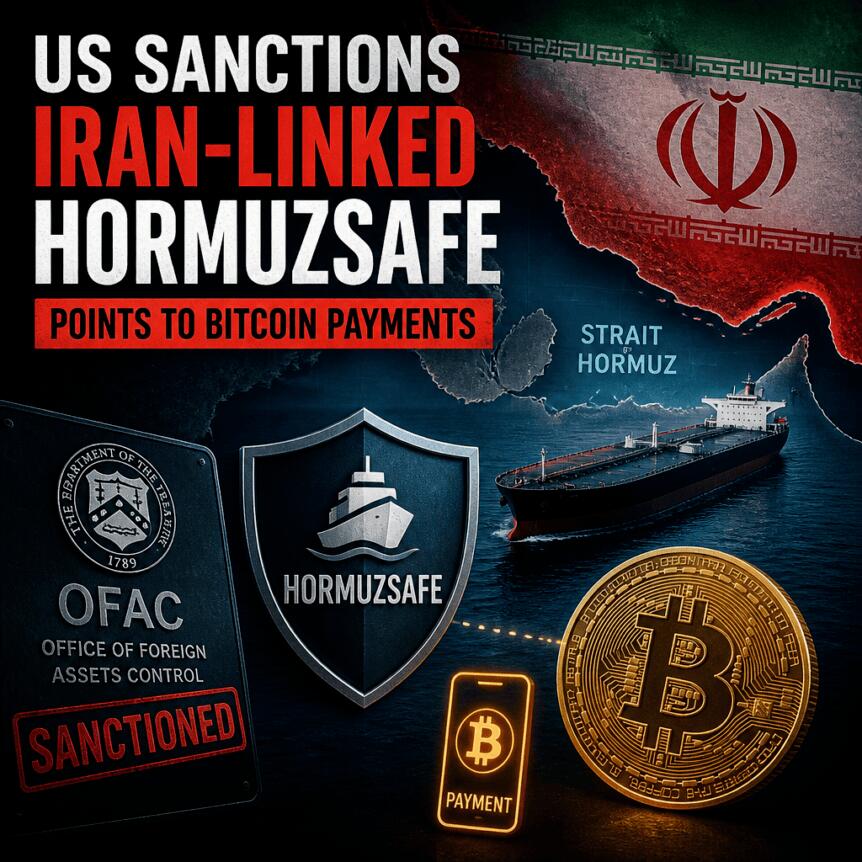
The U.S. Treasury has sanctioned two Iranian maritime insurance-related companies, alleging they are part of an Islamic Revolutionary Guard Corps (IRGC)-backed network that used cryptocurrency payments to help evade Western sanctions. In its action, the Treasury said one of the firms accepted Bitcoin and other digital assets from commercial vessels as part of a requirement to obtain approved coverage before transiting the Strait of Hormuz.
The designations were issued by the Treasury’s Office of Foreign Assets Control (OFAC) on Wednesday. OFAC named Persian Gulf Marine Insurance Company and HormuzSafe Marine Services Authority as entities it says were “integral” to an IRGC-aligned insurance structure targeting shipping flows through one of the world’s most strategically important chokepoints.
Key takeaways
- OFAC sanctioned two Iranian maritime insurance firms, alleging they supported an IRGC-linked network requiring approved coverage for vessels transiting the Strait of Hormuz.
- OFAC alleges HormuzSafe accepted Bitcoin and other crypto as part of efforts to bypass sanctions while generating revenue for the IRGC.
- The action follows earlier reporting and speculation that Iran was exploring crypto-based maritime insurance or payment mechanisms for ships moving through the strait.
- Treasury also expanded the campaign by sanctioning additional entities tied to Iran’s “shadow fleet” and identifying vessels as blocked property.
Treasury alleges a crypto-enabled insurance gate for Hormuz shipping
According to the U.S. Treasury, Persian Gulf Marine Insurance Company and HormuzSafe Marine Services Authority were connected to a sanctions-evasion scheme tied to maritime traffic in the Strait of Hormuz. OFAC said the network operated by requiring commercial vessels to buy approved insurance before proceeding through the waterway—effectively positioning insurance as a control point for shipping.
OFAC further stated that the companies were designated for operating in Iran’s financial sector and that the alleged network helped channel revenue in support of the IRGC. In its announcement, Treasury described the broader objective as enabling Iran to exert greater leverage over shipping through the strait while sidestepping U.S. and allied restrictions.
Treasury Secretary Scott Bessent framed the move as a response to threats to global commerce, saying the United States “will not allow Iran to hold global commerce hostage.”
From reported proposal to sanctioned service
The sanctions come after earlier reports that Iran was considering a Bitcoin-based maritime insurance platform. On May 18, screenshots of a HormuzSafe website circulated online, reportedly offering “digital insurance” for maritime cargo with policies payable in Bitcoin. At the time, coverage noted that the platform’s accessibility was limited when checked, and reporting suggested Iran was still evaluating the model.
State-linked media at the time, including Fars News Agency, suggested the proposed system could generate substantial revenue by issuing insurance policies and certificates related to financial responsibility. While those earlier reports were speculative and based on online materials, Wednesday’s OFAC action indicates U.S. authorities believe the crypto-enabled insurance structure was already being used—or at least that it was sufficiently operational to warrant enforcement.
For investors and market participants, the key implication is less about near-term price moves and more about how sanctions enforcement is increasingly targeting payment rails. If maritime insurance functions as a gatekeeper for transit, then the Treasury’s focus on crypto payment acceptance suggests regulators are monitoring how sanctioned actors might monetize critical infrastructure chokepoints.
Why Bitcoin, and why insurance matters
OFAC said HormuzSafe accepted BTC and other digital assets as part of efforts to evade sanctions, alleging the platform generated revenue on behalf of the IRGC while strengthening Iran’s control over shipping through the Strait of Hormuz.
This approach aligns with a broader logic U.S. authorities have cited before: sanctioned entities may favor crypto because certain assets do not rely on a centralized issuer that can freeze balances. Earlier coverage had pointed out that centralized stablecoins could be frozen by issuers, while Bitcoin’s mechanics do not feature a central operator capable of directly blocking funds in the same way. The U.S. has previously acted against crypto tied to Iran, including by freezing USDT associated with Iranian activity.
Insurance is also an especially consequential lever in international trade. The ability to secure coverage can determine whether commercial vessels can transit restricted routes. In the context of the Strait of Hormuz—which earlier reporting noted handles about one-fifth of global oil trade—any system that influences access or compliance requirements can reverberate across energy logistics.
Earlier reporting cited the Bitcoin Policy Institute in relation to claims that Iran accepted oil toll payments using a mix of payment types including Chinese yuan, USDT, and Bitcoin. However, that earlier account also emphasized that there was no onchain evidence of Bitcoin payments occurring at the time. Wednesday’s enforcement therefore represents a shift from reported consideration to alleged operational enforcement.
Broader sanctions campaign: shadow fleet and blocked vessels
This latest OFAC action does not stand alone. The Treasury said it also sanctioned eight companies linked to Iran’s “shadow fleet” and identified eight vessels as blocked property. While the details of every entity and vessel were not repeated in Wednesday’s summary, the combined package signals a wider effort to disrupt maritime activity tied to sanctions evasion.
For the industry, this means compliance risk may extend beyond ship-to-ship transactions or cargo handling. If insurance approval is part of the operational workflow, then insurers, shipping counterparties, and compliance teams may face increased scrutiny and additional due diligence requirements—particularly around payment methods and counterparties involved in risk coverage and transit documentation.
It also highlights how sanctions enforcement is converging across sectors: Treasury’s approach ties together maritime control, financial services, and crypto payment channels in a single enforcement narrative.
What to watch next
Readers should watch for follow-on enforcement actions and for how shipping and insurance counterparties adjust their compliance processes, especially regarding any crypto-related payment requests connected to transit coverage through the Strait of Hormuz. The U.S. Treasury’s allegations suggest that regulators view digital asset rails not as a peripheral topic, but as part of the infrastructure that can enable sanctions-evasion in high-impact trade corridors.