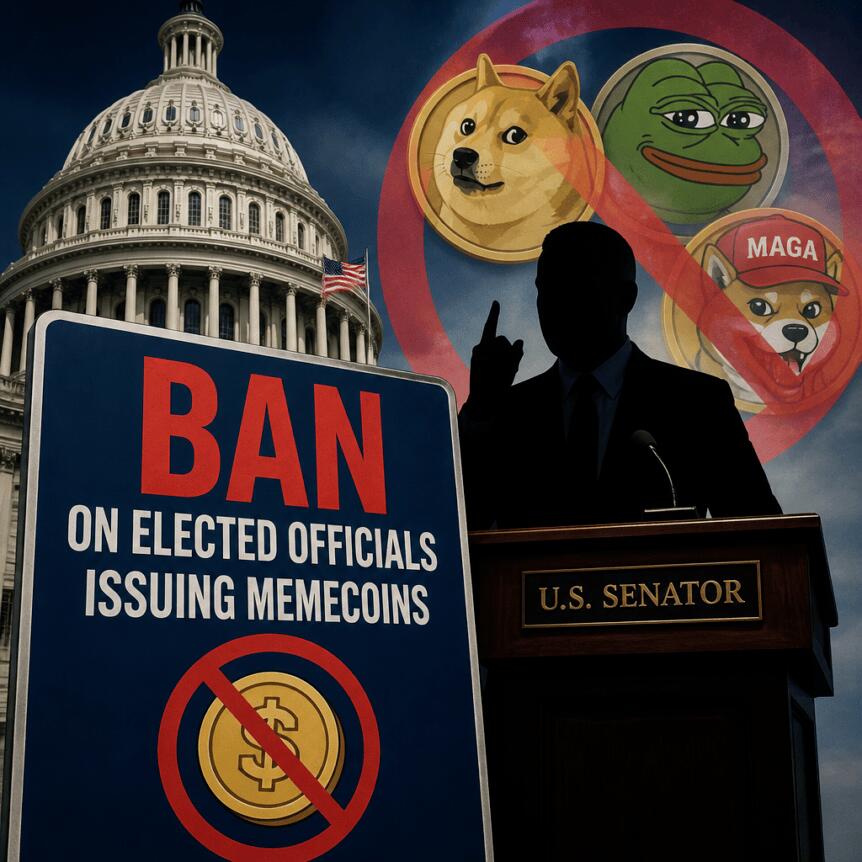
Senator Kirsten Gillibrand, a leading US lawmaker involved in negotiations on digital-asset market regulation, has proposed a new ethics rule aimed at preventing elected officials—and the president and their spouse—from issuing or backing their own tokens. The push comes as renewed scrutiny continues around conflicts of interest in the crypto space.
In a notice released on Friday, Gillibrand said Congress should consider legislation that would bar elected officials and their spouses from “issuing or sponsoring their own digital assets.” Her proposal specifically covers the US president and their spouse, while not clarifying whether the restriction would also apply to other family members or, for example, the vice president’s office.
Key takeaways
- Senator Kirsten Gillibrand is calling for a ban on elected officials and their spouses issuing or sponsoring their own digital assets.
- The draft she outlined would cover the president and the president’s spouse, according to her Friday statement.
- The proposal targets concerns about self-dealing and insider influence in crypto-related policy.
- Gillibrand’s ethics push ties into broader legislative negotiations around the Digital Asset Market Clarity (CLARITY) Act, where ethics issues have contributed to delays.
- The new restriction does not explicitly extend to other relatives, even as other criticisms have focused on family involvement in crypto-linked activities.
A targeted ethics rule aimed at token issuance
Gillibrand framed her proposal as a practical safeguard for a sector still working toward consistent federal rules. In her comments, she argued that officials and their spouses should not be able to issue memecoins, emphasizing the risk that personal financial incentives could undermine consumer protections and efforts to combat illicit activity.
Her statement links the ethics concern directly to conflicts of interest: she said “self-dealing” should not be allowed to weaken the policy work required to strengthen safeguards and expand financial access. Gillibrand also pointed to the broader public interest in ensuring enforcement and rulemaking are not distorted by insider advantages.
The senator’s notice also suggested that any workable solution must be broad enough to address the integrity of the legislative process, particularly when lawmakers have influence over market structure and consumer-facing rules.
How this connects to the CLARITY Act negotiations
Gillibrand is not introducing the idea in isolation. She is also among the lawmakers negotiating the Digital Asset Market Clarity (CLARITY) Act in the Senate—a bill that has reportedly faced delays linked to ethics concerns, tokenization questions, and how stablecoin incentives would be handled.
According to earlier reporting, Gillibrand expected the chamber to vote on the CLARITY Act by the Senate’s August state work period, but said no one would support the bill without addressing ethics concerns. Her reasoning centered on the possibility that elected officials could “get rich” from crypto markets due to their insider status.
That legislative backdrop helps explain why a narrower proposal about memecoin issuance by officials and spouses could still be politically important: it would target a concrete scenario—token sponsorship or issuance by those with rulemaking power—rather than leaving ethics questions as a vague debate.
Earlier coverage from Cointelegraph noted that lawmakers were wrestling with ethical and structural concerns in the broader package, including issues related to tokenization and stablecoin-linked rewards.
GENIUS Act history and memecoin conflict concerns
Gillibrand’s latest proposal also aligns with a moment in the development of stablecoin regulation. During consideration of the Guiding and Establishing National Innovation for US Stablecoins Act (GENIUS Act) in 2025, she said that senators had removed provisions specifically targeting Trump’s connections to the crypto industry, including the president’s memecoin Official Trump.
At the time, Gillibrand said the memecoin was likely “illegal based on current law,” but she acknowledged that fully addressing Trump’s ethics problems would require a “very long and detailed bill.” Trump later signed the GENIUS Act into law in July 2025.
That history highlights a recurring tension in Washington’s approach to crypto ethics: even when lawmakers see potential conflicts, crafting a solution that both clears legal scrutiny and achieves political consensus can be difficult. Gillibrand’s new initiative appears designed to shorten that distance by creating a rule that directly restricts token issuance or sponsorship by officials and their spouses.
Trump’s response and the wider conflict-of-interest debate
The proposal arrives amid continued debate over whether crypto profits by political figures create improper influence. This week, Cointelegraph reported that Trump said he earned about $1.4 billion from crypto ventures in 2025, the same year he took office.
According to Cointelegraph’s earlier reporting, Trump also asserted there was “nothing illegal” and “nothing wrong” with profiting from investments as president, while not directly answering questions about perceived conflicts of interest. The underlying concern for critics is not only whether transactions are legally permissible, but whether they erode trust in policymaking when an official’s financial exposure is tied to the regulatory outcomes.
Gillibrand’s proposal also stops short of explicitly extending the ban to all relatives. While she focused on elected officials and spouses, other criticisms have targeted the role of Trump’s sons in crypto-adjacent ventures, including World Liberty Financial and American Bitcoin, as reported in the article’s discussion of prior controversy.
That gap may matter for supporters of stricter rules: if spouses and officials are barred, critics may still ask how regulators should treat token sponsorship that is effectively enabled through broader family involvement, especially where family-linked businesses or holdings can influence perception—even if not always statutory ethics triggers.
As the CLARITY and stablecoin-related policy agendas continue to evolve, the key question for investors, builders, and market participants is whether ethics restrictions become part of a final legislative package—or remain a recurring obstacle that slows major crypto bills. Watch closely for whether Gillibrand’s proposal gains bipartisan traction, and whether negotiators are willing to translate ethics objections into enforceable rules rather than leaving them to case-by-case scrutiny.