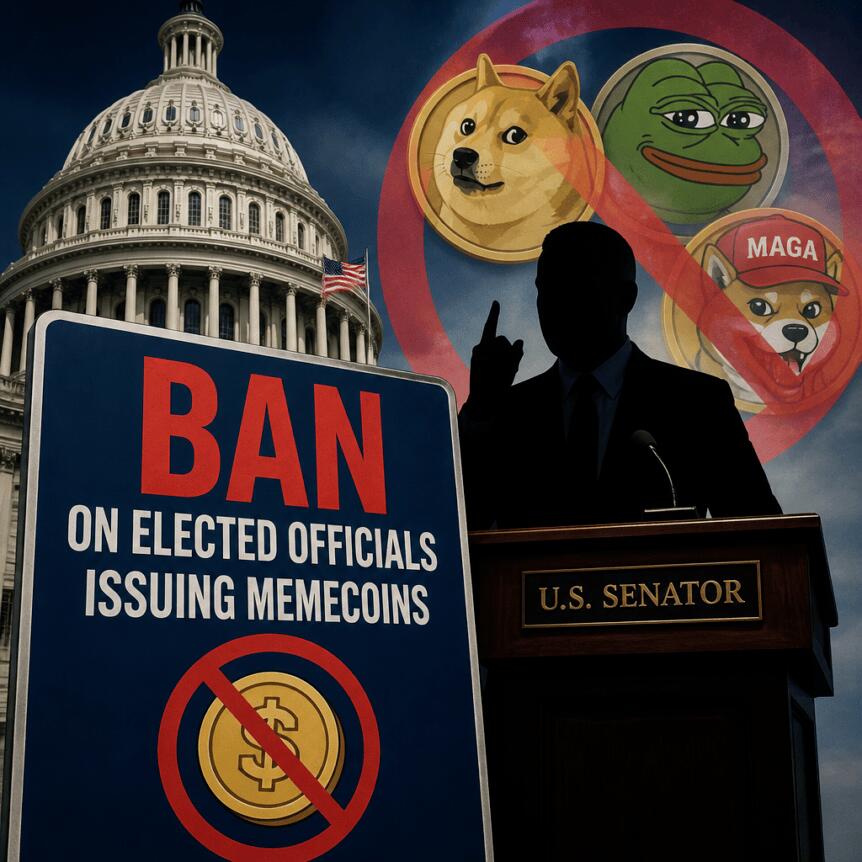
Senator Kirsten Gillibrand has renewed her push for tighter ethics rules around digital assets, proposing that elected officials—and the president and their spouse—be barred from issuing or sponsoring their own tokens. Her latest remarks explicitly referenced President Donald Trump and First Lady Melania Trump’s memecoin activity.
Gillibrand, a New York Democrat involved in negotiations over US digital asset legislation, said in a Friday announcement that Congress should consider measures preventing public officials from using their position to promote or benefit from token launches. The proposal focuses on “issuing or sponsoring” digital assets, and would apply to a president and their spouse; it did not spell out whether similar restrictions should cover the vice president’s office or other relatives.
Key takeaways
- Senator Kirsten Gillibrand proposed banning presidents and elected officials from issuing or sponsoring their own tokens, including memecoins.
- The restriction would clearly cover the president and their spouse, but the scope for vice presidents or other family members was not specified.
- Gillibrand links the idea to concerns about self-dealing, consumer protection, and efforts to curb illicit finance.
- Her comments come amid broader Senate work on digital asset market-structure and stablecoin legislation that has faced ethics-related scrutiny.
- The proposal follows shifting approaches in earlier legislation consideration around Trump-related crypto involvement.
Why Gillibrand is targeting token sponsorship by officials
In her Friday statement, Gillibrand argued that “public officials and their spouses should not be issuing memecoins,” framing the move as basic conflict-of-interest prevention rather than a partisan effort. She said the goal is to stop self-dealing from undermining consumer protections and complicating efforts against illicit finance.
The senator’s remarks emphasize the potential for elected officials to benefit from token-related projects that could be influenced by their access to policymakers, regulators, and legislative timelines. In her view, such concerns are especially urgent in markets that are still developing guardrails for disclosure, investor protections, and anti-manipulation enforcement.
Connection to the CLARITY Act and ethics as a gating issue
Gillibrand is also one of the lawmakers involved in negotiations on the Digital Asset Market Clarity (CLARITY) Act in the Senate. According to prior reporting, progress on the bill has been slowed by worries that extend beyond token rules themselves—particularly concerns about ethics, tokenization practices, and stablecoin reward structures.
Gillibrand previously indicated that the chamber could not move forward without addressing ethics questions, pointing to the risk that elected officials could “get rich” from insider access. In that context, the token-sponsorship proposal aligns with her broader stance that ethics constraints should be treated as foundational, not optional.
The senator’s framing also highlights a recurring legislative tension in the US crypto policy debate: how to extend oversight to new financial products while limiting opportunities for lawmakers to profit from the very markets they help shape.
How stablecoin and memecoin provisions were handled in earlier legislation
During consideration of the Guiding and Establishing National Innovation for US Stablecoins Act (GENIUS Act), Gillibrand said senators had removed provisions that specifically targeted Trump’s ties to the crypto industry, including his memecoin Official Trump. In her account at the time, the memecoin was likely “illegal based on current law,” but she suggested that trying to fully cover Trump-related ethics issues would require a “very long and detailed bill.”
Eventually, Trump signed the GENIUS Act into law in July 2025. Gillibrand’s new proposal suggests that even after that outcome—when lawmakers reportedly narrowed focus on Trump-specific provisions—ethics concerns have not gone away. Instead, she appears to be seeking a more general rule that would constrain future token issuance by officials and their spouses.
Notably, Gillibrand’s proposed memecoin restriction did not appear to be designed as a blanket ban covering all family members. The difference matters politically and legally: it shapes how broadly the rule could reach beyond a president’s spouse, while still addressing the most direct relationship that can be tightly linked to official influence.
Trump’s response and the wider conflict-of-interest debate
Gillibrand’s renewed comments arrive as Trump has continued to dismiss perceived conflicts of interest involving his crypto investments. This week, he reported that he earned about $1.4 billion from crypto ventures in the year he took office, while also holding the power to influence legislation that affects digital assets, including both the GENIUS Act and the CLARITY Act.
According to Trump, there was “nothing illegal” and “nothing wrong” with profiting from investments while serving as president, and he did not directly answer questions about the perceived conflicts. The contrast with Gillibrand’s position is stark: she argues that legality alone does not resolve the underlying ethical risk when public officials’ influence intersects with markets where their own token or sponsorship interests could be monetized.
The broader backdrop also includes criticism of involvement by Trump’s sons in crypto-adjacent ventures, including their connection to World Liberty Financial and a Bitcoin mining company described as American Bitcoin. While Gillibrand’s new proposal does not explicitly extend to those broader family circumstances, it reinforces that lawmakers and watchdog voices remain focused on whether personal ties to crypto create unfair advantages or distort policy incentives.
For investors and builders, the practical significance of Gillibrand’s proposal is straightforward: if adopted, a ban on token issuance or sponsorship by officials (and a president’s spouse) could reduce expectations of politically driven token promotion. It may also shape how exchanges, issuers, and intermediaries approach compliance and disclosure when influential figures are involved.
Still, much remains uncertain. Key questions include how “sponsoring” would be defined in law, whether enforcement would rely on existing securities and commodities frameworks, and—if a rule passes—how much legislative time it would take to harmonize it with the ongoing CLARITY Act process. Readers should watch how ethics language evolves in both the market-structure and stablecoin bills, and whether lawmakers treat conflict-of-interest guardrails as a prerequisite rather than an afterthought.