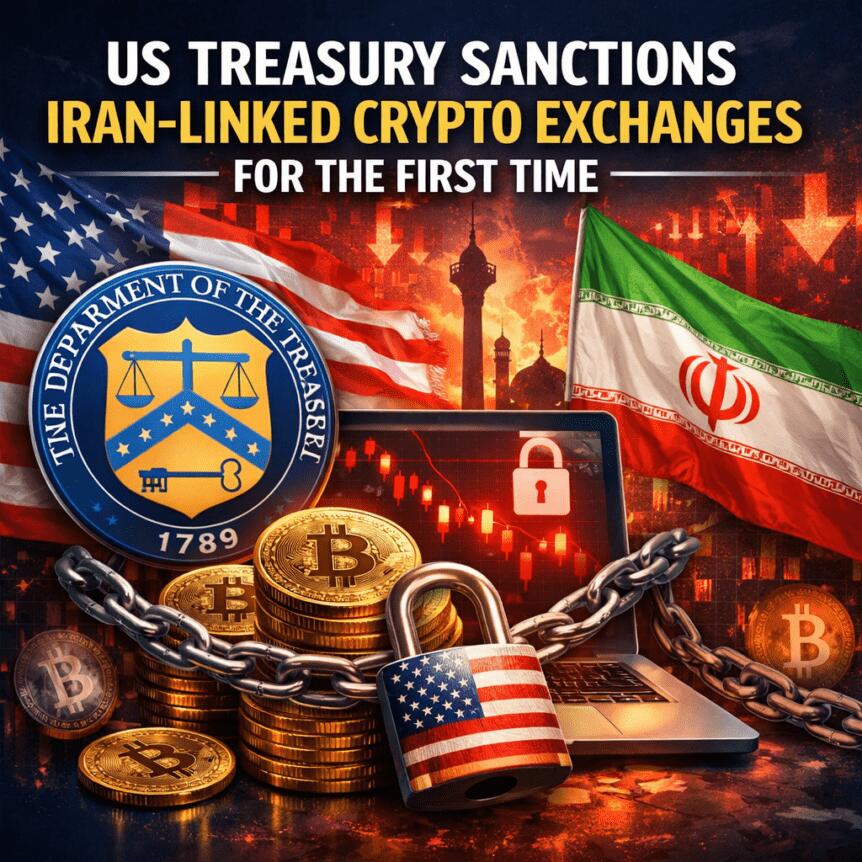
The United States tightened its Iran sanctions regime by targeting digital asset platforms for the first time, signaling a new phase in how financial enforcement leverages crypto infrastructure. In a Friday statement, the Treasury Department’s Office of Foreign Assets Control (OFAC) announced the designation of two UK-registered cryptocurrency exchanges—Zedcex Exchange Ltd. and Zedxion Exchange Ltd.—as entities linked to Iran’s financial network and to individuals tied to the Islamic Republic’s broader apparatus. The move arrives as Tehran faces intense international pressure over internal repression and its use of alternative financial channels to skirt sanctions.
OFAC named Eskandar Momeni Kalagari, Iran’s interior minister who oversees the Law Enforcement Forces, among those sanctioned, arguing that Tehran’s leadership profits from a system that constrains its population while exploiting illicit finance routes. Treasury Secretary Scott Bessent—speaking in tandem with the designation—stressed that Washington will continue to target networks that enrich elites at the expense of ordinary Iranians and that digital assets are increasingly used to bypass traditional controls. The designation is part of a broader set of actions aimed at Iranian officials and networks accused of violently suppressing protests while moving funds through alternative channels.
In a related move, OFAC named Babak Morteza Zanjani, a prominent Iranian businessman whose prior embezzlement of billions from the national oil company led to a conviction. The Treasury alleges that after his release from prison, Zanjani was redeployed by the Iranian state to facilitate the movement and laundering of funds, providing financial support to projects tied to the Islamic Revolutionary Guard Corps (IRGC). The sanctions underscore a pattern officials say is aimed at cutting off illicit finance lifelines that feed both state operations and militant proxies.
On the sanctions’ reach beyond Iran’s borders, OFAC highlighted the designation of two UK-registered exchanges, Zedcex Exchange Ltd. and Zedxion Exchange Ltd., asserting that these platforms are connected to Zanjani and have processed substantial volumes of transactions linked to IRGC-associated entities. OFAC stated that Zedcex alone has handled more than $94 billion in transactions since its registration in 2022, illustrating how crypto exchanges can operate as cross-border conduits in sanctioned environments. This represents OFAC’s first designation of a digital asset exchange for operating in the financial sector of the Iranian economy, according to the Treasury.
Beyond the immediate sanctions, Treasury officials framed the action as part of a holistic effort to choke off the Iranian regime’s financial channels—particularly those that rely on digital assets to obscure flows or bypass traditional banking regimes. The department’s broader messaging has repeatedly stressed that Iran seeks to leverage crypto infrastructure to move money in ways that complicate enforcement, a concern that policymakers say risks enabling human-rights abuses and the funding of state security operations.
Amid these legal and geopolitical developments, the narrative surrounding Iran’s use of crypto remains nuanced. Last week, blockchain analytics firm Elliptic reported that Iran’s central bank had accumulated more than $500 million worth of USDt (USDT) during a period of severe economic stress, likely using the stablecoin to support the rial’s value or to settle international trade. The firm noted that the buildup coincided with a drastic depreciation of the rial, which lost substantial purchasing power over eight months. Elliptic suggested the central bank leveraged USDT on the local exchange Nobitex to buy rials, a mechanism that mirrors certain central bank activities in crypto markets. The dynamic highlights how state actors are integrating digital assets into traditional macro-financial management, particularly in environments where fiat liquidity is constrained and sanctions risk is high.
These developments come at a moment when the crypto ecosystem is increasingly entangled with state actors and sanctioned economies. The sanctions also occur against a backdrop of geopolitical tensions and debates over how crypto infrastructure should be treated under international law. While proponents of crypto-as-sanctions-buster argue that digital assets offer alternative avenues for trade and remittance, policymakers counter that these tools can shield illicit activity from traceability and complicate enforcement efforts. In parallel, the narrative surrounding Iran’s internet access and the potential for crypto to provide means of communication or financial support to citizens under strain adds layers of complexity to how sanctions are navigated in practice.
Why it matters
First, the OFAC designation signals a new enforcement frontier: digital asset exchanges are now explicitly within the crosshairs of U.S. sanctions policy. By naming the UK-registered platforms connected to IRGC-linked networks, authorities are sending a message that crypto gateways can be treated as integral pieces of a sanctioned economy, not merely as speculative venues. This raises the bar for exchanges and service providers seeking to operate in or with sanctioned jurisdictions, potentially impacting correspondent banking relationships, KYC/AML regimes, and cross-border settlement flows.
Second, the actions underscore how crypto tooling is entwined with real-world policy objectives. Tehran’s use of stablecoins to support a collapsing fiat regime demonstrates how blockchain rails can be repurposed to sustain international trade and domestic liquidity when conventional channels are constricted. The US government’s emphasis on tracing and cutting off these flows shapes the risk calculus for exchanges, liquidity providers, and fintechs that may otherwise engage with emerging markets under pressure.
Third, the episode has implications for transparency and compliance in a sector-wide sense. As regulators increasingly scrutinize the use of digital assets in sanctioned economies, market participants may face heightened scrutiny and operational constraints. This is especially consequential for firms operating in or adjacent to Iran and other high-risk jurisdictions, where the pressure points—compliance costs, reputational risk, and regulatory clarity—can influence strategic decisions about market access and product design.
Finally, the linkage to IRGC-linked financing and high-profile figures such as Kalagari and Zanjani frames crypto as not only a financial instrument but also a geopolitical vector. The intersection of energy revenue, state capacity, and digital asset flows illustrates why policymakers insist that sanctions enforcement must evolve in step with technology—ensuring that enforcement capabilities keep pace with new methods of fund movement and value transfer.
What to watch next
- Follow-up OFAC guidance and any additional designations related to Iran’s crypto ecosystem and IRGC-linked networks.
- Regulatory responses from crypto-licensing regimes in the United Kingdom and other jurisdictions that intersect with sanctioned entities.
- Independent analyses of how Iranian authorities adjust crypto usage, including shifts in stablecoin activity and cross-border settlements.
- Updates from financial security researchers on the adoption of crypto rails by Iranian state actors and the effectiveness of sanctions in constraining such flows.
Sources & verification
- OFAC press release announcing the sanctions on Zedcex Exchange Ltd. and Zedxion Exchange Ltd. (SB0375).
- Treasury statements and public remarks by Secretary Scott Bessent regarding targeting Iranian networks using digital assets.
- Elliptic report on Iran’s central bank USDT holdings and the use of stablecoins to support the rial.
- Public reporting on the designation of IRGC commanders and security officials as part of broader sanctions measures.
Sanctions mark a new frontier for crypto-enabled enforcement against Iran
The latest actions by the United States place digital asset platforms at the center of an evolving sanctions regime, illustrating how crypto infrastructure now functions as a strategic tool in geopolitical finance. By designating two UK-registered exchanges linked to Iran’s broader financial and security apparatus, OFAC is signaling that crypto markets cannot be treated as a separate or neutral domain when there are compelling policy grounds to cut off illicit finance channels. The designation also reflects a broader effort to disrupt the flow of funds that support the IRGC and allied networks, a priority for policymakers who argue that conventional channels are too easily exploited by those seeking to thwart international norms.
Equally, the sanctions illuminate how crypto can absorb macroeconomic pressures. Iran’s central bank reportedly accumulated substantial USDT reserves as the rial weakened, illustrating how stablecoins may serve as a bridge for liquidity and trade in a sanctioned economy. The intertwining of sovereign finance and crypto rails underscores the necessity for robust compliance frameworks that can distinguish legitimate, legitimate-use activity from illicit transfers, especially in markets where state actors possess both the motivation and the means to adapt digital assets for strategic purposes.
For market participants, the development signals heightened vigilance. Exchanges, wallets, and payment processors operating in or near sanctioned environments must reassess risk controls, customer onboarding, and network relationships. Regulators will likely continue to refine definitions of high-risk jurisdictions, while firms that can demonstrate clear, verifiable compliance trajectories may navigate the evolving landscape more confidently. In the broader crypto economy, these actions add another data point in the ongoing question of whether digital asset markets alter how sanctions are enforced, or whether they simply create new layers of complexity for policymakers, businesses, and users alike.