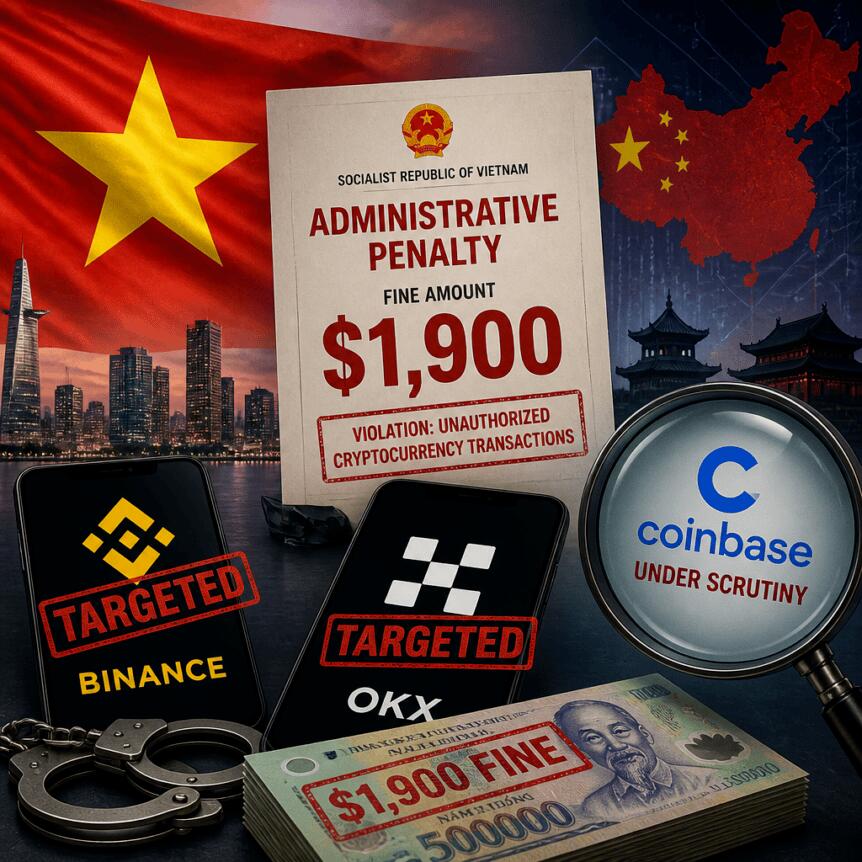
Vietnam is moving to tighten oversight of crypto trading by cracking down on retail users who access overseas platforms not licensed in the country. At the same time, lawmakers and regulators across Asia are continuing to reshape how digital assets fit into financial law—through new classifications, asset-management rules, and enforcement actions.
Below is a regional roundup of the most consequential policy and compliance developments highlighted across Vietnam, Malaysia, Japan, South Korea, China and Hong Kong, and Indonesia.
Key takeaways
- Vietnam plans penalties of up to $1,900 for retail crypto trading on unlicensed offshore exchanges such as Binance, OKX, and Bybit, ahead of a regulated market rollout that is scheduled to begin on September 1.
- Japan’s parliament has passed revisions that reclassify cryptocurrencies as financial assets, shifting oversight away from the Payment Services Act and introducing new compliance requirements.
- South Korea is seeking to include crypto within the country’s “national assets” framework by rewriting the State Property Act as a National Asset Basic Act.
- In South Korea, regulators have begun sanction procedures against Upbit operator Dunamu following a $30 million hack, while broader legislative gaps around digital asset failures remain under review.
- Malaysia’s immigration and local authorities are investigating an Israeli citizenship controversy tied to Network School in Forest City, amid claims that the venue has been used through second passports.
Vietnam sets penalties for retail trading on offshore exchanges
Vietnam’s Finance Ministry has outlined fines targeting retail users who trade crypto on unlicensed overseas platforms rather than using locally licensed exchanges. The proposed penalties can reach up to $1,900 for retail participants, depending on the specifics of the activity and the platform involved.
The enforcement focus extends beyond individual traders. Domestic investors who trade crypto assets designated exclusively for foreign investors can face fines up to $3,800. Meanwhile, crypto companies that provide or advertise services without a license—or fail to properly identify customers—or unlawfully handle crypto account data can be fined up to $7,600.
The policy is scheduled to take effect alongside a regulated digital asset market framework due to start on September 1. However, the sticking point is that Vietnam’s regulator has not yet issued exchange licenses for the regulated market, even though five exchanges have reportedly been approved “in principle.”
For investors and traders, this gap matters: penalties are aimed at use of unlicensed offshore venues, but the local licensing pipeline is still not operational. Market participants should watch closely for when Vietnam’s first regulated exchange licenses are formally issued and which products and investor categories each approved platform will be allowed to support.
Malaysia investigation highlights passport and visa compliance risk
Malaysia’s immigration authorities are investigating claims that Network School in Forest City—founded by Balaji Srinivasan and designed around the idea of “network states”—has been hosting Israeli citizens via second passports.
According to reporting linked in the source coverage, the allegations trace back to an activist group, Malaysia Protest 4 Palestine, which accused the school of operating as a “gathering place for Israeli entrepreneurs.” In response to the controversy, Srinivasan had threatened to remove the Network School and its associated investments from Malaysia, according to earlier international headlines mentioned in the source.
The Immigration Department said its investigation found that 266 foreigners have valid documents. Separately, the Johor state government is continuing its probe to ensure compliance with local rules, including business licenses, building usage, and commercial operations.
From a policy perspective, the episode underscores how quickly immigration, licensing, and nationality rules can collide with crypto-adjacent narratives and cross-border talent flows. While dual nationals holding Israeli passports are reported to be allowed “for now,” the controversy suggests scrutiny could intensify, potentially closing loopholes that make certain residency or entry routes easier than regulators intend.
Japan reclassifies crypto as financial assets
Japan has moved to tighten the legal framework around digital assets by passing revisions to the Financial Instruments and Exchange Act that reclassify cryptocurrencies as financial assets.
As described in the source coverage, this change takes crypto regulations out of the Payment Services Act. The shift is framed as a mixed outcome for market participants: it brings regulatory expectations closer to traditional finance (TradFi), including stricter enforcement and compliance burdens, while also changing the tax profile for holders.
One of the most immediate implications is enforcement. The source notes that unlicensed crypto platforms could face penalties of 10 million yen or up to 10 years in jail. A new ban on insider trading in crypto is also included, to be policed by the Securities and Exchange Surveillance Commission.
On the tax side, current crypto tax rates—reported as up to 55%—are expected to be reduced to approximately 20%, with a three-year carry forward for losses. However, the revised tax rules do not take effect until 2028.
This timing gap creates uncertainty for investors trying to plan around a trading and tax strategy that spans the transition. Market participants should consider how current tax treatment applies until the 2028 effective date, and whether future guidance clarifies how trading activity should be recorded across the regulatory transition.
South Korea proposes crypto inclusion in national asset management
South Korea is looking to formally expand the scope of state asset management to include both crypto and intellectual property. The Ministry of Economy and Finance announced it is rewriting the 1950 State Property Act into a National Asset Basic Act, which would define “national assets” in a way that explicitly embeds cryptocurrency.
The source coverage emphasizes that the older framework was developed during an economy centered largely on real estate, and that the update would shift emphasis from merely managing assets to generating value from them. The practical implications for the industry are straightforward: if crypto is treated as a category of national assets, it could influence how the state approaches custody, risk management expectations, and the boundaries of public participation or oversight.
Regulatory enforcement and legislative follow-through
South Korea’s broader regulatory direction also includes enforcement actions. The source notes that the Financial Supervisory Service (FSS) has started sanction procedures against Upbit operator Dunamu after the platform was hacked for about $30 million in November. The FSS is reportedly determining whether the incident violated the Virtual Asset User Protection Act, while the source highlights that the law may not provide sanctions specifically for hacks or IT failures.
The coverage further states that legislators are expected to address that oversight in a forthcoming Digital Asset Basic Act, with talks reportedly restarted after a four-month pause.
Alongside enforcement and legislation, the source includes other ongoing developments, such as extensions of victim compensation schemes to cover crypto scams and a proposal by tax authorities to establish clearer procedures for seizing self-custodied crypto wallets during investigations.
Coinbase verification shift for mainland China users
Separately, Wu Blockchain reports that Coinbase has opened up user verification for accounts solely based in China. Previously, Chinese users reportedly needed to provide a Hong Kong address; the source claims they can now verify using only a Chinese ID card and a Chinese address.
However, the report also states that China does not currently appear in Coinbase’s list of supported countries on its help documentation. That mismatch suggests either a narrow operational change or a staged rollout of verification capabilities that does not equate to full country support for services.
For users, the practical takeaway is to confirm eligibility directly during onboarding and to treat verification availability as distinct from whether all account features are accessible in a given jurisdiction.
Other regional updates: Hong Kong tokenized funds and Bybit’s Indonesia platform
In Hong Kong, the source notes that the territory approved its first crypto-native tokenized fund from Baillie Gifford, allowing professional investors to have direct blockchain-based ownership of underlying assets.
Meanwhile in Indonesia, the coverage says Bybit is launching a regulated platform following its acquisition of the local NOBI exchange. Bybit is reportedly retaining NOBI’s senior management team to run the Bybit Indonesia operation, signaling continuity on the operating side while shifting regulatory posture under the new ownership structure.
Across the region, the common theme is that regulation is tightening while timelines and operational gaps remain: Vietnam’s licensing is still pending even as penalties loom, Japan’s tax relief arrives years after the legal reclassification, and South Korea’s state-asset framework is taking shape alongside enforcement for platform security. The next signal to watch is how quickly regulators turn policy announcements into functioning compliance infrastructure—especially licenses, tax guidance, and enforcement standards that affect day-to-day trading and custody decisions.