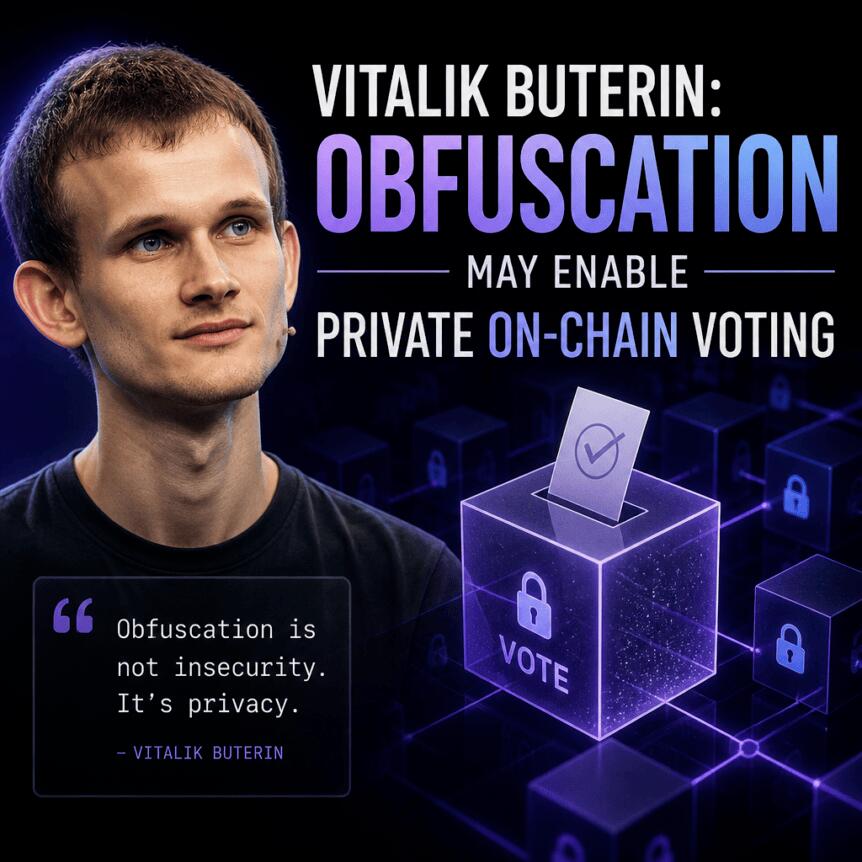
Ethereum co-founder Vitalik Buterin has laid out a longer-term cryptography blueprint for private, onchain voting that aims to avoid the need for a trusted group to handle ballots. In a technical essay published Monday, Buterin argues that a cryptographic technique known as indistinguishability obfuscation (iO) could let blockchain systems compute voting results while keeping individual votes hidden and limiting opportunities for collusion.
The proposal centers on replacing traditional threshold-style committees—groups that collectively decrypt encrypted votes—with protected programs designed to reveal only the final outcome. Buterin cautions, however, that the approach is not yet practical, with the most conservative versions requiring extremely heavy computation and faster variants depending on less-tested security assumptions.
Key takeaways
- Buterin’s proposal uses indistinguishability obfuscation (iO) to create “protected programs” that can compute vote tallies without exposing ballot contents.
- The design is intended to reduce reliance on threshold committees that jointly decrypt results, potentially lowering the trust needed for private onchain voting.
- Even with iO, blockchains remain essential because protected programs can’t stop being copied or support state updates on their own.
- Buterin describes current constructions as computationally impractical, positioning the idea as research direction rather than a near-term deployment plan.
From encrypted ballots to protected programs
Buterin frames iO as a method for hiding software logic. In his explanation, iO transforms a piece of code into a protected program such that others can run it to obtain the intended output, but cannot inspect the internal code or retrieve embedded sensitive data. He emphasizes that this approach focuses on concealing the program itself, rather than solely masking the data it processes.
In the context of voting, the idea would be to package the tallying and eligibility logic into an obfuscated program. Voters could submit encrypted ballots, and the system would execute the protected program to produce a final tally without exposing how individual participants voted. In effect, this would remove a key requirement of many private voting schemes: coordinating a set of operators (a threshold committee) that holds decryption capabilities and must behave honestly.
Buterin also notes that blockchains still have to do the heavy lifting for public coordination and evolving state. While iO can hide computation details, it cannot prevent copying or manage changing information by itself, so a blockchain—or similar distributed infrastructure—would remain necessary for the system to function over time.
Why dropping threshold committees matters
Private onchain voting typically involves operational trust assumptions, even when votes remain cryptographically protected. In many designs, groups of operators must safeguard information and follow the protocol correctly—particularly during decryption or tallying. Buterin argues that eliminating (or sharply reducing) the need for threshold committees could make decentralized governance more resistant to manipulation.
In his view, reducing this dependency could also lower the risk of insider interference and enable voters to participate without exposing voting behavior. However, the core promise is not only privacy for individuals; it is also a shift in who has meaningful control over the outcome. Instead of multiple parties jointly controlling decryption, the tally would be derived from running a protected program intended to reveal only what the system needs to disclose.
That said, the essay’s emphasis on security assumptions and computational feasibility underlines that the practical challenge is formidable. The approach is designed to minimize trust—but it still must be engineered so that security holds under realistic operating constraints.
Security trade-offs and why deployment is still out of reach
Buterin’s assessment is explicit: the idea, while conceptually aligned with “almost no trust assumptions,” is not ready for real-world use. He describes the most conservative constructions as requiring what he calls “galactic” amounts of computation—suggesting that the computational overhead would overwhelm any system intended for everyday participation.
He also points to a tension faced by cryptographic research more broadly: faster constructions tend to rely on weaker or less-tested security assumptions. In other words, an implementation that is technically feasible may not yet offer the same level of assurance as the most conservative theoretical design. This leads Buterin to characterize iO-based private voting less as a deployment-ready system and more as a long-term research direction.
For investors and builders watching Ethereum’s roadmap, the takeaway is that privacy research is moving toward more rigorous “how it’s computed” privacy—yet the path from cryptographic theory to production-grade systems will require major advances in efficiency and confidence in assumptions.
How this fits into Buterin’s broader privacy agenda
This iO voting essay builds on earlier work by Buterin linking advanced cryptography to stronger privacy and reduced coercion risk. In October 2024, he connected iO with private voting in an Ethereum roadmap he published, arguing that the technique could improve privacy guarantees.
He has also pushed for practical privacy steps within Ethereum’s ecosystem. In April 2025, Buterin proposed a more immediate privacy roadmap that called for integrating privacy tools into existing wallets. That proposal also advocated for stronger protections against data collection by infrastructure providers used by wallets to access Ethereum, reflecting an emphasis on privacy not just at the cryptographic layer but in the surrounding network services.
Buterin has additionally directed personal funds toward privacy-preserving projects. According to earlier coverage by Cointelegraph, on Jan. 30 he earmarked 16,384 Ether (ETH) (about $45 million at the time) to support initiatives focused on privacy, open infrastructure, and self-sovereign tools.
Read together, these threads show a consistent direction: privacy improvements are being pursued both through long-horizon cryptographic designs like iO and through nearer-term engineering changes that could reduce exposure to tracking and data collection.
For now, the most important question is what—if anything—can be improved to make iO-based voting computationally viable without sacrificing security confidence. Readers should watch for follow-up research that narrows the performance gap and clarifies which security assumptions would be acceptable for real deployments.