
U.S. Regulator Approves Spot Bitcoin and Ethereum Trading, Signaling Potential for Market Growth
The Commodity Futures Trading Commission (CFTC) announced on Thursday that spot trading of Bitcoin and Ether will now be conducted on its registered futures exchanges. This landmark decision marks a significant step toward mainstream acceptance and institutional involvement in the cryptocurrency market, paving the way for enhanced liquidity and market stability as the industry approaches 2026.
Key Takeaways
- Recognition by the CFTC grants Bitcoin and Ether a legitimacy comparable to traditional commodities, attracting institutional capital.
- Regulated US markets are likely to increase liquidity, reduce volatility, and bring crypto trading back onshore.
- The decision mirrors historic shifts seen in gold markets after regulatory clarity, potentially fueling long-term growth.
- Broader institutional exposure is expected, with increased participation from pension funds, banks, and hedge funds.
Bitcoin and Ethereum Can Scale Like Gold
Drawing parallels with the historical evolution of gold, the CFTC’s move echoes the 1970s shift that transformed gold from a fragmented over-the-counter commodity into a globally traded asset. When gold was introduced to regulated US futures exchanges, liquidity concentrated on the Commodity Exchange (COMEX), institutions entered extensively, and transparent pricing established a foundation for sustained long-term investment. Since then, spot gold prices have surged by over 4,000%, illustrating the transformative power of regulatory clarity.
The CFTC’s recent classification of Bitcoin and Ether as commodities aligns them with this framework, effectively removing issuer-focused regulatory barriers imposed by the Securities and Exchange Commission. Previously, US traders relied on offshore platforms like Binance, which captured over 41% of global spot activity, due to lack of regulated US venues. Now, with domestic approved markets, cryptocurrencies can develop a similar maturity to gold, supported by transparent, regulated trading environments.

Enhanced Institutional Exposure and Increasing Liquidity
The recognition of Bitcoin and Ether as regulated commodities opens the door for traditional institutional investors—pension funds, banks, and hedge funds—to treat cryptocurrencies on par with other CFTC-recognized assets. This move addresses long-standing gaps, providing standardized rules, surveillance, custody provisions, and investor protections. Results from a joint survey by Coinbase and EY-Parthenon reveal that 86% of institutional investors already hold or plan to gain exposure to cryptocurrencies, with most favoring regulated venues over offshore exchanges.
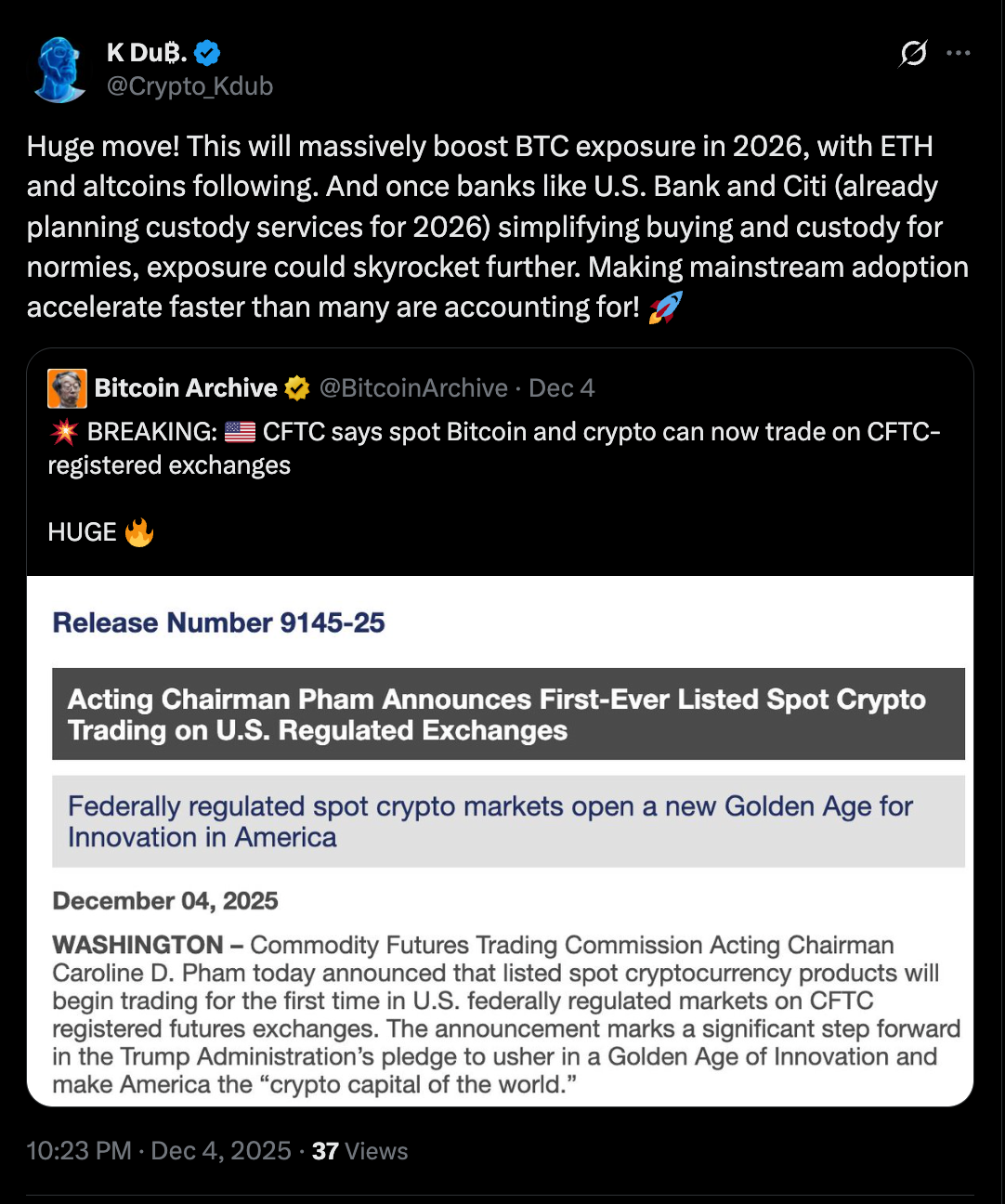
This regulatory clarity is expected to boost liquidity, attracting more US traders and market makers, which in turn will deepen order books and narrow spreads. Historical examples, such as the rapid expansion of WTI oil futures since their launch in 1983, demonstrate how regulatory approval can catalyze exponential growth in trading volumes. Daily trading of oil futures now exceeds one million contracts, highlighting the enormous market potential for cryptocurrencies as regulations facilitate larger participation and reduced volatility through increased order flow.
Ultimately, the move by the CFTC signals a pivotal moment for cryptocurrencies, encouraging greater integration into traditional financial systems and fostering a more mature, liquid market environment as the industry approaches 2026.