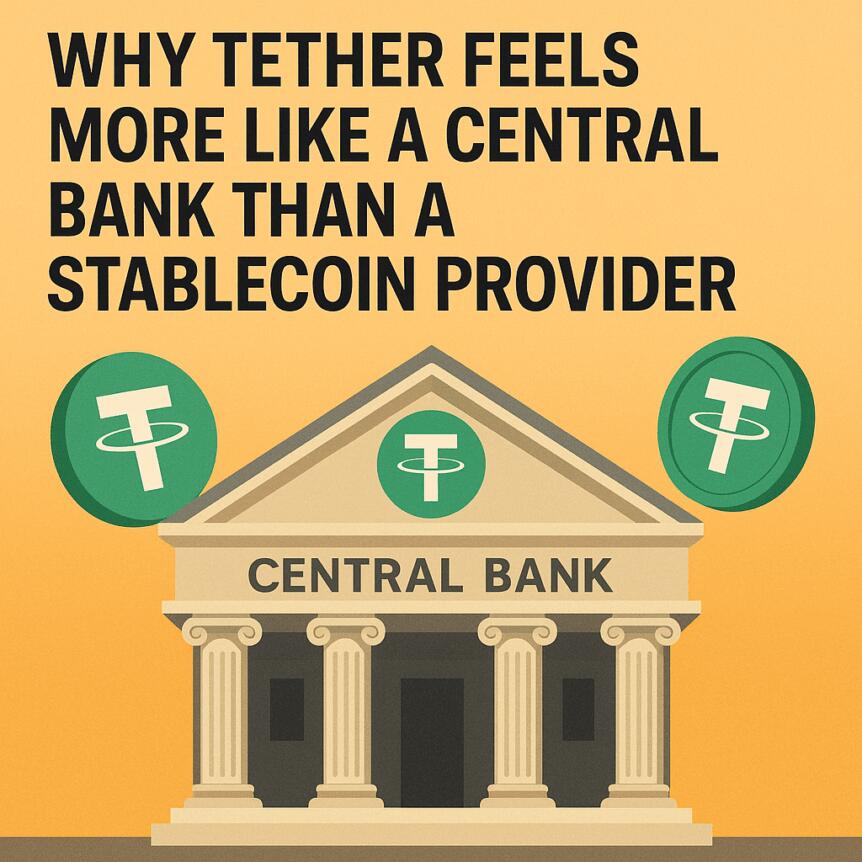
Cryptocurrency markets are continually evolving, with stablecoins like Tether playing an increasingly influential role. Recent disclosures reveal that Tether operates more like a private central bank than a traditional stablecoin issuer, managing a large and complex balance sheet, generating substantial profits, and exercising policy-like tools to navigate market and regulatory landscapes. This shift highlights the growing intersection between traditional finance and the crypto economy, raising questions about regulation, transparency, and systemic influence within digital assets.
Tether holds a reserve of $181.2 billion against liabilities of $174.5 billion, resulting in an excess of $6.8 billion, with reserves heavily invested in US Treasurys, gold, Bitcoin, and reverse repos.
In 2025, high interest rates have enabled Tether to generate over $10 billion in interest income — a level of profit uncharacteristic of typical crypto issuers, akin to a financial institution.
The company exercises policy-like measures, including freezing sanctioned addresses, adjusting blockchain support, and allocating profits to Bitcoin, resembling functions of a central bank.
Despite these similarities, Tether lacks a public mandate or backstop, relying instead on attestations rather than comprehensive audits, and depends on private counterparties for its reserve management.
Once focused solely on issuing stablecoins, Tether now functions as a significant financial entity within the crypto space. Its balance sheet comprises short-term U.S. Treasurys, reverse repos, gold, and Bitcoin, with the capacity to mint and redeem USDT at scale. Additionally, it can freeze addresses linked to sanctions, reflecting an active stance on compliance and security, akin to a private central bank.
Acting like a central bank: What does that mean?
In practice, Tether performs four activities that mimic central banking functions:
First, it issues and redeems stablecoins on demand: verified users can mint new USDT via fiat wire transfers or redeem them for USD, with the overall supply dependent on these processes. Secondary-market trading occurs on crypto exchanges, while the underlying balance sheet shifts through minting and redemption actions.
Second, it manages its reserves much like a fixed-income desk, predominantly holding short-term U.S. Treasurys and repos, with some gold and Bitcoin. This approach ensures liquidity and sustains demand for U.S. debt instruments in the broader financial ecosystem.
Third, it earns “seigniorage”-like profits by collecting interest on its Treasury holdings, providing Tether with a consistent income stream — over $10 billion so far in 2025 — and generating excess reserves of about $6.8 billion in the third quarter alone.
Finally, Tether employs policy-style tools such as contract-based functions to freeze or restrict address activity, especially in cases involving sanctions enforcement, and can adjust blockchain support to mitigate operational risks.
Expanding on policy levers that resemble central bank tools
Beyond that, Tether exercises intervention strategies similar to a central bank. It can freeze addresses associated with sanctioned entities or law enforcement notices, as part of a proactive compliance policy introduced in December 2023. It has already acted on cases such as wallets linked to Russian exchange Garantex, showcasing its ability to control dollar liquidity on-chain.
Its reserve management parallels open-market operations, maintaining a portfolio of mostly liquid U.S. Treasurys and repos to allow efficient minting and redemption. Profits are generated from high-yield holdings, bolstered by a carefully managed reserve profile that supports large-scale operations and excess capital buildup.
In addition, Tether has disciplined its blockchain activity by supporting and later winding down several networks, including Omni, BCH-SLP, Kusama, EOS, and Algorand, focusing liquidity where demand and infrastructure are strongest. Furthermore, it plans to launch USAT, a US-regulated dollar token—issued by Anchorage Digital Bank—to provide a compliant onshore US dollar alternative alongside USDT, signaling its ambition to expand within strict regulatory boundaries.
From stablecoin issuer to infrastructure player
In recent years, Tether has evolved beyond a simple stablecoin provider into a broader financial infrastructure operator. Since April 2024, it has been organized into four divisions: Tether Finance, Data, Power, and Edu. These units oversee digital asset services, data analytics, renewable energy projects, and educational initiatives, broadening its influence across the blockchain ecosystem.
On the energy front, Tether has invested in Volcano Energy in El Salvador, a wind and solar plant powering Bitcoin mining operations. It has also ceased support for several legacy blockchains to streamline its infrastructure focus and partnership strategies, prioritizing platforms with strong usage and development pipelines.
To further penetrate the US market, Tether announced plans for USAT, a US-regulated stablecoin issued by Anchorage Digital Bank, aiming to offer a compliant dollar token that coexists with USDT, which continues serving global users.
Why the analogy breaks
Despite its increasing resemblance to a central bank, Tether remains a private company without a sovereign mandate. It lacks the ability to set interest rates, serve as a lender of last resort, or implement macroeconomic policies. Its transparency relies on quarterly attestations rather than full audits, and it depends on private banking and custodial arrangements that are outside direct government control.
Additionally, some of its “policy-like” actions—such as freezing addresses—are primarily compliance measures rather than macroeconomic tools. The company’s dependency on private counterparts means market confidence revolves around its reserve transparency and operational stability.
In December 2023, Tether disclosed assisting law enforcement agencies in freezing over $835 million linked to illicit activities, exemplifying its active role in compliance but also highlighting the limits of its authority.
Where Tether fits in the bigger picture
Overall, Tether appears more akin to a private, dollar-denominated central bank within the crypto ecosystem—expanding and contracting supply, managing reserves, earning substantial profits, and exercising policy-like controls—though without formal sovereign backing. Its trajectory will be influenced heavily by ongoing reserve transparency, profit reports, regulatory developments, and the potential introduction of its onshore USD stablecoin in the US market. How it navigates these factors will determine whether it continues to resemble a central bank or diverges into a different role within the digital economy.