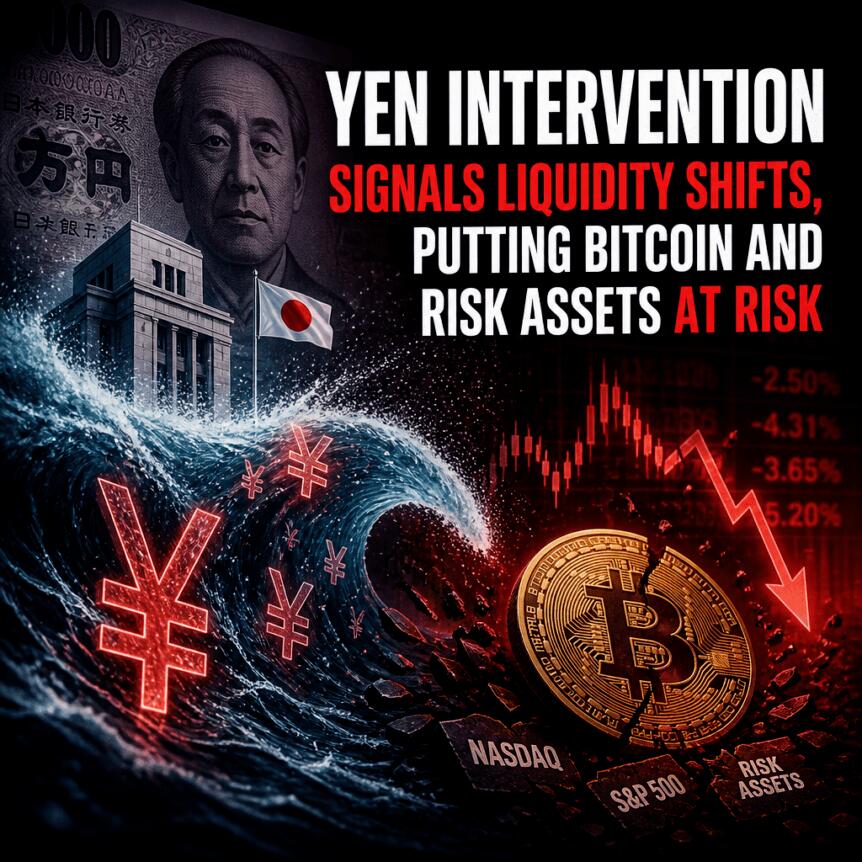
The United States and Japan have carried out a rare joint intervention to support the yen, and the follow-up messaging from Washington suggests the coordination is likely to intensify rather than fade after a single market move. For crypto markets, the key question is how the intervention affects global dollar liquidity and the balance-sheet stress that can follow when the yen carry trade unwinds.
Earlier this month, the US and Japan conducted their first joint yen intervention since the late 1990s, when the yen was still considered a different kind of funding currency. The event also reinforced the role of Fed-related dollar liquidity channels—an issue that matters to traders broadly, including those holding Bitcoin and other risk assets.
Key takeaways
- The first US-Japan joint yen intervention since 1998 sets a potential precedent for future coordination.
- Treasury Secretary Scott Bessent emphasized meeting with Bank of Japan Governor Kazuo Ueda ahead of the late-August G20 finance ministers session.
- Bessent highlighted the Fed’s FIMA repo facility as a “backstop” and urged that it be upsized to support dollar liquidity.
- Japanese two-year bond yields rose above 1.57% on Monday, signaling higher rates and increasing pressure on yen funding strategies.
- Crypto market participants view a possible end to the yen carry trade as a swing factor for liquidity conditions and risk appetite.
US-Japan coordination returns to the spotlight
Last week’s intervention was notable not only for its timing but for its design. According to reporting in the source, the New York Fed sold euros on behalf of the US Treasury, using the Exchange Stabilization Fund (ESF), a reserve pool used for currency stabilization activities. The practical goal was to support the yen, which had fallen to around 164 per US dollar—levels described as the weakest in roughly four decades.
That “first since 1998” framing matters because it hints at a shift toward deeper macro-policy coordination. If interventions become more common, markets may start pricing not just immediate exchange-rate stabilization, but longer-term expectations for policy alignment between Washington and Tokyo.
Bessent’s message: more planning, and more liquidity insurance
After the joint intervention, US Treasury Secretary Scott Bessent publicly drew attention to upcoming coordination with the Bank of Japan. He specifically said he planned to meet with BoJ Governor Kazuo Ueda during the G20 gathering of finance ministers in North Carolina at the end of August. Bessent’s post emphasized ongoing “close coordination” with Japan’s leadership and central bank.
Beyond the meeting itself, Bessent’s focus shifted to liquidity plumbing. He pointed to the Fed’s Foreign and International Monetary Authorities (FIMA) repo facility, describing it as an important backstop and arguing that it should be expanded “in the coming months.”
The core mechanism, as described in the source, is that the Fed provides dollars to foreign institutions. Those institutions can use Treasuries as collateral, which helps increase the supply of dollars outside the US without forcing sales of US Treasuries. For US Treasury markets, that distinction is material: if dollar liquidity support is delivered via repo channels rather than through abrupt Treasury market actions, the risk of destabilizing pricing and yields is reduced.
The yen carry trade unwind: why bond yields and liquidity collide
The yen carry trade has long depended on a relatively low-yielding yen funding base. The source argues that expectations have built around the trade’s gradual disintegration as Japan moves away from the prolonged era of very low interest rates.
A tangible indicator of that shift appeared in the domestic bond market. According to the article, Japanese two-year bond yields rose above 1.57% on Monday, a move interpreted as evidence that low-rate conditions are ending sooner than many markets had previously assumed. When yen yields rise, the economic logic of borrowing in yen and investing elsewhere becomes less attractive, increasing the probability of carry trade unwinds.
The liquidity angle is complicated. Carry trade unwinds can produce sharp cross-currency flows, which may temporarily tighten financial conditions for some market participants. Yet, Bessent’s emphasis on FIMA’s role signals a policy effort to prevent such stress from spilling into broader dollar funding markets—an effort that could support risk assets if it succeeds.
That tension is part of why reactions to the intervention were described as mixed in the source. Economist Mohamed El-Erian argued that Washington is now “bound into coordination” with the BoJ, suggesting that the effectiveness of the strategy may increasingly rely on a broader alignment within Tokyo—across the central bank, the Ministry of Finance, and the Prime Minister’s Office—rather than on US actions alone.
What this could mean for Bitcoin and risk assets
For Bitcoin, the immediate causal path isn’t direct—BTC doesn’t trade on yen carry trade mechanics. But liquidity conditions often influence how investors and institutions manage exposure to volatile assets. In that sense, the same macro levers that affect currency markets can still shape the risk environment for crypto.
The source highlights a particularly bullish hope circulating in Bitcoin circles: that a disorderly or at least notable yen carry trade unwind could ultimately tighten funding stress and reshape global liquidity in ways that benefit BTC. Even if that outcome is framed as a “bull case,” the pathway depends on whether policymakers can cushion the dollar-liquidity shock while also allowing yen stabilization to proceed.
At the same time, there are clear reasons for caution. If Japanese actions push up the cost of borrowing across markets—or if liquidity support via repo facilities proves insufficient—investors could see risk assets react to financial tightening rather than easing. The source specifically notes that Japan’s large holdings of Treasuries could raise yields if more Treasury-related sales occur, which would spill into broader borrowing costs. That’s why the emphasis on FIMA matters: it’s intended to support dollar liquidity without directly impairing Treasuries.
Watch points for traders and long-term holders
The next phase will likely be defined by two things: whether the US and Japan continue institutional coordination after the initial intervention, and how large and sustained any liquidity support becomes via the FIMA repo facility. Traders should also monitor Japanese short-end rates—such as the two-year area cited above—because they offer an early signal of how quickly funding incentives are changing and how much pressure remains for carry trade positions to unwind.