Brazil’s B3 has taken tokenization from concept to cattle pen. Earlier coverage of the exchange’s pilot highlighted how a farmer in southern Brazil used 10 tokenized cows as collateral to secure a loan of 100,000 Brazilian reais (about $19,600), effectively “herding” the animals into a blockchain-based custody arrangement.
The stunt went viral because it sounded absurd at first glance. But the broader implication is serious: if ownership and claims over physical assets can be expressed onchain—along with the permissions and verification needed to back financing—then tokenization can move beyond collectibles and test whether real-world collateral can be made more programmable.
Key takeaways
- B3’s tokenized-cattle collateral deal is positioned as a practical proof-of-concept for livestock-backed lending, even if the initial ticket size was relatively small.
- The strangest tokenization experiments—from onchain farts to burned art—show that the “token” can represent nearly any claim, but market liquidity depends on the legal and commercial layer.
- Projects that tie token value to auditable real-world data (such as sales performance or commodity trading rails) highlight what tokenization still needs: reliable verification and enforceable rights.
- Well-known cases like music royalty tokens and the first-ever tweet NFT illustrate that cultural novelty doesn’t automatically translate into durable investor returns.
Tokenization’s viral edge: when the asset sounds ridiculous
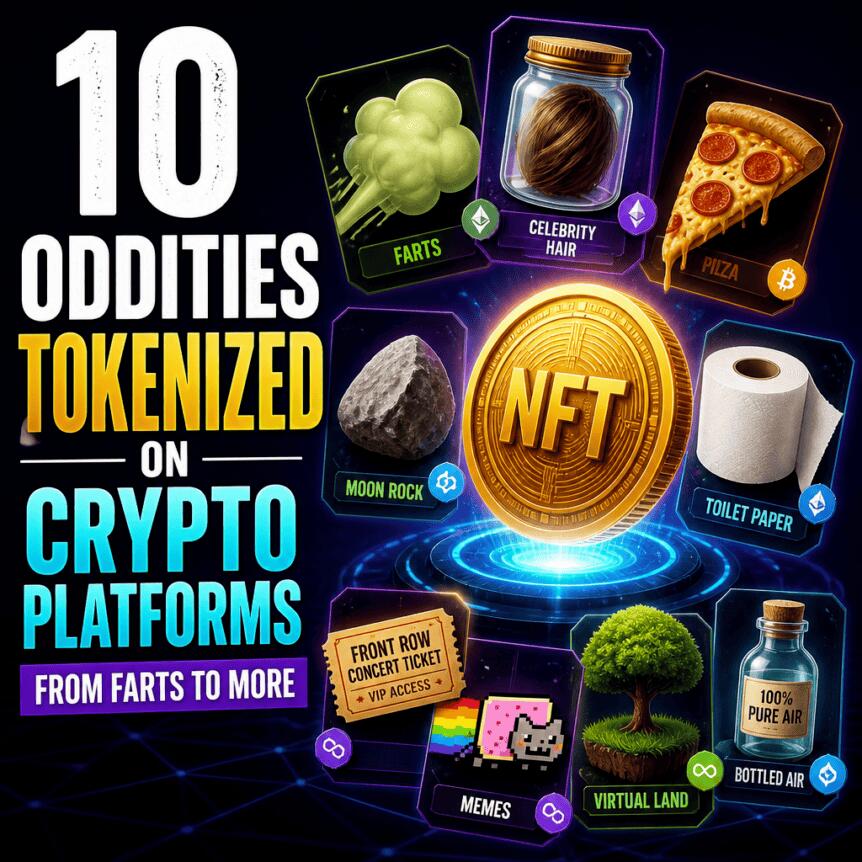
Not every tokenized asset is designed for institutional adoption. During the NFT boom, a filmmaker recorded his own farts during the pandemic and minted each sound as an NFT. He sold the pieces for 0.05 ETH apiece (around $85 at the time), turning something deliberately un-serious into a transaction with a clear price and buyer demand.
The point isn’t that flatulence will power mainstream finance. It’s that tokenization can package almost any item—or measurable event—into a transferable digital unit. The real question for investors and users is what that unit means legally and economically once the novelty fades.
Cows and the hard part: connecting blockchain claims to enforceable collateral
The B3 cattle story stands out because it wasn’t just a token minted for entertainment. The loan structure relied on a Brazilian investment fund, Target FIDC, which provided each cow with its own digital token linked to an encrypted digital identity. In effect, the tokens acted as an onchain representation of the collateral, while the real-world animal custody and contractual terms underpinned the financing.
Initial lending volumes cited in reporting pointed to a proof-of-concept that could scale: the first loan was about $19,600, and the pilot was framed as potentially supporting significantly larger livestock-backed financing if the model holds. Broader context also matters for future scope; agriculture is a major global economic sector, so the asset universe for collateral tokenization is far larger than cattle alone.
Still, this type of deal underscores a recurring constraint in real-world asset tokenization. Tokenizing an asset is not the hard part—building a system where rights are enforceable, transfer rules are clear, and the underlying data remains verifiable across counterparties is.
From whiskey and horses to uranium: the range of “real” claims
Some tokenization efforts target assets where scarcity and ownership transfer are familiar concepts—whiskey casks, for example. With whisky often increasing in value over time, projects have experimented with putting casks onchain so investors can buy whole units or fractional stakes, while the physical inventory sits in bonded warehouses. The appeal is straightforward: the token can simplify how ownership is divided and administered, even though investors still depend on the performance of the underlying market and storage arrangements.
Racehorses present a similar complexity. Tokenization can break ownership into shares, allowing investors to participate in prize money, breeding income, or proceeds from future sales without buying an entire animal. But luxury asset tokenization also invites skepticism about liquidity and legal continuity. As one comment attributed to Chris Turner, co-founder of impact investment firm KULA, put it: placing an item on a blockchain doesn’t automatically make it more liquid or valuable if the legal rights, transfer processes, and market structure stay the same.
Even commodities are being explored in this broader spectrum. Tezos-backed metals platform metals.io is described as targeting uranium by building “financial rails” for technology-flavored commodities, with reported trading activity between November 2024 and July 2026 totaling $21.5 million across roughly 18,200 trades and about 7,400 unique wallets. The reporting also suggested that institutional interest exists, but tokenized rails remain cautious—an important reminder that adoption can lag even when the infrastructure works.
When cash flows meet verification: fish revenue, royalties, and burned art
Some of the most instructive experiments are those that attempt to tie token value to verifiable real-world performance. Brickken, for instance, received an unusual proposal from a Chilean fish-processing company: issuing tokenized debt where interest payments would adjust based on verified fish sales. Brickken’s executive Edwin Mata described the concept as a tokenized, revenue-linked instrument where the token represents the lender’s contractual claim and the returns depend on independently verified sales performance.
In the end, the fish never moved fully onchain. The obstacle, as explained in the reporting, was that fish sales still depended on audits, commercial reporting, and legal agreements that could not yet be automated. That outcome highlights a crucial reality for tokenization: the bottleneck is often not the blockchain itself, but the reliability and operational readiness of the data and rights it depends on.
Music royalties followed a similar “promising but not mainstream yet” pattern. The earliest examples cited include 3LAU’s 2021 Royal platform initiative, and later use of Royal for selling streaming royalty rights involving rapper Nas. While onchain royalty concepts gained attention during the NFT boom, coverage noted that tokenized music royalties have not become a widely adopted asset class—an observation consistent with how streaming economics and distribution incentives can be misaligned with tokenholder returns.
Then there are the cases that make a philosophical point rather than a financial one. Burnt Banksy reportedly involved the purchase of a Banksy print, livestreamed destruction, and minting of NFTs to preserve the “ownership record” on-chain. In parallel, the broader debate around whether burning a physical asset destroys value or merely transforms the meaning of ownership became part of the story itself. Regardless of where readers land, these examples show that tokenization can outlive the underlying object—although that does not guarantee investor outcomes.
The NFT era’s headline assets: and what happened after the hype
The first tweet NFT is one of the clearest reminders that scarcity narratives alone don’t ensure strong performance. In 2021, Jack Dorsey tokenized and sold his first-ever tweet (“just setting up my twttr”) to Sina Estavi for $2.9 million, later becoming a symbol of the NFT boom. A year later, reporting noted Estavi attempted to resell it for $48 million but reportedly received bids far below the asking price, with an offered figure cited as $6,800.
That contrast—between blockbuster initial sales and much weaker subsequent bids—reflects what many market participants eventually learned: the ability to tokenize a claim doesn’t eliminate valuation risk. Tokenization can improve access, administration, settlement, and transferability, but it cannot turn a poor purchase into a good investment.
As tokenization continues to move from novelty to structured lending pilots like B3’s cattle collateral, readers should watch whether these systems can scale verification and legal enforceability without sacrificing usability. The next test will be less about what can be tokenized and more about what tokenized claims can reliably support in real financing and real secondary markets.