Cryptocurrency and blockchain advocates are watching the latest US midterm results closely, not because Washington’s politics are inherently new, but because control of Congress can determine whether stalled crypto legislation finally moves—or whether existing proposals face tougher opposition. With all 435 House seats and 35 Senate seats on the ballot, the next few hours are expected to clarify how President Donald Trump’s remaining two years in office may unfold legislatively.
For the crypto industry, the stakes are especially tied to the fate of the CLARITY Act, a stalled effort aimed at establishing a clearer market-structure framework for digital assets. Depending on which party wins control of either chamber, the industry could see either renewed momentum—or an escalation of scrutiny surrounding Trump’s own crypto-related activity.
Key takeaways
- All 435 House seats and 35 Senate seats are up for election, shaping the balance of power for the remainder of the term.
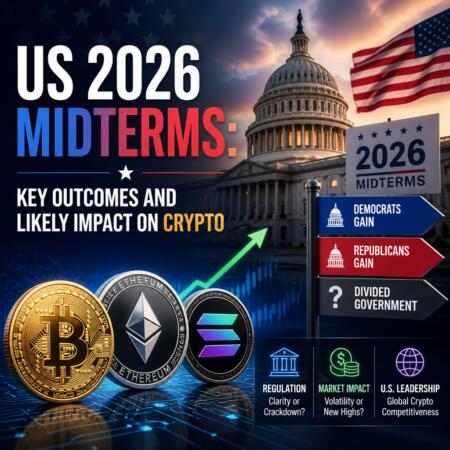
- Prediction markets have rapidly moved toward Democratic control of both chambers, with odds converging near certainty.
- Democrats need 218 House seats and 51 Senate seats to hold majorities in both chambers.
- Crypto policy could hinge on the election outcome, including whether the stalled CLARITY Act gains traction or faces renewed delays.
- Blockchain-focused political spending is concentrated in a set of high-priority races tracked by the Blockchain Association.
Prediction markets point to a Democratic sweep
Across prediction markets, traders have increasingly priced in Democratic control of Congress. As of late evening reporting on Nov. 3, Kalshi and Polymarket showed Democrats at roughly a 99% chance of winning Senate control, while House control was priced at nearly 100%.
Earlier in the day, odds were notably lower, according to the Blockchain Association’s election dashboard. By around 8:05 pm ET, the dashboard showed Democratic Senate-control odds of 94% on Kalshi and 93% on Polymarket, compared with earlier readings of 75% and 75.5% respectively. House-control odds sat at 98% and 99% on those platforms. The shift underscores how late results can quickly change the expected path for Washington’s next legislative phase.
As the vote count progressed, the reported balance included Democrats and allied independents holding a majority in the Senate count mentioned in the dashboard updates, while Democrats held a larger share of the House seats already secured.
How the crypto debate intersects with congressional control
Crypto policy in the US has often moved through a mix of executive-branch regulation and piecemeal legislative proposals rather than a single unified framework. In that context, changes in congressional leadership matter because they influence whether lawmakers can advance market-structure efforts, or whether efforts stall again due to lack of consensus.
During the campaign, blockchain advocates also highlighted the idea that Congress alone may not be able to deliver lasting regulatory stability. In remarks attributed to 1inch’s deputy general counsel, Maylea Ma, the emphasis was on federal agencies taking the lead in the next stage of crypto regulation rather than Congress. Ma argued that while agencies are engaging more with crypto projects, that engagement does not provide the same stability as a statute that cannot be reversed with each change in administration.
That tension is likely to remain central for traders and builders alike: if Democrats gain control, supporters may press for legislative progress such as the CLARITY Act; if not, industry participants may instead focus on agency rulemaking and enforcement dynamics as the more immediate driver of compliance requirements.
Key races drawing heavy crypto-linked spending
Election attention has also focused on specific states where crypto-aligned political action committees have spent large sums. The Blockchain Association’s election dashboard identifies dozens of priority races, including Senate contests and House matchups.
Ohio Senate: Jon Husted vs. Sherrod Brown
In Ohio, Republican Sen. Jon Husted faces Democrat Sherrod Brown, a long-time critic of cryptocurrency. The race has drawn significant crypto-industry spending, including about $56 million from Fairshake and $7 million from the Winklevoss-backed Digital Freedom Fund, according to figures cited in earlier reporting within the source material.
Nebraska Senate: Pete Ricketts vs. Dan Osborn
Nebraska features Republican Sen. Pete Ricketts against independent challenger Dan Osborn. Earlier reporting cited Fairshake spending of nearly $11 million in support of Ricketts, while later compiled data referenced Federal Election Commission filings showing additional opposition spending—organized through Fairshake-affiliated entities—moving the total figure for the anti-Osborn side.
Ricketts’ legislative record is part of the reason the race matters to crypto stakeholders: he has supported legislation including the CLARITY Act and GENIUS Act, and has voted to advance portions of the CLARITY package through committee activity and related procedural votes, as described by crypto advocacy sources cited in the source material.
Texas Senate: Ken Paxton vs. James Talarico
In Texas, the contest between Republican Ken Paxton and Democrat James Talarico includes campaign support from entities backed by the Winklevoss-linked Digital Freedom Fund. Both candidates, however, have been characterized as holding generally pro-crypto positions by Stand With Crypto ratings referenced in the source material—highlighting how spending can converge around broader regulatory goals even when candidates come from different political backgrounds.
Wyoming Senate: Harriet Hageman vs. James Byrd
Wyoming’s open-seat dynamics also draw interest because Sen. Cynthia Lummis—who chairs a Senate Banking Subcommittee on Digital Assets—has been an influential pro-crypto lawmaker and is not seeking reelection. In the prior reporting cited in the source material, Lummis was linked to major digital-asset initiatives, including sponsorship of the BITCOIN Act of 2025 for a US strategic Bitcoin reserve, alongside support for market-structure legislation such as the CLARITY and GENIUS Acts.
For the challenger side, the source indicates that Stand With Crypto lists no documented position on cryptocurrency for Byrd, while Hageman’s record includes support for multiple crypto bills.
Maine Senate: Troy Jackson vs. Susan Collins
In Maine, Susan Collins—one of the Republicans who opposed advancing the CLARITY Act in September—faces Democrat Troy Jackson. The race matters because Collins’ objections reportedly related to bank deposit impacts, while Jackson has been described as supporting clearer legislation for the digital asset sector, including ending what supporters characterize as debanking of lawful crypto businesses and preserving self-custody rights.
Super PAC spending remains a defining feature
The election’s crypto footprint has also been visible in political spending channels. The source material describes Fairshake as leading the money through affiliated super PACs including Defend American Jobs and Protect Progress, with support announced for dozens of House incumbents after members were identified as having voted in favor of the CLARITY Act in 2025.
Other groups mentioned include the Digital Freedom Fund—tied to Tyler and Cameron Winklevoss—and Fellowship PAC, which has backed candidates from both parties. For industry participants, these spending patterns are a signal of where lawmakers are expected to land on regulatory priorities, even before final election outcomes are confirmed.
As results settle, the key question for crypto stakeholders is not only who wins, but how quickly new majorities can convert electoral arithmetic into legislative or oversight priorities. Investors, builders, and compliance teams should watch closely for the early policy signals that typically follow control shifts—especially around the CLARITY Act and the balance between congressional action and agency rulemaking.