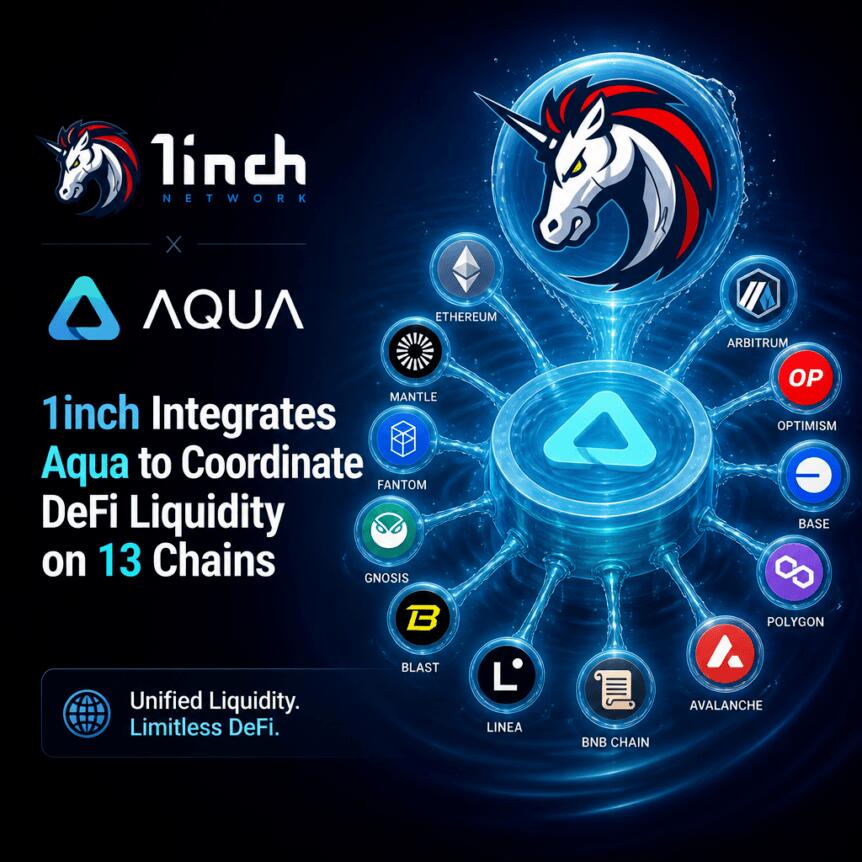
1inch has unveiled Aqua, a DeFi protocol designed to unify liquidity across multiple decentralized markets without forcing liquidity providers (LPs) to deposit funds into a specific venue. The announcement frames Aqua as a way to make liquidity more flexible across blockchains and protocols, while still enforcing capital constraints so funds aren’t overextended in simultaneous trades.
According to 1inch’s release on Tuesday, Aqua lets LPs authorize multiple strategies from a single wallet inventory and keeps the assets in that wallet until an executed swap settles—rather than routing the liquidity into any one liquidity pool. The protocol is already deployed across 13 blockchains, including Ethereum, Arbitrum, Base, Robinhood Chain, and BNB Chain.
Key takeaways
- Aqua coordinates liquidity across protocols without requiring LP funds to be deposited into a single pool.
- Wallet-backed strategies maintain atomic settlement, reverting trades if they exceed available wallet balances.
- Assets can only be used in one operation at a time, limiting effective over-allocation even if liquidity is “advertised” broadly.
- Incentives are planned via a pending tokenholder vote: 500,000 USDC plus 10 million 1INCH tokens earmarked for adoption.
How Aqua is meant to work
At the core of Aqua is an integrated system that 1inch describes as combining a generalized onchain registry, wallet-backed automated market making (AMM) strategies, atomic settlement, and consumer-facing position management.
Instead of tying liquidity to a particular protocol, the LP effectively “authorizes” strategies against their wallet’s available inventory. This distinction matters for capital efficiency: liquidity can be made available across a broader set of supported markets, potentially improving access for traders searching for swaps on different venues.
1inch also emphasizes a hard constraint designed to prevent true capital multiplication. While a provider can advertise the same amount of liquidity across multiple protocols, the liquidity cannot support unlimited simultaneous executions.
To illustrate the trade-off, 1inch’s explanation includes a scenario in which an LP supplying $10,000 can list $10,000 on three protocols for a combined $30,000 advertised availability, but only $10,000 worth of trades can run at the same time with those funds. In practice, this is closer to coordinated “overbooking” with strict execution limits than to a mechanism that multiplies liquidity across independent pools.
Atomic settlement and balance safety checks
In an interview with Cointelegraph, a 1inch spokesperson said Aqua can be used by “resolvers” holding a 1inch-issued access credential, noting that not all protocols are supported under the system.
The spokesperson further explained how Aqua prevents swaps from exceeding the wallet’s balance. They stated that all quoted positions are priced against the market maker’s live wallet balance, and once a fill occurs, remaining quotes adjust to reflect what’s left.
If an attempted swap would go beyond available funds, the system is designed to revert atomically. As the spokesperson put it: “If a swap would exceed the actual balance, it reverts atomically.”
For investors and traders, this approach addresses a key risk in liquidity aggregation: ensuring that quoted prices and advertised availability correspond to real executable inventory. Rather than relying on liquidity being pre-positioned in a given pool, Aqua ties execution to wallet state at settlement time.
Expansion across blockchains—and how incentives may pull liquidity in
Aqua’s initial rollout is positioned as multi-chain from the start, with deployments on 13 networks. That matters because one of DeFi’s practical frictions is not only the fragmented liquidity across protocols, but also the fragmentation across chains—each with its own trading dynamics and wallet activity.
To accelerate usage, 1inch says a related tokenholder process is underway. Pending vote approval, the protocol will allocate 500,000 USDC toward incentives for adopting Aqua, alongside 10 million 1inch (1INCH) tokens, described as roughly $830,000 at the time of writing. The announcement says the initiative is designed to “accelerate liquidity growth and swap activity across supported pairs.”
The incentives are contingent on approval through 1inch’s governance forum, referenced by the company in its announcement. If approved, the program would connect Aqua’s technical liquidity unification goal to a direct adoption push—something that typically becomes critical early when new routing or liquidity coordination systems must prove they can attract meaningful volume.
Why Aqua’s design could change how liquidity is routed
Liquidity aggregation in DeFi has traditionally meant either routing trades through existing pools, or encouraging liquidity providers to place capital into specific venues. Aqua’s differentiator is the separation between where capital resides (the wallet inventory) and where it is made actionable (strategies across markets).
However, the protocol’s constraint—that assets aren’t truly multiplied and can participate in only one operation at a time—suggests Aqua is aiming for better coordination rather than unlimited leverage of inventory. The “advertise broadly, execute limitedly” framing implies that Aqua could improve utilization when overlapping demand is unlikely, while preventing failure scenarios where more traders execute than the capital supports simultaneously.
That uncertainty—how often real-world demand overlaps across the set of supported strategies—will likely determine how quickly Aqua’s theoretical improvements translate into measurable routing performance. Investors and builders may want to monitor whether swap volume increasingly clears via Aqua-linked pathways and whether the promised improvement in liquidity availability shows up in practice as more wallets and resolvers participate.
Finally, it’s worth noting that 1inch’s announcement arrives amid ongoing internal turbulence. Earlier this month, Cointelegraph reported that co-founder Anton Bukov said he was “fired” from 1inch in November 2025 after “push[ing] for change” in company management and operations. While that dispute isn’t directly tied to Aqua’s technical rollout, it remains part of the broader context around execution risk and governance decisions as the protocol moves into incentive-driven adoption.
For now, the key question for readers is whether Aqua can attract liquidity at scale and translate its unified wallet inventory model into sustained swap throughput—particularly once the proposed USDC and 1INCH incentive program is decided. The next watch items are the tokenholder vote outcome and whether Aqua’s multi-chain deployments drive measurable growth in routed trading across the supported pairs.