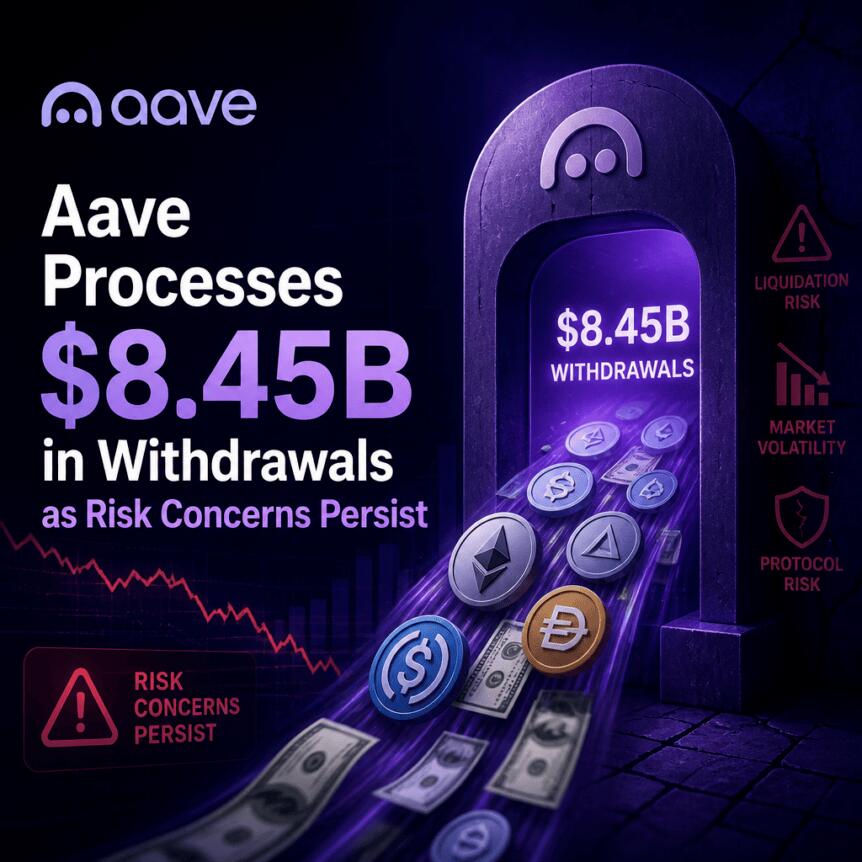
In April 2026, Aave faced one of the sharpest liquidity shocks in recent DeFi history. According to Galaxy’s analysis referenced in the coverage, users withdrew roughly $8.45 billion from the protocol in the aftermath of the KelpDAO rsETH bridge exploit. The key point for investors and users: Aave’s contracts were not compromised, but connected markets still experienced severe stress.
The episode quickly became a referendum on what “survival” really means for decentralized lending. Aave continued operating, yet analysts and risk observers argued that a functioning core does not automatically translate into comprehensive safety—especially when collateral, borrowing demand, and liquidity are tied to external assets and across multiple protocols.
Key takeaways
- Aave was not hacked; the turmoil followed an external rsETH bridge incident that propagated into Aave via collateral and liquidity linkages.
- Roughly $8.45 billion flowed out after the April 2026 rsETH exploit, illustrating how quickly DeFi can experience bank-run-like dynamics.
- Aave relied on built-in risk tooling and emergency controls to contain damage as some pools hit full utilization, limiting immediate withdrawals.
- Surviving a single stress event does not settle debates about DeFi systemic risk, including concentration and fast-moving user behavior.
- For users, protocol size and transparency are not substitutes for understanding the assets behind lending markets and governance changes.
A stress event triggered outside Aave
The pressure did not originate in Aave’s own code. It began with the KelpDAO rsETH bridge exploit in April 2026, where attackers stole about $292 million worth of rsETH from KelpDAO’s LayerZero bridge. That theft intensified concerns that some rsETH holdings might not be fully backed.
Those concerns mattered to Aave because rsETH was used beyond its source ecosystem. As the token’s perceived backing came into question, the risk spread to DeFi markets that accepted rsETH as collateral. In practical terms, when collateral loses credibility, lenders face increased exposure to bad debt, while borrowers and depositors tend to reposition to reduce risk—often by withdrawing.
That is where liquidity stress accelerated. As more users attempted to exit, some Aave markets saw utilization climb toward the ceiling. When pools approach or reach full utilization, withdrawals become harder for certain participants because the liquidity needed to satisfy redemptions is already deployed. In other words, the episode looked like a DeFi version of a bank run—not because Aave failed to follow its internal rules, but because DeFi markets can react instantly and continuously on-chain.
What Aave’s founder argues—and why it isn’t the end of the debate
Aave founder Stani Kulechov framed the event as evidence of resilience: the core protocol logic continued to work as designed even amid high stress. That distinction is important. Aave did not suffer a direct exploit of its own contracts; however, the surrounding markets were still forced into emergency modes as external asset disruption rippled through collateral and borrowing channels.
Supporters point to the transparency and determinism of DeFi lending—features that differ from traditional banking crises. Collateral and risk settings are visible on-chain, liquidation mechanisms follow predefined smart contract rules, and participants can inspect activity in real time. In theory, such properties reduce some information asymmetries that have historically contributed to conventional financial breakdowns.
Yet independent analysts, as reflected in the coverage, took a more cautious view. The core argument is not that Aave failed to function; it is that “functioning under stress” may not be sufficient to prove that the system is safe in the broader sense. If adverse shocks continue to arrive from connected components—bridges, collateral issuers, or other DeFi venues—then Aave’s ability to limp through one crisis does not guarantee it will navigate the next without more severe outcomes.
Survival versus safety: the role of concentration and network effects
Critics warn against treating a single successful defense as full validation. Stress events can be interpreted through multiple lenses: strong design helps, but favorable conditions and the specific nature of the shock also matter. In the rsETH case, the market still experienced liquidity strains severe enough to require emergency action, including freezes and risk parameter adjustments.
Another concern highlighted in the coverage is concentration risk. Independent observers noted that large exposures can be spread across many DeFi platforms at once. If a small number of actors control outsized positions, their decisions—such as exiting or closing during volatility—can amplify instability system-wide. The same concentration dynamic has been a longstanding concern in traditional finance, and DeFi’s composable architecture can translate it into a faster-moving ecosystem.
Beyond actor concentration, DeFi’s composability is a double-edged sword. Interoperability helps protocols grow and coordinate liquidity across the ecosystem, but it also creates more pathways for stress to spread. When a lending market depends on collateral that is itself linked to leveraged positions and other connected systems, the resulting network can become harder to unwind during shocks. The condition of the wider DeFi system therefore cannot be separated from a single protocol’s performance.
Unlike regulated banks that can run supervised stress tests under defined frameworks, DeFi’s stress tests happen live—using real user funds, real collateral, and no rehearsals. That doesn’t mean DeFi lacks testing; it means the “test” may occur while markets are already under strain.
How Aave’s risk controls shaped the outcome
Even though the incident began elsewhere, Aave’s internal safeguards influenced what happened next. The platform manages borrowing and liquidation through structured limits such as loan-to-value parameters and liquidation thresholds, while also using mechanisms like supply caps and borrow caps to control how much exposure can build around specific assets.
Aave also uses features designed to reduce cross-asset contagion. Isolation Mode can restrict the impact of higher-risk collateral, while Efficiency Mode (E-Mode) applies special settings for assets that typically move together. Governance, with support from risk advisers, is intended to adjust these parameters as needed—though, as observers note, governance changes can take time, and risk models may not fully anticipate rapid spillover during novel conditions.
During the withdrawal surge, these measures generally held, with core protocol functions continuing to operate. Still, utilization reached 100% in major pools in the coverage description, which helps explain why some withdrawals could not be processed smoothly. The takeaway is not that controls prevented all harm; it’s that they likely narrowed the scope of what might otherwise have become a complete failure.
What users and builders should watch next
The rsETH episode shows that Aave can survive extreme liquidity stress without a direct protocol exploit, but it also highlights how external asset failures can quickly propagate through collateral and liquidity connections. Going forward, readers should focus on how quickly risk parameters can be adapted through governance, how effectively protocols manage external collateral dependencies, and whether the ecosystem’s concentration and composability risks are addressed with the same urgency as smart-contract security.