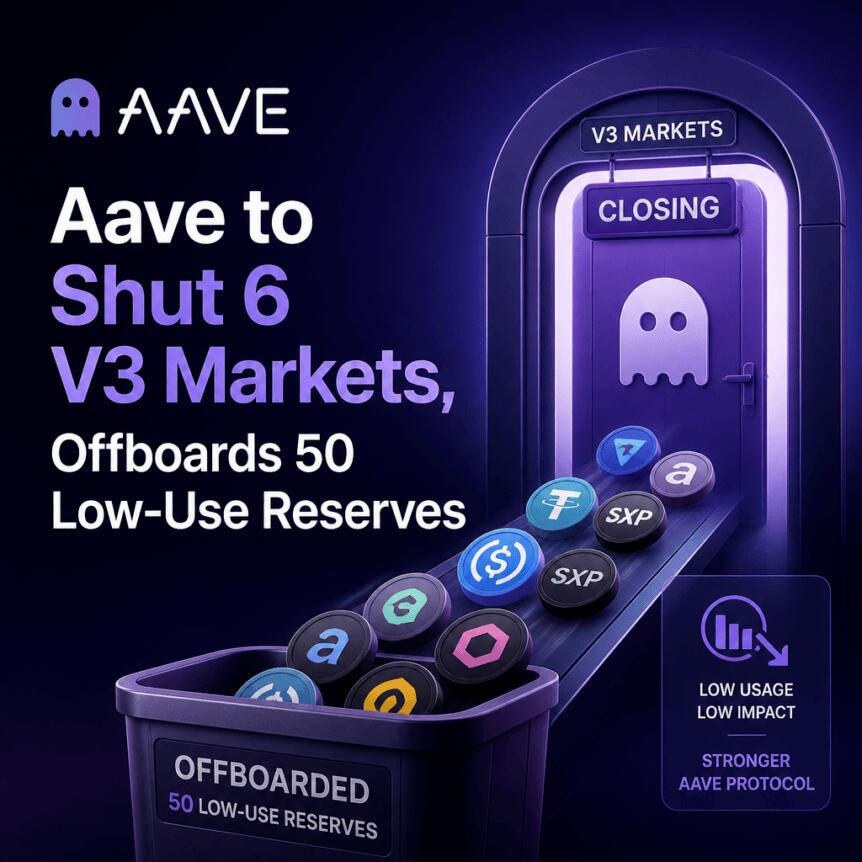
A proposed Aave governance initiative would wind down multiple Aave V3 lending deployments on six blockchains and retire a large set of low-usage token listings. The plan, advanced through the protocol’s ARFC process, targets a cleanup covering $98.1 million in supplied assets and $15.6 million in outstanding debt, based on balances recorded on July 28.
According to LlamaRisk, which worked with Aave service providers on the assessment, the proposal recommends offboarding 50 low-use reserves and retiring 21 matured Pendle principal token listings across 11 deployments. It also calls for retiring all 25 reserves on Sonic, Scroll, zkSync, Metis, Soneium, and Aptos.
Key takeaways
- The ARFC would deprecate Aave V3 markets on Sonic, Scroll, zkSync, Metis, Soneium, and Aptos, alongside removing 50 low-use reserves and 21 matured Pendle principal token listings.
- The scope is tied to on-chain balances measured July 28, with $98.1 million supplied and $15.6 million in debt included in the cleanup.
- Risk service provider LlamaRisk characterizes the action as part of Aave’s broader risk-governance frameworks rather than a reversal of its multichain growth thesis.
- Prior multichain “temp check” voting already shut down underperforming instances on zkSync, Metis, and Soneium and set a $2 million annual revenue floor for new deployments.
- Aave founder Stani Kulechov framed the move as reducing both economic and technical risk surface under updated listing and risk frameworks.
What the ARFC would change in Aave V3
An ARFC—an “Aave Request for Comment”—is presented as a detailed governance proposal and precursor to an Aave Improvement Proposal. It is not itself confirmation that final on-chain voting has been completed or that execution is already underway.
In this case, the recommendation focuses on reducing exposure to markets with limited usage or maturing positions. LlamaRisk’s work with other Aave service providers outlines multiple categories of deprecation: low-use reserves and certain Pendle principal token listings that have matured, alongside full reserve retirements on the six named chains.
Aptos exit arrives after a rapid liquidity decline
The inclusion of Aptos stands out because it follows relatively recent deployment activity. LlamaRisk’s materials indicate Aave launched its V3 market on Aptos about 11 months earlier. In that period, liquidity fell by 94% over six months, and quarterly revenue reportedly dropped below $1,000, according to LlamaRisk.
Under the proposal, not all chains are treated the same way. LlamaRisk states that every reserve on Scroll, zkSync, Metis, and Soneium was already frozen. By contrast, Sonic and Aptos remained active at the time of the snapshot, with the ARFC recommending that they be frozen as well.
This structure matters for how quickly deprecations could translate into actual risk reduction. Freezing already stops new activity, but full retirement would further narrow Aave’s operational footprint on those deployments.
How earlier “temp check” decisions set the stage
The ARFC is not the first governance signal that Aave would be willing to scale back underperforming V3 instances on certain chains. A prior “temp check” on Aave’s multichain strategy concluded on Dec. 5, 2025, according to the governance record referenced in the source materials. That vote reportedly returned 923,400 votes in favor and under 1% against changing reserve behavior for underperforming instances.
That earlier governance outcome included actions affecting zkSync, Metis, and Soneium—specifically shutting down instances—and introduced a $2 million annual revenue floor for new instance deployment. In other words, the latest ARFC reads less like a sudden pivot and more like an operational follow-through on criteria that were already accepted by the community.
Risk framework updates and protocol-wide cleanup logic
The proposal aligns with Aave’s evolving risk and listing governance. The source notes that Aave added Scroll to the affected set through an accelerated process in April, referencing a direct-to-AIP proposal. In that description, the measure was framed as completing Scroll’s deprecation after a rapid deterioration in network liquidity and Aave market activity.
Separately, Aave published an updated risk framework on June 9 covering asset, bridge, monitoring, and chain risk, along with criteria for winding down reserves or deployments. The current ARFC announcement, as described in the source materials, suggests “de facto” adoption of these rules for the present cleanup.
Aave founder Stani Kulechov also addressed the initiative in a Thursday social media post. He said the move would “reduce Aave’s economic and technical risk surface as part of the new Aave Risk Framework and Technical Asset Listing Framework.” He further emphasized that the action “is not a reversal” of the protocol’s multichain expansion strategy, and that Aave would continue continuous risk assessment across deployments.
That distinction is likely important for market participants. Aave’s multichain approach appears to remain intact conceptually, but the governance direction points toward tighter enforcement of performance and risk thresholds—essentially focusing capital and attention on deployments that meet criteria and exiting those that do not.
Why this matters for users and market participants
For users and liquidity providers, deprecations can change the path of capital: liquidity may diminish further as reserves are frozen or retired, and markets tied to low-use reserves can become less accessible over time. For borrowers and lenders, winding down V3 markets can also affect how easily positions can be adjusted, particularly if token listings tied to specific assets or principal tokens are retired after maturity.
For investors and governance observers, the bigger signal is how Aave is operationalizing its frameworks. By connecting deprecations to measurable liquidity and revenue outcomes—and by referencing an earlier temp check that set a revenue floor—the ARFC underscores a governance style that is increasingly rules-driven rather than ad hoc.
Readers should watch for the next procedural steps: whether the ARFC proceeds into an Aave Improvement Proposal for formal voting, and how execution is sequenced across the chains involved—especially where Sonic and Aptos were still active at the time of the July 28 snapshot.