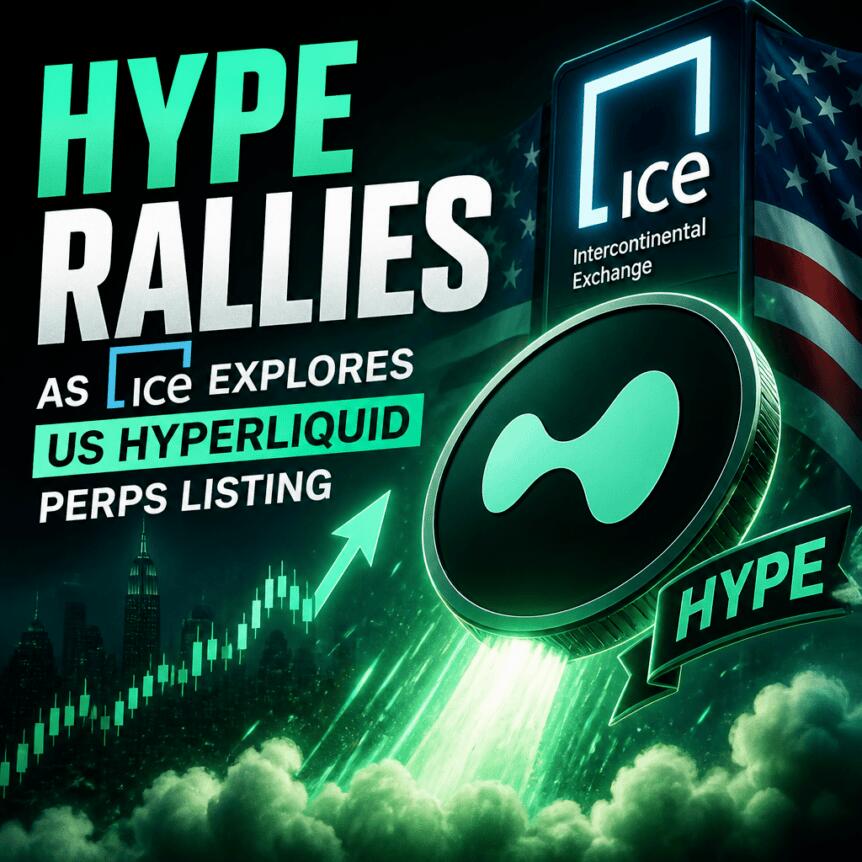
Hyperliquid’s native token HYPE jumped roughly 20% on Thursday after Intercontinental Exchange (ICE)—the owner of the New York Stock Exchange—announced plans to bring Hyperliquid-based US perpetual futures through a regulated market structure. The news follows rising political attention on getting Hyperliquid’s trading activity into the country “fully compliant and legal fashion,” as stated by President Donald Trump earlier this month.
At the time of writing, HYPE was trading above $96, according to CoinGecko data, approaching September’s all-time high near $97.96. The move centers on ICE’s proposed markets for crypto and traditional asset types, while explicitly aiming to carve out a separate clearing setup designed to protect existing institutional customers from retail counterparty risk.
Key takeaways
- ICE said it will seek regulatory approval for onshore US perpetual futures markets built on Hyperliquid, targeting retail traders.
- HYPE’s surge reflects market anticipation around a potentially regulated US access route for Hyperliquid-style perpetuals.
- ICE plans to use a dedicated clearing structure to separate retail counterparty exposure from its largely institutional customer base.
- Trade[XYZ] counts billionaire Stanley Druckenmiller among investors, drawing high-profile social media attention.
- ICE’s tokenized securities venture with OKX faces additional issuer objections, though those concern tokenized shares—not the perpetual futures proposal.
ICE and Trade[XYZ] target regulated Hyperliquid perpetuals
ICE and Trade[XYZ] said in a joint announcement Thursday that they intend to pursue regulatory approval to launch US onshore markets for cryptocurrencies, stocks, indexes, commodities, and currencies. The proposed venue would focus on retail participants, while ICE said it would operate separately from its institutional futures business.
ICE also indicated that the structure would include a dedicated clearing approach intended to insulate existing institutional customers from retail counterparty risks. The companies did not provide a launch date or disclose the size of ICE’s investment stake in Trade[XYZ], according to reporting described in the source.
Perpetual futures differ from traditional futures contracts in that they do not have an expiration date, enabling traders to maintain leveraged positions for as long as margin requirements are met. Hyperliquid is described as the largest decentralized exchange globally for trading perpetual instruments, with DefiLlama data cited in the source.
The key investor relevance is straightforward: a regulated US venue could change how US-based retail traders access Hyperliquid-style perpetual exposure—at least in theory—by routing participation through approved brokers and identity and Anti-Money Laundering (AML) checks. Still, the plan remains contingent on approvals.
Why HYPE reacted: expectations of US “perpetual” access
The immediate market response—HYPE trading about 20% higher on Thursday—appears tied to the possibility of a more structured, US-compliant pathway for retail participation in perpetual futures linked to Hyperliquid’s trading venue. Perpetual markets are typically associated with high trading activity and leverage, so any development that could broaden participation tends to be closely watched.
At the same time, readers should note the distinction between “permission to launch” and “actual availability.” The announcement signals intent and a regulatory path, but it does not establish timing. That matters because perpetual derivatives liquidity and participation can be sensitive to policy details, broker onboarding timelines, and the exact contours of what regulators ultimately approve.
Political context also plays into market interpretation. The source points to President Trump’s Aug. 19 comments that CFTC Chair Michael Selig was working to bring Hyperliquid into the US “fully compliant and legal fashion.” While that remark did not itself outline a specific mechanism, it provides a narrative backdrop that may have supported the token’s enthusiasm as the ICE/Trade[XYZ] plan emerged.
Druckenmiller investment sparks Musk attention
Trade[XYZ] also gained visibility due to its investor roster. Billionaire Stanley Druckenmiller wrote on X that he is “excited to be an investor in trade(xyz)” and said he expects to use the company’s products.
Elon Musk amplified the attention by reposting Druckenmiller’s message with the comment “Interesting.”
ICE is taking a minority stake in Trade[XYZ], but the source says the companies did not disclose the investment amount. According to the reporting, outreach to ICE and Trade[XYZ] for additional comment had not received a response by publication.
Operationally, the announcement described would require identity and AML checks for customers and direct trading through participating futures brokers. Distribution is expected via ICE’s joint venture with OKX, though this still depends on additional approvals tied to the broader regulatory framework.
ICE previously invested in OKX, with the source citing that deal at a $25 billion valuation in March. That connection may matter for traders watching where liquidity and distribution could come from, but the timeline and exact implementation remain subject to regulatory conditions.
OKX tokenized securities objections don’t automatically carry over
While the Trade[XYZ] plan is about perpetual futures, ICE’s broader collaboration with OKX is also under scrutiny due to issuer objections related to an ICE/OKX tokenized stock venue. The source reports that the tokenized securities operation has disclosed objections from 38 companies, up from 26 reported earlier on Oct. 27.
The cited Oct. 28 public notice lists additional names including Walmart, Eli Lilly, Carnival, Arcos Dorados, and Cigna. However, the objections are described as concerning tokenized shares, not perpetual futures. As a result, it would be inaccurate to assume that difficulties in one product line automatically translate into the same regulatory outcome for the Hyperliquid-based derivatives proposal.
Regulatory nuance is also important on the derivatives side. The source notes that the CFTC approved Kalshi’s Bitcoin perpetual contract in May, while also stating that perpetuals referencing other asset classes may be reviewed case by case.
For market participants, that suggests the compliance bar could vary depending on the underlying asset category—especially if the proposal includes stocks, indexes, commodities, and currencies alongside cryptocurrencies.
For now, the next thing to watch is how regulators respond to the market application details—particularly the scope of assets permitted, the final clearing and broker mechanics, and the approval timeline. Until those elements are confirmed, the HYPE move looks more like a speculative re-pricing of regulatory possibility than a guaranteed near-term change in US access.