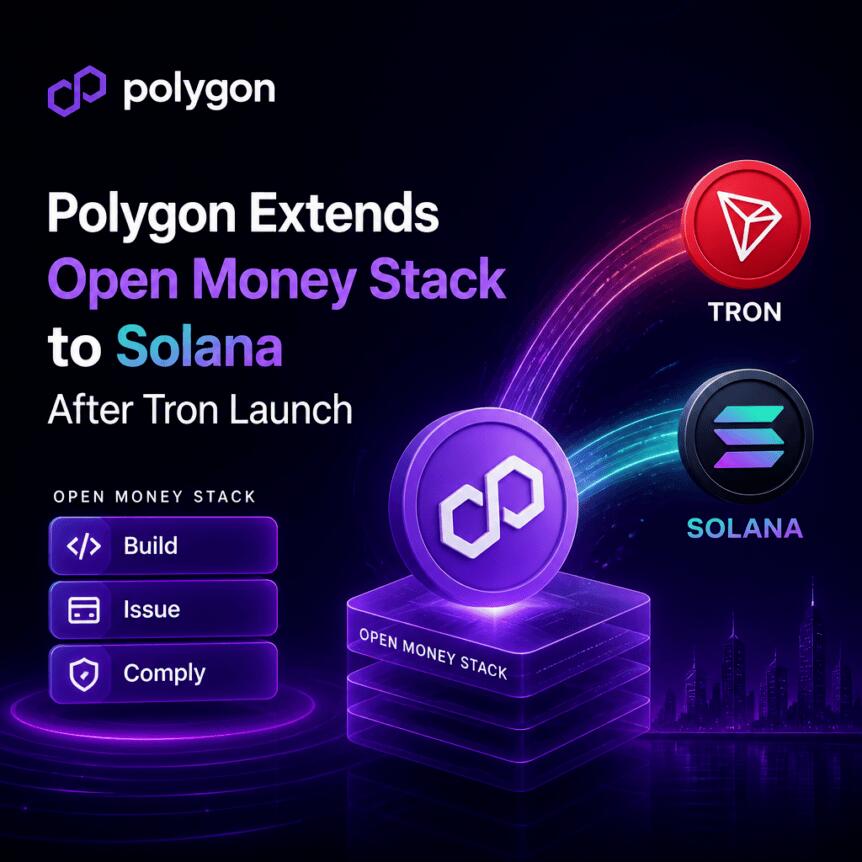
Polygon Labs is extending its Open Money Stack to the Solana network, a move designed to help businesses connect traditional banking rails with crypto wallets and payout infrastructure. The service, which already supports integrations across Polygon, Ethereum, and other EVM-compatible networks, now aims to bring similar functionality to Solana-based companies building stablecoin-powered payment flows.
Polygon CEO Marc Boiron said the decision is being driven by customer demand and rising stablecoin usage. He also pointed to Polygon’s earlier expansion of the same stack to Tron, underscoring a broader strategy to reduce friction for businesses that want to reach customers without being locked into a single blockchain.
Key takeaways
- Polygon’s Open Money Stack is now available for Solana: businesses can connect bank funding, customer wallets, and payouts to Solana-based stablecoin activity.
- Integration targets real-world payment flows: the update adds access to bank, card, and cash funding as well as embedded wallets and routing into payout networks.
- Stablecoin transfer volume is cited as justification: Token Terminal data shows Solana recorded about $5.76T in stablecoin transfers from Jan. 1 to Oct. 27, versus Tron’s $6.94T.
- Polygon also highlights ecosystem breadth: Polygon Trails has supported Solana-to-Ethereum-compatible transfers since August, and the new extension builds on that groundwork.
- Kira is named as an early customer: the company provides U.S. dollar accounts and stablecoin-based cross-border payments services to businesses.
Why Polygon is bringing Open Money Stack to Solana
Open Money Stack is positioned as a bridge between bank accounts and crypto rails, enabling businesses to accept funding from traditional sources, provide customer wallets, and arrange payouts. With the Solana integration, Polygon is effectively offering the same “stack” concept to teams operating on Solana rather than forcing them to route all payment activity through Polygon or EVM networks.
Polygon Labs says this matters because payment activity increasingly spans multiple networks. Vibhu Norby, chief product officer at the Solana Foundation, linked the move to the scale of stablecoin settlement and the need for businesses to deliver payments to broader customer bases.
Norby told Cointelegraph that as activity grows, connecting Solana to bank accounts, wallets, and payout networks helps businesses reach more customers and markets with stablecoin payments.
Stablecoin flows: Solana vs. Tron
In supporting the expansion, Polygon pointed to stablecoin transfer volumes tracked by Token Terminal. According to that data, Solana recorded roughly $5.76 trillion in stablecoin transfers between Jan. 1 and Oct. 27. Over the same period, Tron recorded about $6.94 trillion in stablecoin transfers.
The comparison highlights an important point for operators: even when one chain leads in a given metric, businesses often want optionality. Polygon’s strategy of adding non-EVM support suggests it is trying to meet demand on multiple major networks rather than betting everything on a single ecosystem.
What exactly changes with the Solana integration
Polygon said its Polygon Trails service has supported transfers between Solana and Ethereum-compatible networks since August. The Solana expansion of Open Money Stack goes further by extending access to additional “real-world” capabilities within the same integration layer.
Boiron said the updated offering adds bank, card, and cash funding options, customer account support, embedded wallets, and payouts—using the same general integration model businesses have used on Polygon and other EVM networks. In other words, it’s not just about moving value across chains; it’s also about enabling a full payment stack that begins with fiat funding and ends with settlement through payout partners.
Boiron also argued that fragmentation in customers and payment activity is a key driver. He said businesses report that customer payment behavior is already distributed across networks, and that they do not want to force users to pick a single chain or build custom connections for each part of the payment workflow—such as bank providers, wallet interfaces, routing services, and payout partners.
Polygon added that the broader stack was already available for eligible uses on Polygon, Ethereum, and other EVM networks, positioning Solana support as a continuation of that approach rather than a brand-new product category.
Early adoption and the broader licensing backdrop
The company named Kira as one of the first customers using the Solana integration. The Grid previously cataloged the Solana ecosystem in a snapshot that, according to Polygon, listed hundreds of companies and projects; Polygon pointed to that context to illustrate ecosystem depth. Boiron also described Kira as among the initial businesses applying the Solana-enabled stack.
Beyond product expansion, Polygon’s timing also reflects its push to strengthen payment capabilities in regulated markets. Earlier coverage from Cointelegraph noted that Polygon completed its acquisition of Coinme, which provided Polygon’s U.S. payments business with access to 37 money transmitter licenses and 11 state exemptions covering 48 states. That acquisition is relevant because Open Money Stack’s pitch relies on connecting traditional funding sources with crypto settlement—capabilities that typically depend on licensing and compliance readiness.
With Solana support now added, Polygon appears to be expanding not only across blockchains but also across layers of the payment process—pairing network-level integrations with the infrastructure needed to handle fiat-to-crypto flows.
What to watch next
For businesses and builders, the practical question is whether Solana-based payment providers can move faster toward end-to-end stablecoin experiences—especially for customers who already transact across multiple networks. The next signals to monitor are adoption from more Solana payment firms and how Polygon’s Open Money Stack rollout scales alongside ongoing stablecoin transfer growth on Solana.