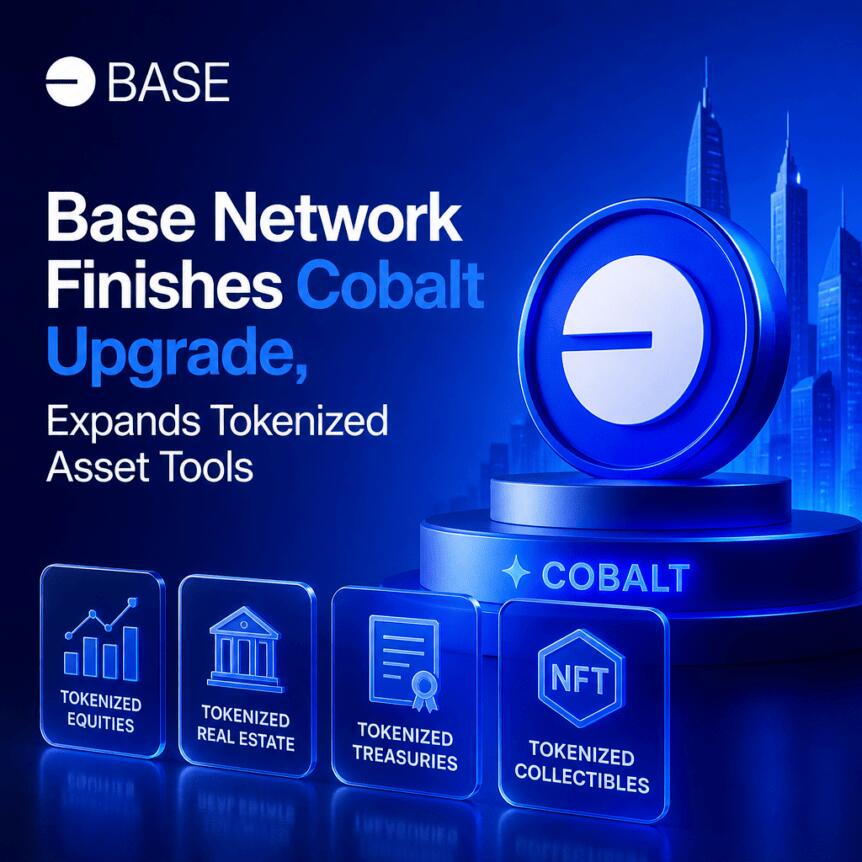
Base has activated its Cobalt upgrade, positioning the Ethereum layer-2 network to support more regulated, issuer-controlled token transfers while also introducing a new way to submit “conditional” transactions. The update is Base’s third major upgrade and comes as the chain continues to court tokenized finance use cases.
According to Base, Cobalt expands its B20 token standard to help issuers apply multiple compliance checks to the same asset, and it adds administrative controls for certain transfers. It also introduces “Validity Transactions,” which only become eligible for inclusion once specified onchain conditions are met—an approach designed to give users more control over timing.
Key takeaways
- Cobalt upgrades Base’s B20 standard with “conditional transactions” and issuer tools aimed at tokenized asset compliance.
- Issuers can enforce multiple recipient requirements—such as identity checks, accreditation status, and sanctions screening—on the same token.
- Validity Transactions allow users to submit transactions that only become eligible once blockchain state matches predefined conditions.
- Some token transfers can be authorized by administrators without the holder’s approval, based on issuer-enabled permissions.
- Base emphasizes performance and Ethereum-aligned upgrades, including future plans to reduce block times and add protocol features for transaction fees and batching.
B20 gets issuer-grade compliance checks
The core of Cobalt is an expansion to Base’s B20 token standard. Base says issuers can now attach several compliance checks to the same token type, allowing the asset to enforce recipient requirements at transfer time.
Base’s example scenario outlines how an issuer could require recipients to complete identity verification, qualify as accredited investors, and not appear on a sanctions list—all under issuer-defined rules.
The upgrade also supports scheduled updates for corporate actions such as stock splits. Base describes these changes as adjustments to how many shares are shown in wallets and apps, explicitly noting that this does not require minting or burning tokens and does not change the holder’s underlying balance.
New administrative transfer controls for tokenized assets
Cobalt further introduces a mechanism that gives authorized administrators the ability to move tokens out of a holder’s wallet without obtaining the holder’s approval. In addition, Base says issuers can require that a transfer include a public note.
Crucially, Base frames this as opt-in functionality: issuers decide whether the feature is enabled and who qualifies as an authorized administrator. Base also states that it itself cannot initiate these transfers.
For investors and builders, the practical significance is that tokenized real-world assets and other regulated products often require operational processes—such as compliance-related adjustments and certain custodial actions—that are difficult to map cleanly onto permissionless transfer models. By adding issuer-level controls, Base is effectively trying to reduce the gap between traditional issuance workflows and onchain settlement.
Validity Transactions: conditional eligibility before inclusion
Beyond compliance and administration, Cobalt introduces “Validity Transactions.” These are submissions that do not become eligible for inclusion until specified onchain conditions are satisfied.
Base describes a scenario where a trader submits a swap transaction that only becomes eligible if an asset reaches a certain price before a defined block deadline. In that model, Base holds the transaction and evaluates the conditions against the chain’s state as each block is built.
Base also says transactions submitted through this system can remain private until they are included in a block, addressing a common concern with conditional execution—namely, that waiting for a condition could expose intent or strategy prematurely.
While this is not the same as full onchain smart-contract execution, it can still matter for traders who want more predictable timing or who need an execution window tied to state changes, without requiring the user to craft complex contract logic for every contingency.
Base ties Cobalt to its wider push into tokenized finance
Cobalt’s release follows Base’s broader shift toward tokenized finance infrastructure. On July 8, Base activated B20 as a native token standard for stablecoins, tokenized real-world assets, and other fungible tokens—enabling issuers to create assets without building custom token contracts (as reported by Cointelegraph: Base to Activate B20 Standard for Stablecoins, RWAs and Other Tokens).
The upgrade also aligns with earlier signals from Base’s leadership. Earlier coverage from Cointelegraph noted that Base creator Jesse Pollak said the network had made a “wrong bet” by prioritizing creator, content, and messaging apps and falling behind in areas such as prediction markets and perpetual futures (reported here: Base’s Social Bet Left It Trailing… Pollak). Pollak emphasized that financial applications, including trading and payments, would become a bigger focus as Base pursued a path toward “global finance.”
That focus quickly translated into product activity. On Aug. 25, Coinbase launched tokenized US stocks on Base, issuing B20 tokens representing shares in Apple, Nvidia, Meta, and Alphabet (as covered by Cointelegraph: Coinbase Taps Chainlink for Tokenized Stock Data on Base).
Base says it plans additional network improvements in coming months, including reducing block times from two seconds to 200 milliseconds, introducing protocol-level support for sponsored transaction fees and bundled transactions, and adopting some of the technical changes planned for Ethereum’s “Glamsterdam” upgrade.
Taken together, Cobalt looks less like a standalone feature update and more like an incremental move toward a chain designed for regulated issuance, issuer operations, and faster transaction processing—capabilities that tokenized finance deployments tend to require.
For readers watching next, the key question is how quickly issuers and trading platforms will integrate these new capabilities—particularly the conditional transfer compliance controls and Validity Transactions—and whether Base’s planned performance and fee features will make tokenized workflows more practical at scale.