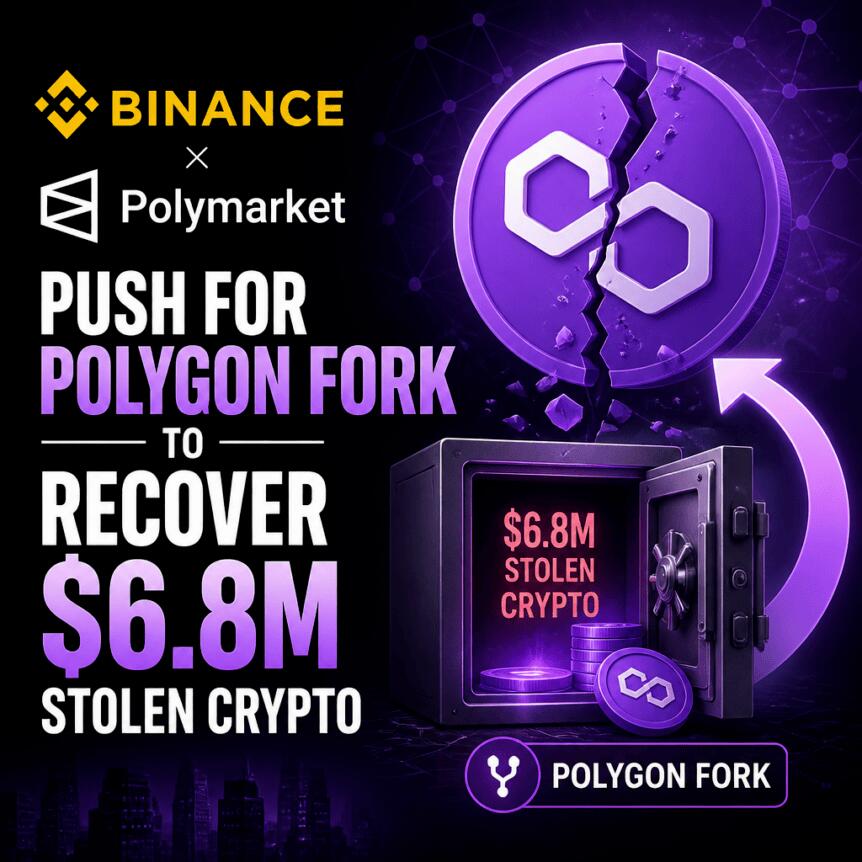
Binance and Polymarket have jointly proposed a Polygon hard fork designed to recover roughly 70.49 million POL tokens—assets they say were stolen in two separate security incidents tied to the companies. The tokens are valued at about $6.8 million at the amounts cited in the governance proposal.
According to the Wednesday proposal posted on the Polygon forum, the recovery plan targets five attacker-controlled addresses: 23.86 million POL (worth about $2.31 million) associated with the Polymarket hack across four addresses, and 46.63 million POL (about $4.51 million) held in a single address linked to the Binance incident.
Key takeaways
- The proposal aims to remove stolen POL from five attacker-controlled addresses and move them to pre-designated recovery wallets.
- Polygon block producers have already blocked outgoing transactions from the affected addresses, but the plan states those measures can’t restore ownership.
- The hard fork would occur at a predetermined block without changing POL’s total supply.
- Approval and testing are required first, with discussion scheduled for Nov. 5 and no confirmed mainnet activation date yet.
How the proposed Polygon hard fork would work
The governance document outlines a targeted network change rather than a general protocol upgrade. If approved, the hard fork would take stolen POL out of the attacker-controlled addresses and transfer the funds to verified recovery wallets associated with Polymarket and Binance.
The process would execute at a predetermined block height. Crucially, the proposal indicates that this would not alter POL’s overall supply—only the control and custody of the specific tokens believed to be stolen in the incidents.
Polygon block producers have already placed temporary restrictions on transactions from the affected addresses, the proposal notes. Those steps have limited the stolen tokens’ ability to move, but the document emphasizes that such measures are not enough to return the funds to the rightful owners.
Why “blocked addresses” aren’t the same as recovery
Temporary blocking can stop further movement of compromised tokens, but it doesn’t restore them to the correct parties. In this case, the proposal argues that only a protocol-level action—executed at the predetermined block—can reposition the tokens from attacker-controlled wallets to recovery custody.
For users and investors, the difference matters: token freezing can reduce immediate risk, yet it leaves the underlying ownership dispute unresolved. A hard fork proposal, by contrast, attempts to settle custody by changing the state of the blockchain at a specific point in time.
Still, the plan’s success depends on governance approval and the ability to carry out the upgrade cleanly on Polygon’s test environment before any mainnet activation.
Governance steps, timeline, and what remains uncertain
The proposal requires Polygon governance approval and testing on the Amoy testnet before activation. The forum post indicates that discussion is scheduled for Nov. 5, but it does not confirm when the mainnet hard fork would actually occur.
That sequencing is important for traders and builders because protocol changes, even targeted ones, can introduce operational risk if testing doesn’t surface edge cases. Investors should also watch for any governance amendments that could adjust the targeted addresses, the recovery-wallet setup, or the precise execution block.
Background: two separate incidents tied to Polygon-linked custody
The hard fork proposal follows two high-profile security events that the involved parties say resulted in stolen POL held on Polygon.
Earlier reporting referenced a record Binance hack, described by Cointelegraph as unfolding around Oct. 29, and noted that Polygon hard fork discussions are being driven by the need to recover tokens trapped in attacker-controlled addresses. In parallel, Polymarket temporarily suspended trading after it reported that a third-party provider had been compromised, according to Cointelegraph’s coverage.
These incidents set the stage for a cross-industry response: rather than relying solely on exchange investigations, monitoring, and legal recovery pathways, the proposal seeks to correct token custody directly at the blockchain layer—using Polygon governance to coordinate the change.
What to monitor next
The next critical checkpoint is Polygon governance discussion on Nov. 5 and the outcome of required Amoy testnet trials. Until a mainnet date is confirmed and the exact mechanics are validated, stakeholders should expect continued uncertainty around whether the recovery will be fully executed and how quickly impacted parties can ultimately access the recovered tokens.