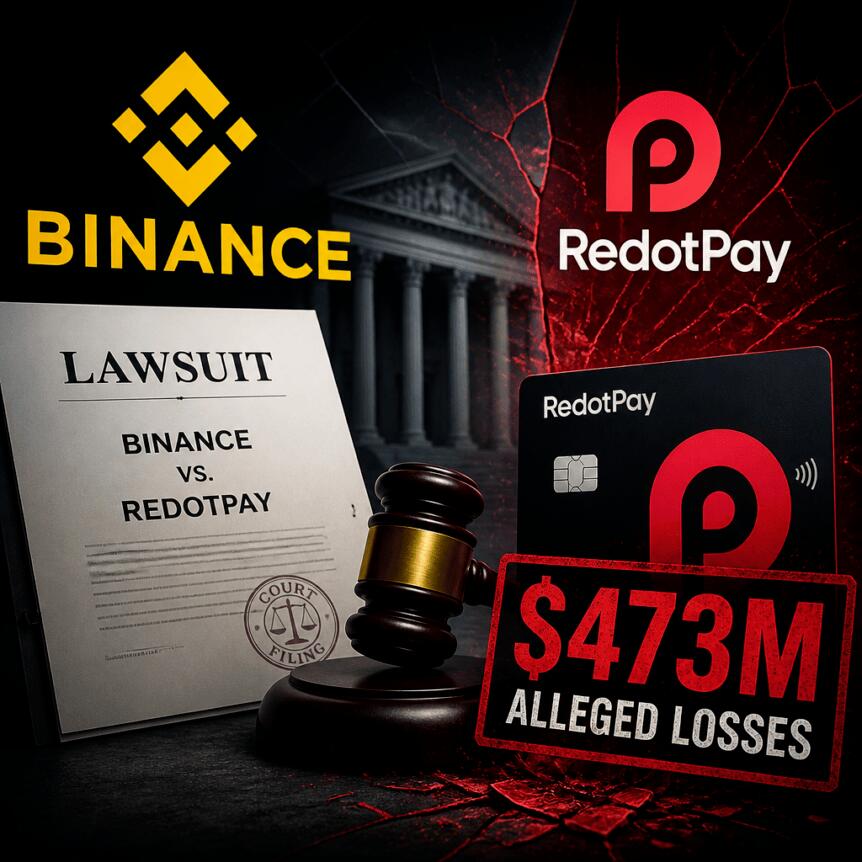
Binance-linked entities have filed a lawsuit in Hong Kong alleging that RedotPay, a Hong Kong-based cryptocurrency payments firm, diverted more than 470,000 users away from the Binance Card through activities they say were outside a commercial agreement. The plaintiffs are seeking nearly $473 million in damages.
The case, detailed in a Hong Kong court filing obtained by Bloomberg, is part of a broader push by Binance-affiliated companies to enforce terms tied to their card offering. Bloomberg reported the litigation may also intersect with RedotPay’s plans as it weighs a potential initial public offering.
Key takeaways
- Binance-affiliated plaintiffs say RedotPay enabled users to load RedotPay payment cards using Binance Pay outside the scope of their agreement.
- The complaint alleges diversion of more than 470,000 users from Binance Card and seeks about $472.8 million in damages.
- RedotPay says the lawsuit will not affect operations and plans to contest the claims.
- A related legal action is also underway in Singapore, where a hearing has been scheduled for Friday.
Hong Kong lawsuit targets alleged diversion of Binance Card users
According to Bloomberg’s report, Binance Holdings affiliates Nest Trading, DistributedTechnologies and Chaintecs Consulting Singapore filed the petition against RedotPay co-founders Gao Zhangpeng, Chan Wa Choi and Yao Chao. The filing centers on alleged breach of a commercial agreement governing RedotPay’s relationship with Binance Card.
The plaintiffs’ core allegation is that RedotPay permitted users to fund RedotPay stablecoin payment cards with Binance Pay in ways they claim were not authorized under the parties’ contract. In their lawsuit, Binance-affiliated entities argue this conduct resulted in substantial customer movement away from Binance Card and toward RedotPay’s own offering.
Damages claim hinges on lifetime customer value
The lawsuit seeks nearly $473 million. In Bloomberg’s account of the filing, the damages calculation is tied to Binance’s estimated lifetime customer value of $925 per user multiplied by the alleged user diversion figure of more than 470,000.
That approach suggests the plaintiffs are not merely pursuing damages for discrete transactions, but for the expected long-term value of a customer base they say was taken from their card product. For investors and market participants tracking crypto payments, the case signals how vigorously major counterparties are now quantifying commercial harm in custody- and payments-adjacent relationships.
Parallel litigation in Singapore adds pressure
Bloomberg further reports that Chaintecs filed a related lawsuit in Singapore. A hearing is scheduled for Friday, according to the court’s published hearing list.
Multiple jurisdictions can matter in crypto-related disputes because different courts may have varying views on contract interpretation, evidence standards, and the enforceability of certain remedies. For parties involved in cross-border payment ecosystems, the existence of parallel proceedings also raises the likelihood that the dispute will stay in the public spotlight longer than a single-country filing.
RedotPay pushes back, says operations will continue
In a statement posted on its website, RedotPay said the legal proceedings would not affect its operations and that it intends to contest the allegations. The company also indicated it would refrain from further comment while the matter is before the court.
“We are confident in our legal position, and are vigorously defending all claims. As the matter is currently before the court, RedotPay will not be commenting further on the allegations, the ongoing proceedings, or matters that will be addressed through the judicial process,” RedotPay said in its published response.
Binance did not provide operational commentary but, according to a spokesperson speaking to Cointelegraph, it would pursue legal options where necessary. The spokesperson said, “While Binance does not comment on ongoing litigation, where necessary we will use courts and other forums to pursue what is right.”
Why this dispute matters for card and payments users
This lawsuit is not just a contractual fight; it highlights the growing importance of compliance and channel controls in crypto card ecosystems. Allegations involving how users load funds—particularly through payment rails like Binance Pay—can directly affect user access, onboarding flows, and which provider ultimately captures transaction-driven value.
Even if the underlying contract is eventually interpreted narrowly, cases like this can influence how payment partners structure permissions, settle revenue-sharing, and document user attribution. Traders and builders watching crypto payments may also take note of how disputes are increasingly tied to quantified customer metrics, signaling a shift away from purely reputational arguments toward measurable economic damages.
As proceedings move forward in Hong Kong and Singapore, the key questions for readers will be what the courts find about the parties’ contract scope—especially whether Binance Pay funding to RedotPay cards fell within agreed boundaries—and how damages, if any, are calculated once the facts are established.