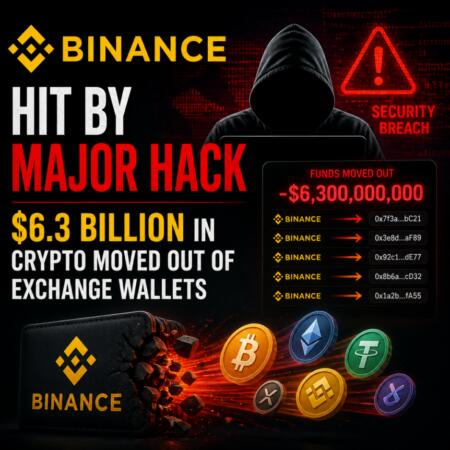
Binance says it has earmarked more than $6.34 billion of its own funds to cover losses from a hack it disclosed as totaling $6.3 billion—while also stating that at least $5 billion of that buffer is already held in the same token assets that were reportedly stolen.
In comments to Cointelegraph, a Binance spokesperson said the $5 billion consists of “the exact token assets that are required,” held in Binance custody. The exchange did not provide a timeline for when the rest of the cover would be completed, nor did it confirm which specific tokens it may still need to acquire.
Key takeaways
- Binance claims it set aside over $6.34B from company funds to address the hack-related shortfall, with $5B already in token assets “in exact” form and held in custody.
- Binance expects the token holdings to be reflected in its next proof-of-reserves report, but declined to disclose wallet addresses for security reasons.
- Blockchain security firm CertiK said it needs additional information to independently verify the on-chain recoverability of the claimed $5B holdings.
- TRM Labs previously said the funds were drained across 10 blockchains and linked the incident to the North Korean hacking group TraderTraitor.
- Observers remain split on coverage completeness: estimates referenced by CertiK suggested a potential gap even after frozen assets and emergency funds are considered.
Binance’s $6.34B coverage plan and the “$5B in required tokens” claim
Binance’s latest statement centers on how it plans to make customers whole after the exchange disclosed a $6.3 billion hack. According to the spokesperson, the exchange has set aside more than $6.34 billion in company resources, with $5 billion already held in the “exact token assets” required for coverage.
The exchange did not specify when it acquired the assets that it says match the stolen tokens. It also did not confirm which tokens still may need to be purchased, when any additional acquisitions would be completed, or how much stolen crypto has been recovered to date.
For transparency, Binance indicated the holdings should appear in its next proof-of-reserves report, which is intended to show what assets it holds to back customer balances. However, the spokesperson declined to share specific wallet addresses, citing security concerns.
Regulatory reporting and why proof-of-reserves is the key next checkpoint
Binance said it provides weekly reporting on company funds to the Financial Services Regulatory Authority (FSRA), the financial regulator associated with Abu Dhabi Global Market in the UAE. The exchange added that the reporting requirement existed before the hack.
That detail matters because it sets expectations for what “extra” disclosures may become available. While proof-of-reserves reporting focuses on assets backing customer balances, Binance’s current narrative is about using company funds to cover losses. Binance’s indication that the token holdings will be visible in its next proof-of-reserves report suggests that investigators and market watchers will likely treat that upcoming publication as the first major opportunity to validate whether the assets Binance claims to have set aside are actually present and match the required token composition.
Still, Binance has not offered a clear, token-by-token schedule for the remainder of the coverage, meaning the question of completeness may linger until further reporting or supplementary evidence is provided.
Security verification concerns: CertiK wants independently verifiable on-chain details
Not everyone is satisfied with Binance’s current level of disclosure. CertiK told Cointelegraph it requires more information to assess whether the $5 billion in token holdings can be independently verified on-chain.
Earlier in the day, CertiK CEO Ronghui Gu estimated that approximately $3 billion in frozen assets, combined with Binance’s $1.17 billion emergency fund, could cover about 66% of the reported losses—implying a potential remaining gap of $2.1 billion. Gu framed the estimated gap as roughly 1.3% of Binance’s reported exchange reserves, which include assets backing customer balances.
CertiK’s position highlights a core tension in post-incident verification: it is not enough for an exchange to assert that holdings match the stolen tokens; independent validation typically depends on verifiable on-chain references that third parties can audit without access to internal custody assumptions.
What happened during the hack and what else is known
Cointelegraph reported that Binance has confirmed suffering a $6.3 billion hack, which it described as the largest cryptocurrency theft on record. Blockchain intelligence firm TRM Labs said funds were drained from Binance wallets across 10 blockchains on Thursday and attributed the attack to the North Korean hacking group TraderTraitor.
Binance also said that about $3 billion in affected assets were frozen with help from blockchain partners. Importantly, the exchange stated those frozen assets were excluded from the company-funds amount set aside to cover losses.
Separately, Nansen told Cointelegraph that it could not verify what Binance has available beyond its emergency fund or where the resources to cover remaining losses would come from—underscoring that much of the coverage debate is still tied to what is publicly verifiable versus what is only claimed internally.
Founders’ remarks and where coverage funding may come from
Binance founders have publicly argued that the exchange has sufficient resources to handle the incident. Binance founder Changpeng Zhao said the company’s SpaceX holdings alone were worth more than $1 billion, connecting the figure to a $500 million investment tied to Elon Musk’s Twitter takeover. He also asserted that Binance’s revenue is adequate to cover the losses, and that the exchange would not need to sell its stake in SpaceX.
Zhao previously stepped down as CEO in 2023 and later served four months in a US prison related to anti-money-laundering violations, though he remains a major Binance shareholder. Forbes has estimated his personal fortune at approximately $115 billion.
In another set of comments, Zhao said Binance accumulates cryptocurrencies it lists because customers can pay trading fees in those tokens. Separately, he stated that Gulf, Binance’s partner in Thailand, had offered financial support.
While these remarks speak to confidence in funding capacity, they do not replace the verification work that regulators and security firms are likely to prioritize—especially when claims center on the token-level composition of assets held to cover a specific stolen portfolio.
For investors and users, the next watch item is Binance’s upcoming proof-of-reserves disclosure and any additional documentation that could help third parties verify the custody and token matching of the $5 billion it says is already in place. Until then, questions about full coverage—particularly the size of any remaining gap—remain partly dependent on what can be independently validated on-chain versus what is still only described in corporate statements.