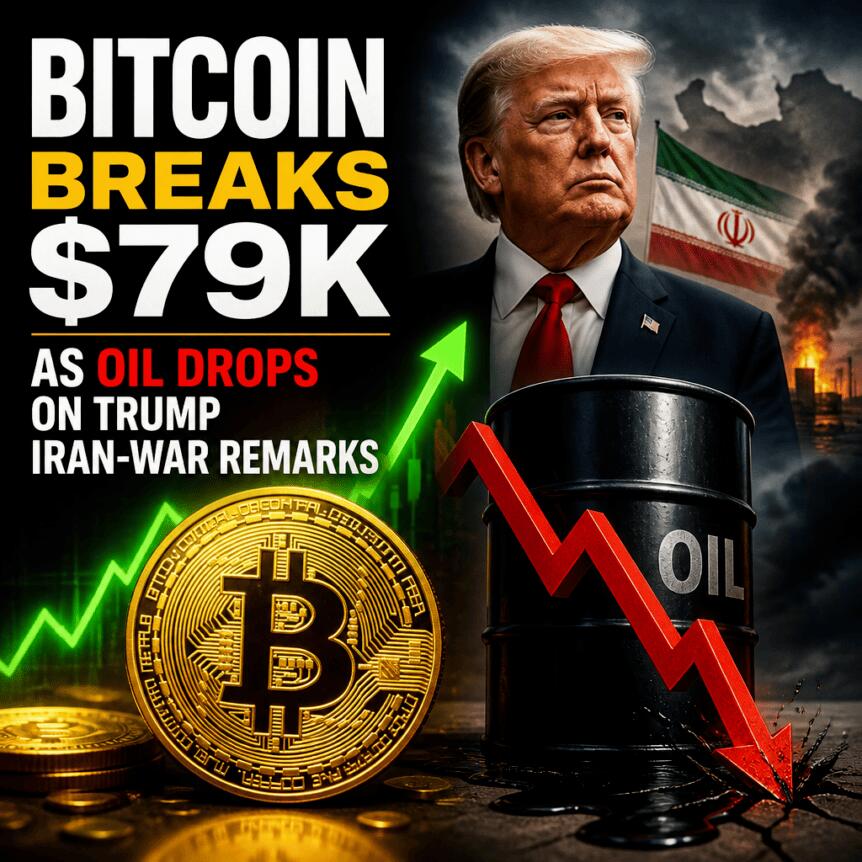
Bitcoin reclaimed the $79,000 area on Monday as traders weighed shifting expectations around the US-Iran conflict and the Federal Reserve’s next move. The bounce came after Trump-linked comments raised the odds of an easing of tensions—helping drag down oil prices—while interest-rate probability models leaned further toward a hike later this week.
According to TradingView data cited by Cointelegraph, BTC/USD erased weekend losses and was up roughly 3% on the day, returning above its 50-week exponential moving average (EMA) near $77,430 after closing below that key level on Sunday. At the same time, markets were still highly focused on the Fed’s Wednesday decision, with policy pricing reflecting renewed confidence that rates will move higher.
Key takeaways
- Bitcoin pushed back above $79,000 as oil prices softened following comments from US President Donald Trump about potential progress toward an Iran deal.
- CME Group’s FedWatch Tool showed a 25-basis-point hike probability rising to 92.7% for the Sept. 16 FOMC meeting, up from 59.4% a week earlier.
- BTC/USD regained the 50-week EMA around $77,430 after a weekly close below the trend level on Sunday.
- QCP Capital argued that sustained high energy prices could create “policy tension” for the Fed—keeping rates restrictive while also worsening growth/inflation trade-offs.
Trump’s comments lift risk sentiment while oil slides
Crypto’s upside was tied to renewed optimism that the US and Iran could reach an agreement. In a post on Truth Social, Trump wrote that Iran “wants to make a deal” and said he would decide whether the US would engage. A separate Truth Social post also suggested that, once the military conflict ends, “Oil will drop like a rock.”
Markets initially responded positively at the open in US equities, but sentiment cooled as uncertainty lingered around Middle East oil-transit routes. The Strait of Hormuz remained a focal point, along with risks to Saudi Arabia’s East-West pipeline and the Bab El-Mandeb Strait as the conflict has expanded beyond Iran.
Energy pricing reflected the shifting narrative. WTI crude traded above $100 per barrel, while Brent was around $105 at the time of writing, even as the direction of oil moved with the latest expectations regarding the conflict’s trajectory.
Rate hike odds surge again ahead of the Fed
While geopolitical headlines moved one leg of the market, interest-rate expectations provided the other. According to CME Group’s FedWatch Tool, the chance of a 25-basis-point hike climbed to 92.7% for the Sept. 16 FOMC meeting—up from 59.4% a week ago.
QCP Capital said the link between energy prices and policy is central to how investors may interpret the Fed’s action. In a Monday market note, QCP warned that prolonged disruption could raise transport and logistics costs, potentially feeding higher inflation expectations and reducing the Fed’s flexibility to pause tightening even if growth data weakens.
“This dynamic creates policy tension: continued energy prices could keep the Fed restrictive, while economic data weakness from higher energy costs could argue for patience.”
As the Fed prepares to announce its latest interest-rate decision on Wednesday, markets were also looking through a base-case forecast of a 25-basis-point increase into a target range of 3.75%–4%.
BTC’s technical picture: 50-week EMA back in focus
Beyond macro drivers, traders continued to track Bitcoin’s technical levels. After a weekly close below its 50-week EMA on Sunday, BTC/USD moved back above the level near $77,430 on Monday, according to TradingView charts referenced by Cointelegraph.
That reclaim matters because the 50-week EMA is often treated by market participants as a trend filter for longer-term momentum. Cointelegraph previously noted that the 50-week EMA functions as a major support objective for Bitcoin bulls attempting to extend a broader bull-market recovery. In practical terms, regaining the level can reduce the immediate risk that BTC remains trapped in a bearish or corrective phase tied to the weekly chart.
However, the bounce also highlights how sensitive the market remains to the coming policy update. With the hike largely priced in, traders are likely to pay closer attention to the Fed’s wording and the implications for the path ahead—especially if energy costs keep complicating the inflation-growth balance.
Why Fed “wording” could matter more than the move
QCP Capital argued that the market had effectively already priced a 0.25% hike, which could mean less price volatility than usual around the decision itself. In that framework, Bitcoin’s near-term direction may depend more on how officials frame the move and what they suggest about future tightening.
QCP further pointed to last week’s Consumer Price Index (CPI) release as an important backdrop. It described the overall reaction to CPI as muted, implying that the key variable now may be messaging rather than the bare fact of whether rates increase.
In other words, even with a hike probability near 90%+ in the Fed’s pricing models, markets may still reprice risk assets if the Fed suggests energy-driven inflation risks are persisting—or, conversely, if it signals growing confidence that inflation is cooling enough to slow the tightening pace.
For traders and long-term holders, the next signals to watch are straightforward: how oil responds if the Iran-conflict narrative continues to soften, and whether the Fed’s language confirms a path consistent with expectations already embedded in market pricing. If BTC holds above the 50-week EMA after Wednesday, it would strengthen the case for buyers defending the trend; if it loses the level again, the market may revert to viewing the bounce as corrective.