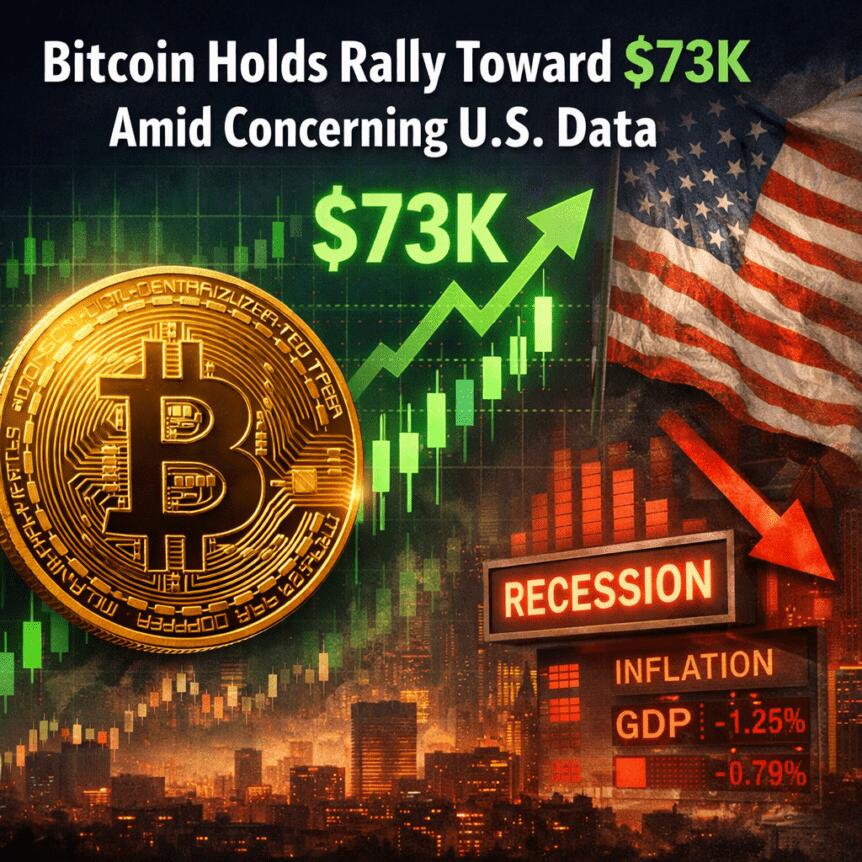
Bitcoin reclaimed the $72,000 level on Thursday as markets weighed a blend of persistent inflation signals, softer-than-robust growth data, and geopolitical tension in the Middle East. The ascent came despite data suggesting inflation remains stubborn and economic expansion cooled, underscoring a market environment where scarce assets can stay in demand even as macro headwinds persist.
On the inflation front, the US Bureau of Economic Analysis reported that the core Personal Consumption Expenditures (PCE) index rose 0.4% in February, reinforcing concerns about sticky price pressures. In the same week, the fourth-quarter gross domestic product was revised to a 0.5% annualized growth rate, a modest pace that keeps the economy on a fragile footing and adds to recession-talk among traders. Taken together, these readings suggest the trajectory for inflation and growth remains uncertain, fueling continued volatility in risk assets including Bitcoin.
Geopolitical headlines complicated the scene. Oil prices surged back toward the mid-$90s and briefly around $97 per barrel after Iranian leaders signaled that the United States and Israel had violated the ceasefire negotiated in the region. The market also watched the political dynamic in the United States, where reports anchored to the Dubai-based and U.S. commentary of a ceasefire circulated in the days prior. In this environment, Bitcoin traders noted that the perceived fragility of any truce could weigh on upside momentum, potentially pushing the price toward support around $68,000 if risk-off conditions intensify. The backdrop was further influenced by statements from Iranian parliamentary speaker Mohammad Bagher Ghalibaf, who highlighted alleged violations of the ceasefire by external actors, a narrative echoed in market chatter around Yahoo Finance reports.
Key takeaways
Bitcoin briefly moved back above $72,000, signaling sustained demand for scarce assets amid a uncertain macro backdrop.
Geopolitical tensions and a rebound in oil prices contributed to a guarded upside, with traders watching for signals about the durability of any Iran ceasefire and its implications for risk assets.
US core PCE rose 0.4% in February, while Q4 GDP was revised to a 0.5% annualized pace, underscoring persistent inflation and a slower growth path that heighten recession risk concerns.
The US dollar softened against a basket of currencies as liquidity expectations rose, but the macro mix kept the narrative complex for BTC and broader markets.
Equities remained resilient—with the S&P 500 trading within striking distance of its all-time highs—while concerns about private credit markets and AI-related debt costs did not trigger an immediate broad sell-off.
Bitcoin’s move amid a mixed macro and geopolitical backdrop
Bitcoin’s climb back toward the $72,000 mark occurred amid a market environment where inflation remains persistent, yet growth signals are tepid. The price action hints at a dynamic in which investors are prioritizing scarce assets as potential hedges against fiat weakness and continued liquidity provision, even as they weigh the probability of policy shifts from the Federal Reserve and the broader risk of a recession.
Some market observers interpret BTC’s strength as a response to liquidity expectations rather than a pure inflation hedge. The narrative suggests that traders may be leaning on Bitcoin as a conditional store of value in an environment where traditional fixed income offers less compelling real yields and where the dollar’s strength has ebbed slightly versus a broad basket of currencies. Yet the pace and durability of BTC’s rally remain tethered to broader risk sentiment, which can change quickly with new macro data or geopolitical headlines.
Trading activity around BTC also reflected a nuanced relationship with traditional risk assets. While Bitcoin has shown correlations with equities at times, the degree of coupling appeared variable in the current week, with some traders noting the asset’s sensitivity to liquidity conditions and the appetite for scarce stores of value as opposed to direct inflation hedges alone. The interplay between BTC and the S&P 500 has been a focal point for market analysis, highlighting how cryptos fit into a broader risk-on or risk-off framework rather than behaving as stand-alone inflation hedges.
Geopolitics, energy markets and risk sentiment
Oil markets provided a live read on the risk environment. After initial spikes tied to Middle East tensions, prices pulled back from the highs as traders weighed the potential for a ceasefire to hold and as headlines suggested a tempered near-term risk. The situation underscored a core market truth: energy prices often act as a barometer for risk appetite. When geopolitical headlines flare, oil reacts quickly, and the broader risk-on or risk-off impulse tends to color equities and crypto alongside it.
The market’s reaction to the ceasefire narrative also illustrated how a single development can ripple across asset classes. The S&P 500 futures reached multi-week highs as some observers interpreted the news as a reduction in near-term geopolitical risk, yet the specter of a fragile truce remained. In such an environment, Bitcoin’s path becomes less about a single data point and more about the evolving balance of inflation expectations, growth prospects, and liquidity provisioning by policymakers.
In parallel, the broader equity backdrop remained robust. The S&P 500 traded only a short distance from all-time highs, a signal that investors were not overly fixated on private-credit stress or the debt-cost pressures facing AI infrastructure firms. For Bitcoin, this translated into a day of price action that leaned into the risk-on narrative, even as traders remained vigilant for any signs of renewed risk-off pressure should geopolitical or macro data deteriorate.
Macro data, the dollar, and the evolving narrative for BTC
The macro backdrop continued to shape expectations for Bitcoin and the crypto market at large. Despite inflation’s persistence, a softer dollar tends to help scarce assets perform, particularly when liquidity support remains in play. The weaker dollar narrative aligned with a view that policy accommodations could persist longer than previously anticipated, a stance that supports Bitcoin’s appeal as a non-sovereign store of value in certain market conditions.
Importantly, the latest inflation and growth readings did not provide a clear blueprint for a rapid rally. Core PCE’s 0.4% uptick and the GDP revision signaling slower growth underscore a scenario where inflation remains a constraint on policy normalization, while growth risks limit the Fed’s capacity to curb liquidity without consequences for financial conditions. In such a setting, traders are watching for any fresh guidance from policymakers that could tilt the liquidity balance—either through rate expectations or balance-sheet actions.
From a market structure perspective, Bitcoin’s correlation with the S&P 500 remains an area of scrutiny. The 30-day relationship oscillates as traders parse whether BTC acts as a hedge, a risk asset-like instrument, or something in between. The current readings suggest a nuanced dynamic: BTC is influenced by risk sentiment, liquidity flows, and macro surprises just as traditional assets are, but with a unique sensitivity to the crypto market’s own structural developments and adoption cycles.
What lies ahead for Bitcoin and the macro regime
While the immediate path remains uncertain, the prevailing thread is clear: recession risks are rising from a backdrop of ongoing inflation and tepid growth, even as demand for scarce assets persists. For Bitcoin, this means opportunities to test new resistance levels exist, but a sustained move higher will likely require a clearer shift in the macro narrative—whether through stronger inflation relief signals, a more definitive pivot in Fed policy expectations, or a tangible easing of geopolitical tensions that reduces risk-off pressure on markets broadly.
Investors will want to monitor several developing threads in the coming weeks: the trajectory of US inflation data, the pace of GDP revisions, the evolution of the dollar, and ongoing developments in the Iran situation and oil markets. Each of these factors can tilt risk appetite and liquidity, shaping Bitcoin’s short-term trajectory as traders reassess the balance between macro risks and the demand for non-sovereign assets.
As the picture evolves, traders should remain cautious about reading a single data point as a signal. The combination of persistent inflation, modest growth, a fragile geopolitical backdrop, and a fluctuating dollar makes the near-term Bitcoin path highly contingent on how these factors interact. What remains uncertain is how quickly policymakers will calibrate liquidity support and how resilient risk appetite will prove when faced with new headlines or data surprises.
Readers should stay attentive to geopolitical updates, oil-price movements, and any fresh guidance from policymakers that could influence market liquidity. The next few sessions could redefine BTC’s support and resistance landscape as investors reassess risk, inflation, and the evolving horizon for crypto adoption.