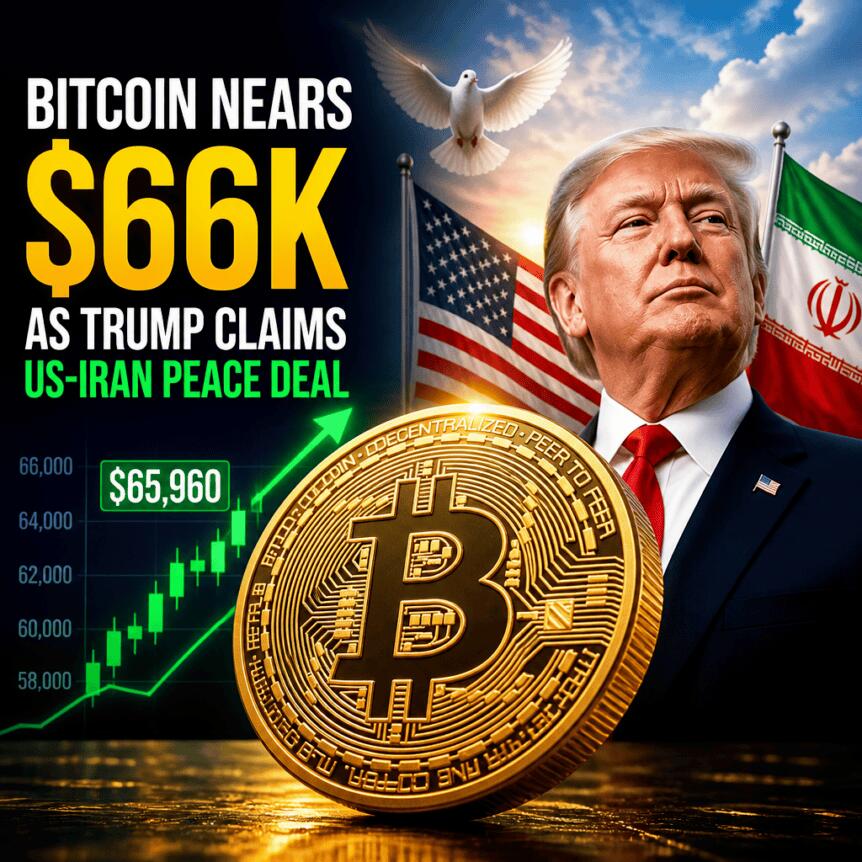
Bitcoin surged to just under $66,000 in Monday morning trading after US President Donald Trump claimed the United States had brokered a peace deal with Iran that would reopen the Strait of Hormuz. Trump said the agreement was completed late Sunday and authorized both the “toll-free opening” of the strategic waterway and the removal of any US naval blockade, adding that “oil will flow” again.
The move quickly spilled into crypto markets. According to TradingView data cited by Cointelegraph, bitcoin reached $65,881 on Coinbase during Monday morning trading—its highest print over roughly the past 12 days. The price had not traded above $66,000 since June 3, highlighting how closely investors were tracking the geopolitical storyline for near-term risk relief.
Key takeaways
- Bitcoin approached $66,000 after Trump claimed a US-Iran peace arrangement would reopen the Strait of Hormuz and remove a US naval blockade.
- Traders appears to have interpreted the announcement as a reduction in geopolitical risk and potential oil-supply pressure, supporting a “risk-on” move into crypto.
- US and Iranian officials confirmed aspects of an agreement, but the full deal details were not immediately available to markets, leaving room for last-minute friction.
- Crypto’s broader market followed higher, while crude benchmarks fell sharply during the same window.
- Additional volatility could come midweek ahead of the Federal Reserve’s interest-rate decision under new chair Kevin Warsh, with markets split by inflation dynamics.
Geopolitics meets liquidity: why bitcoin reacted
Trump posted on Truth Social that “the deal with the Islamic Republic of Iran is now complete,” and he separately called for the immediate authorization of the Strait of Hormuz opening alongside the removal of the US naval blockade. He framed it as enabling global shipping and oil movement.
While the market may focus on crypto fundamentals, the reaction underscored how quickly bitcoin can trade as a macro-sensitive asset when major geopolitical risk shifts. Andri Fauzan Adziima, research lead at the Bitrue Research Institute, told Cointelegraph that the potential deal “removes a major geopolitical risk premium,” prompting a “clear risk-on move as uncertainty fades.” He added that bitcoin’s strength was accompanied by traders rotating back into crypto amid “lower oil pressure” and a broader stability narrative tied to a pro-crypto administration.
Still, Adziima cautioned that despite the bullish price action, the situation may not be fully settled. He flagged the risk of “last-minute signing issues,” reflecting a common reality in macro-driven crypto rallies: confirmation can matter as much as headlines.
What’s confirmed—and what remains unclear
Markets reacted positively to the latest claims, but key implementation details were not immediately available. Cointelegraph noted that the precise terms of the US-Iran deal were not released at the time of reporting and that it would not take effect until Iran signs. Iran’s signing was expected on Friday, according to Associated Press reporting, under mediation by Pakistan.
On the Iranian side, Cointelegraph reported that Iran’s deputy foreign minister, Kazem Gharibabadi, confirmed the agreement on state television. The secretariat of Iran’s Supreme National Security Council also stated that the war on all fronts “will end immediately and permanently beginning tonight” and that the US blockade “will be terminated immediately and in full.”
This mix—US messaging emphasizing authorization and Iranian confirmation of termination—was enough to shift trader expectations quickly. However, the gap between “claimed completion,” “signing expected Friday,” and “details not immediately available” is precisely where uncertainty can linger, even when the initial reaction looks decisive.
Ripple effects across crypto and energy markets
Bitcoin’s rally was not isolated. Cointelegraph reported that the broader crypto market gained around 2% in total capitalization on the day. Several altcoins were described as outperforming, including Hyperliquid (HYPE), Zcash (ZEC), and Near Protocol (NEAR), with some posting double-digit gains.
Energy moves offered additional confirmation that traders were leaning into the “reduced pressure” narrative. Cointelegraph cited crude oil weakness, with WTI falling about 5% to just above $80 per barrel—its lowest level since early March—while Brent dropped around 4.6% to $83.30. A drop in oil prices often signals expectations of easing supply disruption risk, which in turn can reduce one layer of macro uncertainty affecting risk assets.
Bitcoin’s technical backdrop also matters: Cointelegraph noted that bitcoin has been gradually trending up since dipping briefly below $60,000 on June 6. Even with Monday’s strength, the asset remains down roughly 48% from its October peak above $126,000, suggesting the current rally is more of a recovery leg than a full reversal of the larger decline.
Midweek macro catalyst: the Fed decision risk
Even with geopolitical relief in focus, crypto traders have another immediate macro variable to watch. Cointelegraph reported that Wednesday may bring additional volatility as the Federal Reserve schedules its interest-rate decision under new chair Kevin Warsh.
Cointelegraph also cited that Warsh’s positioning appears more receptive to rate cuts, while ongoing inflation—described as topping 4% again in the cited coverage—bolsters the case for possible rate increases. The conflicting signals underline why rate decisions often amplify swings in both risk sentiment and crypto liquidity.
According to Cointelegraph, the CME Fed Watch tool currently predicts a 96.6% probability that rates will remain unchanged at a range of 3.5% to 3.75%. While that suggests limited odds for immediate changes, the bigger risk for traders is what the Fed implies about the path ahead—especially if inflation proves sticky or if communications shift expectations quickly.
For now, the market is trading a geopolitical headline with real macro implications: reopenings, blockade terminations, and—critically—execution. Investors should watch for final agreement language, the timing of Iran’s signature expected Friday, and whether oil continues to ease; alongside that, Wednesday’s Fed decision could determine whether this relief rally holds or flips back into higher volatility.