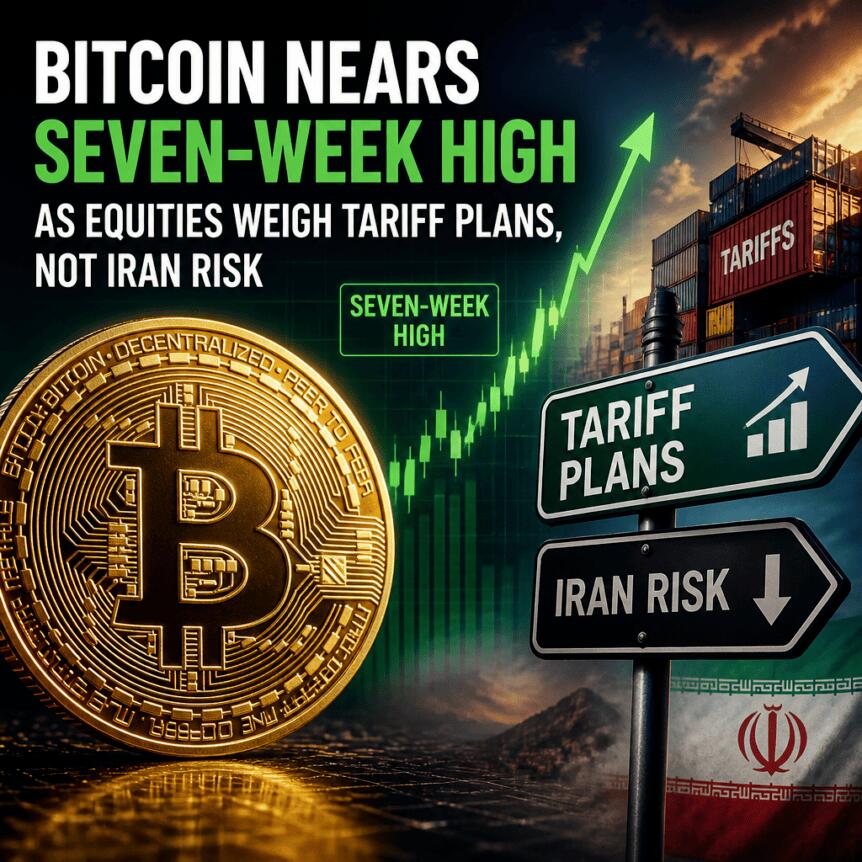
Bitcoin extended its early gains into the Wall Street open, tracking a broader buoyancy in US risk assets despite fresh geopolitical and tariff-related headlines. TradingView data showed BTC/USD pressing toward $67,000 and edging close to its seven-week highs.
What stands out for traders is that neither the latest escalation in the US–Iran situation nor renewed talk of international trade tariffs has meaningfully derailed momentum in crypto markets. Instead, price action suggests participants are leaning toward the view that any disruptions may be temporary—at least for now.
Key takeaways
- BTC moved toward $67,000 and threatened fresh multi-week highs as stocks held up into the US session.
- Escalating tensions involving Iran and the Strait of Hormuz coincided with strength in risk assets rather than a selloff.
- Reported US tariff plans could have been a headwind for speculative markets, but traders appeared to expect a resolution.
- Analysts warn Bitcoin needs to reclaim its 21-week simple moving average to credibly challenge the broader bear-market structure.
Geopolitical escalation and tariff talk fail to cool risk appetite
According to TradingView, BTC/USD approached $67,000 during the session, with momentum that began earlier appearing to persist. The cryptocurrency’s relative resilience came alongside firm trading in US equity futures.
At the same time, the day’s headlines pointed to conditions that often support “risk-off” behavior. The US–Iran conflict saw further escalation after Iran struck targets at Amazon facilities in Bahrain in response to US strikes, and reporting indicated the Strait of Hormuz oil route remained closed.
In commodity markets, the geopolitical pressure showed up in crude prices: WTI oil rose to its highest level in over a month, nearing $85 per barrel, as TradingView’s WTI CFDs chart reflected.
On the policy front, multiple outlets reported that President Donald Trump is planning to introduce new 10% international trade tariffs. The proposal is described as following 50% measures imposed on Canada earlier in the week. Historically, tariff uncertainty can weigh on broader risk sentiment, yet crypto traders did not appear to react with sustained caution.
Instead, commentary from market participants suggested expectations that the situation would ultimately resolve in favor of markets. YouTube host Crypto Rover, for example, summarized the prevailing stance in an X post, writing that “Markets are pricing in peace.”
Stocks in focus as macro risks get tested
While crypto held up, some investors remained confident about near-term equity direction. Caleb Franzen, who runs macro analysis resource Cubic Analytics, posted on X that he had “zero fear” or worry regarding S&P 500 futures, describing the setup as supportive.
Still, the optimism was not universal. Cautionary notes surfaced from senior banking leadership, including JPMorgan CEO Jamie Dimon, who warned that markets were not pricing risks aggressively enough relative to what could come next. The juxtaposition highlights the tension investors face: risk assets can keep rising even when underlying risks are real, as long as participants believe outcomes will be less severe than feared.
Technical pressure point: the 21-week trendline
For Bitcoin-specific direction, attention shifted from short-term resistance levels to a longer moving-average benchmark. Material Indicators cofounder Keith Alan offered a more guarded view of the near-term outlook, arguing that the bear market may still be intact until BTC confirms a stronger trend.
Alan pointed to a “golden cross” involving the 21-day and 50-day simple moving averages on Monday, but emphasized that such signals on lower timeframes don’t necessarily negate a broader downturn. In his X analysis, he warned that bear markets do not always look like bear markets—especially when price action is volatile but not trend-confirmed.
The key condition, according to Alan, is whether Bitcoin can reclaim its 21-week simple moving average. He wrote that the macro trend would be challenged only if BTC pushes above that level, noting that until then, “the Bear Market remains intact.”
At the time of writing, the 21-week SMA was cited at $69,720, a figure that also aligns with Bitcoin’s 2021 all-time high. The larger implication is that reclaiming this long-term trendline would signal more than just a bounce—it would suggest a shift in how the market is pricing longer-duration risk.
Alan also acknowledged that there was “no real resistance” until $67,250, which helps explain why traders were willing to press higher even amid macro uncertainty. However, the absence of immediate resistance near $67,000 does not guarantee follow-through if the move fails at the longer-term moving-average level.
What to watch next for BTC
With BTC approaching the high-$60,000 zone, traders are now likely to monitor whether price can build momentum toward the $69,720 21-week SMA area. If Bitcoin cannot reclaim that threshold, analysts like Keith Alan suggest the market may still be operating under a bear-market structure—even if rallies continue to occur in the shorter term.