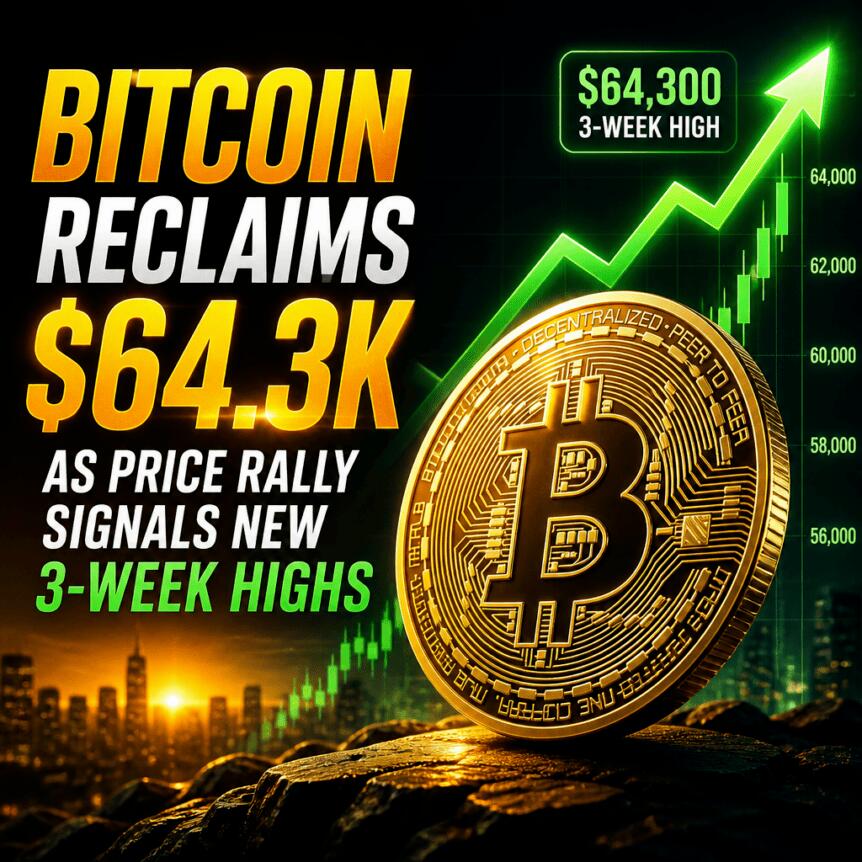
Bitcoin extended its rebound into Friday, pushing toward fresh multi-week highs as softer oil prices and a weaker US dollar helped risk assets regain momentum. TradingView data showed BTC/USD climbing above $64,000, hovering within roughly $400 of its newest three-week peak.
The latest move comes alongside renewed hopes that a US-Iran peace track could reduce near-term geopolitical stress—an angle that has also kept pressure on energy prices. With macro conditions improving at least at the margin, analysts are now watching a specific technical barrier around $65,000.
Key takeaways
- BTC/USD rose above $64,000, approaching fresh three-week highs, according to TradingView.
- Oil weakness and a US dollar pullback have provided a more favorable backdrop for crypto risk sentiment.
- QCP Capital highlighted that US Strategic Petroleum Reserve levels have fallen to their lowest since 1983, increasing downside risk if energy supply tightens.
- The Kobeissi Letter pointed to falling odds of US inflation exceeding 4.5% in 2026, citing Polymarket-linked expectations.
- Analysts are again focusing on $65,000 as “crucial resistance” for Bitcoin’s next directional move.
Bitcoin targets $65,000 as macro headwinds ease
TradingView charts indicated BTC/USD pressing higher, breaking through $64,000 and testing the upper end of a recent range. The distance to a three-week high was relatively small, suggesting the market is still in a short-term momentum phase rather than fully rotating into a cautious consolidation.
That momentum appears to be helped by two macro variables moving in Bitcoin’s favor: oil and the US dollar. While traders monitor many influences at once, the combination of lower energy pressure and a softer currency typically supports broader liquidity conditions for speculative assets.
Oil stays soft amid peace-deal hopes, but energy buffers look thin
Hope that an US-Iran peace effort might be salvaged has been a key narrative behind the day-to-day movement in oil. Even so, crude did not show sustained strength: WTI remained under pressure after rejecting from around $76 per barrel, according to the article’s reference to TradingView’s one-day CFDs chart.
In parallel, QCP Capital warned that the absence of a “monetary cushion” means physical energy buffers matter more than in periods where markets assume relief will be readily financed. QCP also noted that recent developments around Hormuz flows have left supply risks unresolved and highlighted the US Strategic Petroleum Reserve (SPR).
“The reserve looks thinner still: the SPR is at 319.5mb, its lowest since 1983, leaving just 19.5mb before the 300mb stress zone.”
For crypto traders, the practical implication is not that oil must rally for Bitcoin to benefit—but that tighter energy resilience can quickly translate into volatility. If geopolitical risk escalates, energy shocks can tighten financial conditions, potentially reversing the liquidity tailwind that Bitcoin currently appears to be using.
Dollar pullback and inflation expectations point to a friendlier risk tone
The article also emphasized US dollar softness, noting that the US dollar index (DXY) was approaching its lowest levels since mid-June after declining for a third consecutive day. A weaker dollar can ease financial strain and improve the appetite for assets priced in or influenced by global liquidity conditions.
On top of that, The Kobeissi Letter pointed to a shift in inflation expectations for 2026. According to the piece, the probability of US inflation surpassing 4.5% next year dropped to below 20%, referencing data from Polymarket. In its framing, inflation expectations are “coming down again,” supported by a post dated Thursday.
When inflation expectations soften, markets often anticipate a less restrictive policy path. For Bitcoin specifically, that can improve the relative attractiveness of non-yielding assets—though the effect tends to be nonlinear and sensitive to any new macro surprises.
From macro to crypto: “instability has spread,” but bulls press technical levels
While the short-term picture leaned more constructive, QCP Capital also introduced a cautionary counterpoint: it suggested recent stress signals are not confined to traditional finance. The article referenced QCP’s comment that “instability” appeared to spread into crypto after Strategy—identified in the source context—conducted recent BTC sales.
QCP also pointed to private credit as an area where redemption dynamics have worsened, stating that redemption requests cleared the 5% quarterly gates across several funds. That matters for crypto because credit-market pressure can influence funding costs, risk appetite, and the ability of investors to sustain leverage—even if crypto prices temporarily rebound.
Against that backdrop, some traders maintained a bullish near-term stance focused on technical levels. Michaël van de Poppe argued that oil-price direction is one driver of “a lot of upside” across markets and said that “Bitcoin [is] attacking the crucial resistance of $65,000 again.” In his view, a break above $65,000 could help shift broader market structure, flipping “many downtrends on many Altcoins into uptrends.”
What to watch next
With Bitcoin pressing toward $65,000, the key question is whether the current easing in the dollar and oil weakness can persist long enough to clear that resistance. At the same time, investors should monitor energy-risk indicators and broader credit conditions highlighted by QCP, because any reversal there could quickly drain the macro tailwind that’s currently supporting the rally.