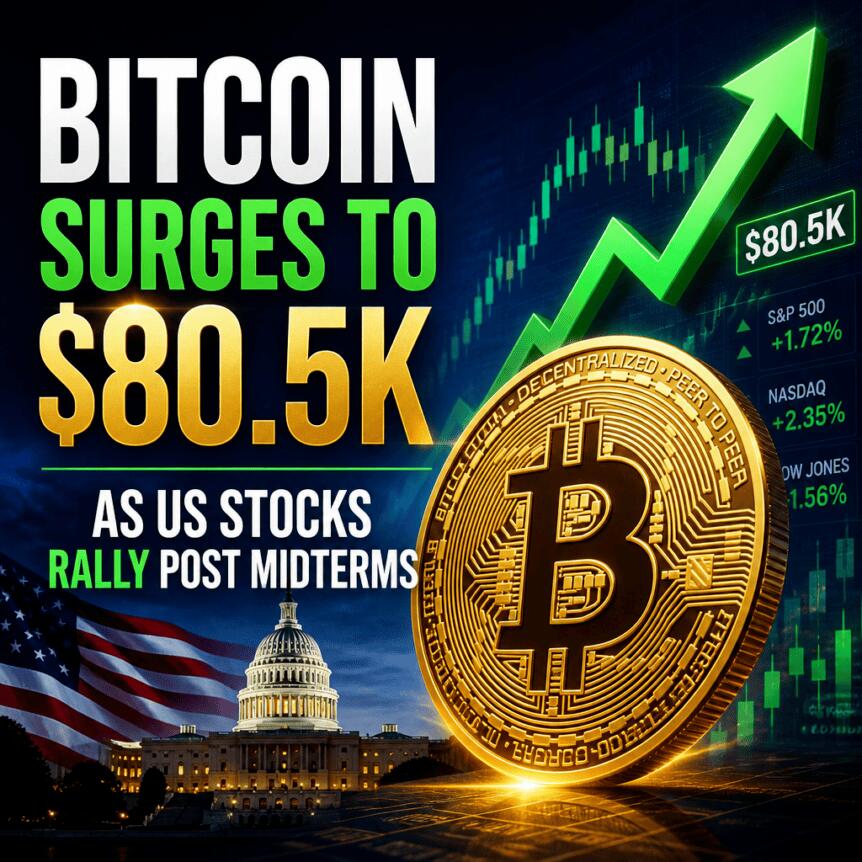
Bitcoin reclaimed the $80,000 level at the Wall Street open on Wednesday as broader risk sentiment improved following US midterm election results that shifted power toward Democrats. The rebound was mirrored in equity index futures, while oil prices eased on growing hopes that tensions linked to the US-Iran conflict could cool.
According to TradingView data cited in earlier market coverage, BTC/USD rose more than 4% and moved back above $80,500 during the start of Wednesday’s trading session, rebounding from its lowest levels in roughly seven weeks.
Key takeaways
- Bitcoin pushed back above $80,000 and $80,500 as equities recovered from an early dip tied to midterm election headlines.
- S&P 500 futures rebounded sharply after falling to a three-month low around 7,490, a move The Kobeissi Letter described as a “textbook bear trap.”
- WTI crude slid below $93 per barrel, with weekly losses of up to 11.9%, as market participants reacted to signals of reduced Iran-related risk.
- CoinShares research head James Butterfill said Bitcoin’s near-term performance is still likely driven more by macro factors—real yields, dollar liquidity, and exchange-traded product flows—than by politics alone.
Bitcoin rides a broader “risk-on” turn after midterms
Crypto’s move higher tracked a sudden improvement in US markets. TradingView figures referenced in the source show BTC/USD gaining more than 4% after slipping to lower levels earlier in the run-up to the election period.
Equity futures set the tone. S&P 500 futures, which had dropped as low as 7,490—its lowest level since late July—then rose quickly toward roughly 7,690, approaching new month-to-date highs. The Kobeissi Letter attributed the initial weakness to a “textbook bear trap,” arguing that the market initially overreacted to the news flow around Democratic gains.
The Kobeissi Letter pointed to the scale of the political shift, stating the Democrats had flipped seven seats in the Senate and 25 in the House of Representatives—one of the largest changes in US political power in nearly two decades, according to the post cited in the source.
What changes—and what doesn’t—for crypto markets
While election outcomes helped spark the immediate turnaround, CoinShares’ James Butterfill suggested investors should not assume politics will be the dominant driver for long. In comments carried in the source, Butterfill argued that for Bitcoin, factors such as real yields, dollar liquidity, and the direction of Bitcoin exchange-traded product (ETP) flows continue to matter more than elections once uncertainty fades.
This framing matters because it highlights a common pattern in macro-driven crypto rallies: even when headlines trigger the first leg of momentum, follow-through often depends on whether traditional financial conditions are improving in a way that supports risk assets broadly. In other words, the midterm result may have served as a catalyst for sentiment, but the sustainability of the rebound still hinges on liquidity and rates-related indicators.
That makes Wednesday’s move important for traders not just as a headline-driven bounce, but as a test of whether crypto can hold gains as attention shifts from political uncertainty to the macro variables Butterfill flagged.
Oil eases on Iran-war hopes, potentially lowering inflation pressure
Commodity markets added another layer to the risk-on backdrop. The source reports that Iran’s reaction to the Democratic election outcome helped push US WTI crude to its lowest levels since mid-October.
In an X post referenced in the source, Iran’s speaker of parliament, Mohammad Bagher Ghalibaf, wrote that voters had “said NO TO WAR, and we endorse this message.” Separately, the source also noted that earlier, US President Donald Trump acknowledged that the Iran conflict was partly responsible for Republican election losses.
As a result, WTI dipped below $93 per barrel during Wednesday trading, down as much as 11.9% for the week. Brent crude moved toward sub-$100 levels for the first time since Oct. 7, according to the same report.
Economist Robin Brooks, quoted in the source, said oil markets had priced in a risk premium that was “too high” before the midterms. He also framed the post-election question around whether the US president will dial back on war-related escalation or pursue a tougher stance, writing that the key issue is whether policy moves in response to the new pricing of geopolitical risk.
In a market environment where crude prices influence inflation expectations, lower oil can translate into more moderate rate-hike expectations—one reason macro investors may treat commodity declines as supportive of wider risk appetite.
What to watch next for BTC and macro-linked sentiment
For readers tracking the durability of Wednesday’s rebound, the next focus is whether Bitcoin’s gains hold as equity futures stabilize and as the market continues to reprice geopolitical risk. CoinShares’ Butterfill specifically pointed to real yields, dollar liquidity, and Bitcoin ETP flows—watching those metrics alongside broader rate expectations may offer clearer signals than headlines alone.