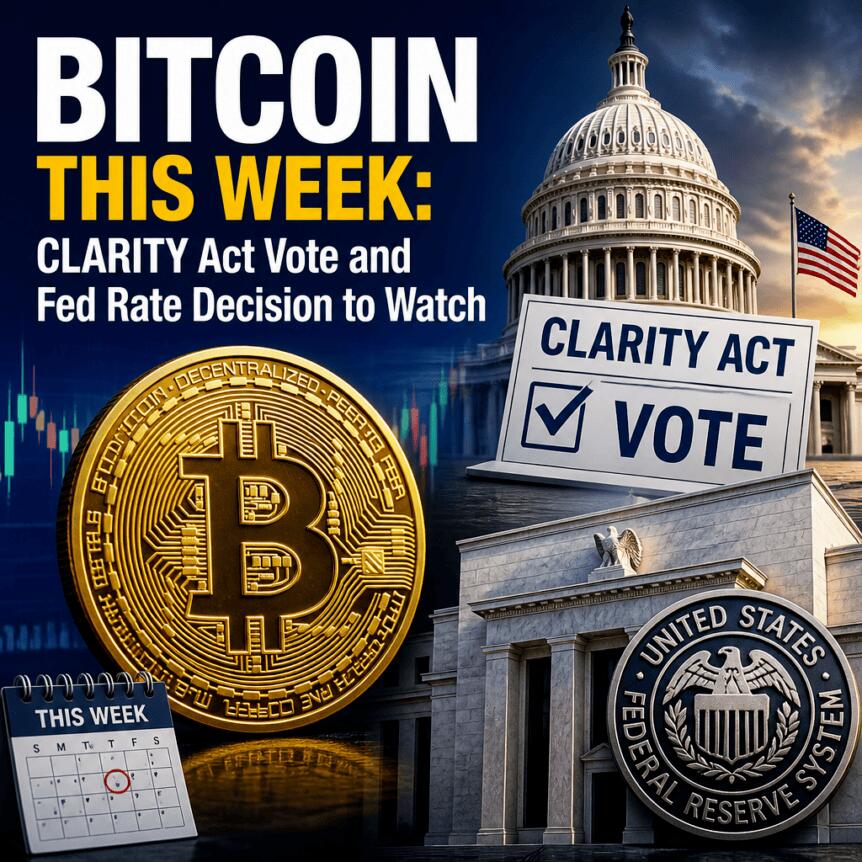
Bitcoin is entering the third week of September trading beneath important weekly support levels, with traders bracing for two closely watched US catalysts: a Federal Reserve interest-rate decision on Wednesday and a Senate procedural vote on the proposed CLARITY Act on Tuesday.
While macro expectations and policy headlines are driving near-term caution, market structure remains mixed. On the one hand, funding-related indicators point to an ongoing build-up of bullish leverage. On the other, Bitcoin’s latest weekly close failed to hold the technical thresholds that bulls had been defending.
Key takeaways
- CME Group’s FedWatch pricing has shifted toward another rate hike, with the probability of holding steady around 13.3% at the time of writing.
- The Senate is set to hold a procedural vote on the CLARITY Act Tuesday, a step that could send the bill to the floor if it clears.
- Crypto sentiment data from Santiment shows a notable drop in Bitcoin open interest in the week through Sept. 11, suggesting traders trimmed exposure ahead of volatility.
- CryptoQuant’s research highlights a return of positive aggregate funding rates since late May, indicating longs are increasingly paying shorts.
- Technically, Bitcoin closed below its 50-week EMA near $77,380, while RSI divergence remains a lingering bullish factor.
Fed decision becomes the main volatility trigger
For risk assets, Wednesday’s Fed outcome is the centerpiece. Multiple policy dynamics are converging: persistent inflation concerns, energy-driven price pressures, and ongoing debate within the central bank about whether rates should be raised.
According to CME Group’s FedWatch Tool, markets were pricing in a low likelihood of a pause. At the time of writing, the implied probability of rates staying at current levels was about 13.3%. Cointelegraph previously noted that markets had reacted differently to earlier decisions—especially around periods when Chair Kevin Warsh kept rates unchanged while some officials preferred a hike—setting up a backdrop where trader expectations can swing quickly.
The shift in pricing comes as inflation data did not deliver major upside surprises, but crude oil has remained a headwind. Markets reacted hawkishly despite the CPI and PPI prints, reflecting elevated energy costs and the sense that supply constraints may not be easing.
Commentary from The Kobeissi Letter emphasized how disruptions tied to key maritime routes could intensify the energy shock. In an X post cited by Cointelegraph, the account warned that roughly 30 million barrels per day may be unable to transit through certain routes, with additional risk flagged for the Bab el-Mandeb Strait. It also pointed to consumer inflation expectations rising, with gas prices and tariffs frequently referenced as contributors.
CLARITY Act vote turns into a near-term sentiment test
Alongside the Fed, US legislative progress on crypto regulation is on the calendar. Tuesday’s Senate procedural vote on the CLARITY Act could become a catalyst for speculative positioning because it determines whether the bill advances toward debate on the floor.
On Monday, Senate Republicans released what they described as their “last, best and final offer” for the Act’s text after bipartisan negotiations aimed at producing a clearer legal framework. Senator Cynthia Lummis, who released a 635-page updated proposal, said the bill was ready following a year of negotiations. She also highlighted ethics restrictions in the proposal and argued that a procedural “no” would oppose reforms and leave US digital-asset markets with insufficient protections.
The procedural step requires 60 votes to pass, with a vote scheduled for 2:15 pm on Tuesday. If the bill clears, it can move to the Senate floor for debate. If it fails, traders are likely to reassess the timeline for regulatory clarity—an uncertainty that can spill over into broader risk appetite.
Market expectations for passage remain cautious. On Polymarket, odds of the CLARITY Act being signed into law in 2026 were cited at about 34% at the time of reporting, with higher probabilities last seen earlier in August.
Derivatives positioning: traders de-risk before headlines
In the lead-up to Tuesday’s Senate vote and Wednesday’s Fed announcement, multiple analytics snapshots suggested traders were adjusting exposure rather than leaning aggressively into the next move.
According to Santiment’s analysis of open interest across exchanges, positioning had already shifted ahead of the two headline events. Santiment commented that the market appeared to have “already made its move,” pointing to the idea that derivatives participants had started preparing for volatility.
Specifically, Santiment data showed Bitcoin open interest in BTC terms falling 13.5% in the week through Sept. 11—down from about 321,497 BTC to roughly 278,151 BTC—followed by only a modest rebound. Over the same period, spot price was reported to have fallen about 5%. Santiment also stated that positioning sat around 20% below levels seen before the mid-August rally.
In practical terms, that matters because reduced open interest often limits how much leverage can amplify price swings. Still, a decline in open interest can also be consistent with traders waiting on confirmation from upcoming policy decisions.
Funding rates stay bullish as Bitcoin trades near $80,000
Even as traders trimmed derivatives exposure, onchain research pointed to continued improvement in sentiment reflected by funding rates. CryptoQuant argued that new signals in perpetual funding suggest bullish pressure building as BTC/USD trades near the $80,000 area.
CryptoQuant noted that aggregate funding rates have gradually risen since the end of May, after a period of negative funding that began in early March. Funding rates—driven by the balance of long and short demand—can reveal whether the market is paying to hold longs or shorts.
In the research cited by Cointelegraph, CryptoQuant described how bearish sentiment had prevailed during a “disbelief phase,” during which funding rates reflected one of the most bearish readings in Binance derivatives. It suggested that the buildup of shorts after a roughly -52% drawdown contributed to the rally seen in May.
CryptoQuant further observed that negative cumulative 30-day funding rates on Binance tended to line up with late-stage bear markets and with major corrections inside bull-market periods. This pattern-based framing is useful for traders, but it does not eliminate uncertainty—funding can remain bullish even if price action later fails to follow through.
Cointelegraph also previously reported concerns about the lack of spot-market participation in Bitcoin’s upside, implying that derivatives-led momentum may not always translate into sustained spot-driven uptrends.
Weekly structure weakens: support breaks under the 50-week EMA
Technical analysis remains the clearest immediate map for where risk may rise or fall. Bitcoin’s latest weekly close did not hold the levels bulls were watching.
As reported, Bitcoin ended the Sunday weekly close around $76,800 after failing to defend key support. Trader and analyst Rekt Capital said that $78,300 was necessary to hold at the weekly close. Failure to do so, he warned, could reopen the possibility of repeating the “failed breakout” pattern seen earlier in May.
Rekt Capital also pointed to a chart of lower highs, suggesting Bitcoin continues to preserve a longer-term bearish market structure. The weekly close was additionally below Bitcoin’s 50-week exponential moving average at about $77,380—a trend line that bulls typically want reclaimed as part of a more durable bullish shift.
Looking to the next technical level, Rekt Capital referenced the 21-week EMA near $72,270 as a potential line in the sand. He added that both the 21-week and 50-week EMAs often act as support in bull markets, and that losing them sustainably would be evidence that Bitcoin is not yet in a fully established bull cycle.
Despite these weaknesses, a bullish factor remains in the background: Bitcoin’s RSI kept higher lows through 2026, maintaining a “weekly bullish divergence” that some analysts treat as a supportive signal even when price temporarily dips.
What to watch next
With the Senate vote on the CLARITY Act and the Fed’s Wednesday rate decision approaching, traders may continue to reshape risk quickly—especially if derivatives positioning swings alongside any procedural or macro outcome. Beyond the headlines, investors should monitor whether Bitcoin can reclaim the 50-week EMA area and whether RSI divergence continues to hold as confirmation, or fades as support weakens.