Tom Lee’s Bitmine Immersion Technologies has restarted a steady program of Ethereum treasury buying, adding 9,926 ETH during the week ending Aug. 16. The company says the purchase brings its Ether holdings to roughly 5.82 million ETH—about 4.8% of Ethereum’s circulating supply—putting it close to its long-term goal of owning 5% of the asset’s total supply.
In its disclosure, Bitmine also provided valuation context: at an ETH reference price of $1,893, the latest portfolio total is worth about $11 billion. But the company notes that many of its ETH were acquired at significantly higher prices, underscoring how difficult the prolonged bear market has been for Ethereum treasury strategies.
Key takeaways
- Bitmine bought 9,926 ETH for the week ending Aug. 16, lifting holdings to about 5.82 million ETH (around 4.8% of circulating supply).
- At a reference price of $1,893, Bitmine’s Ether stake is valued near $11 billion, though acquisition costs are substantially higher for a large portion of the position.
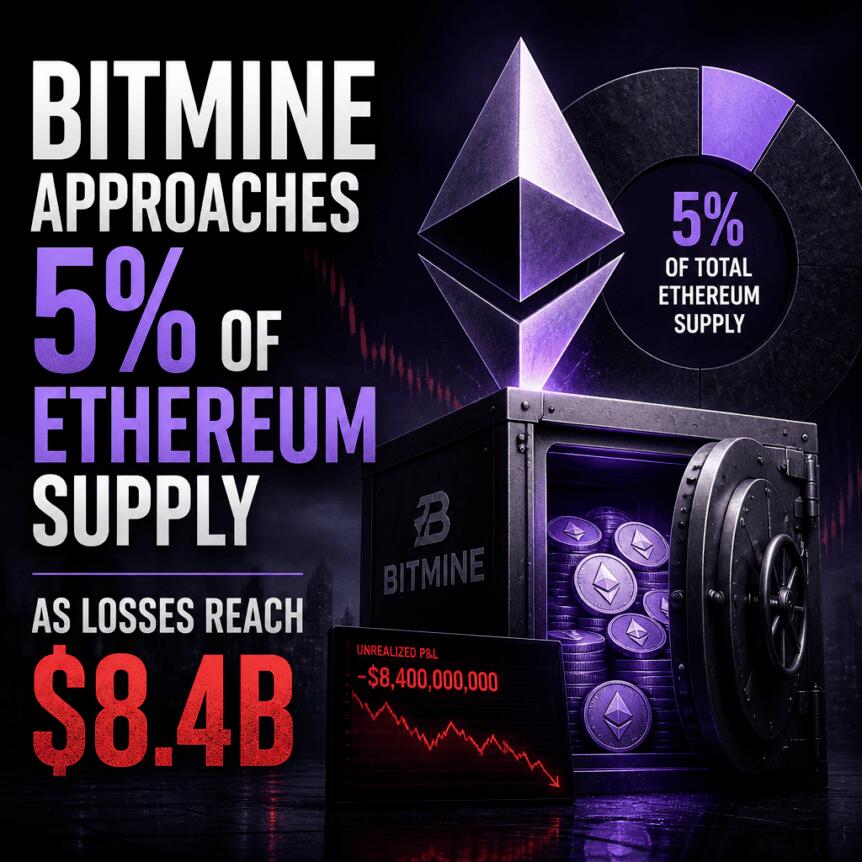
- Industry data cited by DropsTab estimates unrealized losses of more than $8.4 billion on the current ETH treasury.
- Despite the drawdown, Bitmine continues to stake more than 5 million ETH, which it says is generating protocol rewards.
- Bitmine’s staking yield was reported at 2.61% over seven days, implying roughly $287 million in annualized staking rewards, according to Tom Lee.
Restarting the “Alchemy of 5%” push
Bitmine’s strategy is built around scale and patience. After resuming purchases last week, the company is now within reach of its “Alchemy of 5%” target: holding 5% of Ethereum’s total supply. That target matters because it signals a treasury model designed to treat Ether as a long-duration bet rather than a tactical trading position.
According to Bitmine’s disclosure, the latest weekly buy also helps explain why the company continues to frame its program as a process rather than a series of opportunistic trades. The reported accumulation keeps the company moving toward a specific ownership threshold—one that would materially increase its influence and relevance as an institutional holder in Ethereum’s expanding ecosystem.
Unrealized losses remain a pressure point
The renewed buying comes even as Ether’s market environment has tested Bitmine’s conviction. The company is reported to be sitting on more than $8.4 billion in unrealized losses on its ETH holdings, based on industry data cited by DropsTab. DropsTab’s estimate places Bitmine’s unrealized losses at around 43% relative to the company’s reported acquisition costs, despite the current portfolio value being above $11 billion.
That mismatch—between the size of the position and the magnitude of drawdowns—highlights a key risk for any “buy-and-hold” treasury plan executed through a full market cycle. Even when a strategy is long-term, the path matters: buying during a downtrend can create large paper losses that only reverse if market prices recover meaningfully.
Staking helps fund the wait
What differentiates Bitmine’s approach from a simple spot accumulation strategy is its ongoing staking operation. The company said it is staking more than 5 million ETH, which it values at roughly $9.6 billion at current prices. By staking, Bitmine earns protocol rewards for helping secure the network—providing a source of yield that can partially offset the emotional and financial pressure of unrealized drawdowns.
Bitmine’s filing also links its staking activity to a measurable performance indicator. Based on a seven-day staking yield of 2.61%, Tom Lee projects annualized staking rewards of roughly $287 million. While annualized estimates can fluctuate—since staking yields depend on network conditions and how rewards are distributed—the point for investors is clear: Bitmine’s treasury is not entirely exposed to price movement. A portion of its return profile is tied to staking economics rather than only to Ether’s market direction.
Still, staking does not remove the core uncertainty. If Ether’s price does not recover, unrealized losses can remain large even while protocol rewards accrue. Conversely, if Ether rebounds, staking rewards can accelerate the path toward a healthier overall position—both in absolute returns and relative to acquisition costs.
Why steady accumulation is notable now
Bitmine’s restart of weekly Ether purchases suggests the company is treating the current phase of the market as compatible with its long-term ownership targets. Earlier coverage noted that Bitmine has continued accumulating Ether through weekly buys since launching its ETH treasury strategy in June 2025. In that context, the latest addition looks less like a reaction to short-term price action and more like execution of a defined roadmap.
For market observers, that matters because large treasury actions can act as a counterpoint to narratives that institutional interest fades during downturns. Even when unrealized losses mount, Bitmine appears willing to keep buying as it approaches its 5% target—while using staking yield to keep the strategy funded.
There is, however, an important asymmetry to watch. As Bitmine nears the 5% level, further buying can become harder depending on remaining supply dynamics and how the company structures future deployment. The company’s near-term challenge may shift from “can it keep accumulating?” to “how does it manage valuation risk and portfolio efficiency as its position grows?”
Next, investors and traders will likely focus on whether Bitmine can sustain weekly accumulation while Ethereum staking yields remain stable enough to support the projected reward rate. Just as importantly, readers should watch how fast the market price of Ether moves relative to Bitmine’s acquisition costs—because staking can soften the drawdown, but only a meaningful price recovery can fully relieve the unrealized loss picture.