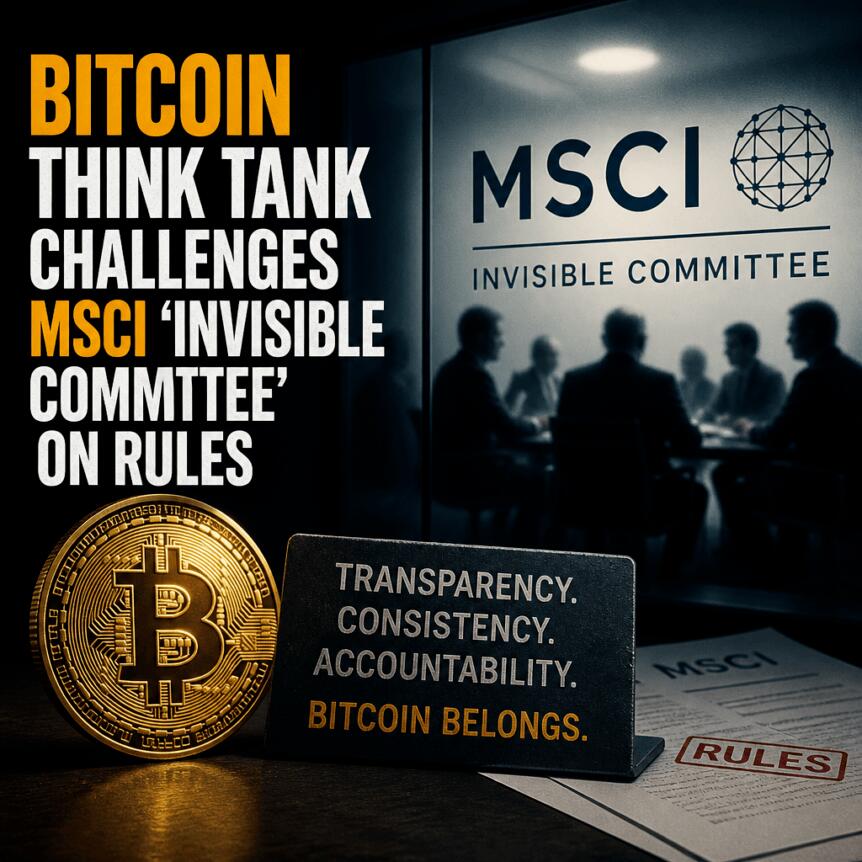
MSCI has reopened its consultation on whether certain “non-operating” companies should be excluded from its global equity indexes—an effort that could again put crypto-related treasury firms like Strategy and Metaplanet under scrutiny. The change matters because MSCI benchmarks are widely used by asset managers, and index removals can translate into forced selling for funds that track those measures.
The latest round of discussion follows earlier pushback on a more crypto-focused proposal. This time, MSCI is considering a broader framework for identifying companies whose value derives mainly from accumulating assets rather than from revenue-generating operations.
Key takeaways
- MSCI’s renewed consultation expands beyond crypto, but its proposal could still result in Strategy and Metaplanet being removed from certain MSCI indexes.
- A policy research group, BPI, alleges that MSCI’s consultation materials were internally linked to digital asset treasury companies, raising questions about how the broader language evolved.
- MSCI’s approach would first assess “substantial operating assets” before applying five additional financial tests.
- Index eligibility changes, if adopted, are expected to be implemented as part of MSCI’s November 2026 Index Review.
From crypto-specific rules to a broader “non-operating” framework
MSCI initially moved toward excluding digital asset treasury companies from its global indexes in 2025. But the plan was shelved in January after resistance, with MSCI saying it would instead review “non-operating companies” more broadly.
On Aug. 3, MSCI returned with a wider proposal that could still affect firms associated with Bitcoin treasuries. The consultation outlines a staged eligibility process: it would first evaluate whether a company has substantial operating assets, and then apply five further financial tests to determine whether it qualifies for inclusion in MSCI Global Investable Market Indexes.
MSCI’s publication describes the intent as identifying companies whose value is driven primarily by accumulating assets rather than by running operating activities that generate revenue. The consultation period also reflects a typical benchmark-provider process: feedback was accepted until Sept. 30, and MSCI said it expects to announce results on or before Oct. 16.
BPI questions whether MSCI’s language shifted—without changing the target
In a research paper titled Wall Street’s Invisible Committee, BPI argues that metadata tied to MSCI’s consultation presentation appears to have been stored in an internal folder specifically for digital asset treasury companies. Based on that observation, BPI says the finding “warrants asking whether its broader language carried forward” from the earlier, crypto-specific exclusion effort.
BPI’s concern is not just about outcomes, but about how MSCI developed its method. The policy group contends that MSCI’s broader approach may still be influenced by the same underlying objective—excluding a category of companies closely associated with digital-asset treasury strategies—even though the consultation is framed more generally.
MSCI accepted public feedback through Sept. 30 and is expected to publish final decisions by Oct. 16. Cointelegraph reached out to MSCI for comment on BPI’s allegations but did not receive a response before publication.
Simulation results suggest possible removals from MSCI indexes
MSCI’s consultation materials include its own simulations of how the proposed methodology would apply to specific companies. In that internal analysis, Strategy, Metaplanet, and uranium investment company Yellow Cake would be removed under the approach.
For investors and market participants, the practical implication is straightforward: if MSCI changes eligibility for widely referenced indexes, funds that rely on those benchmarks may need to adjust holdings to remain compliant. That can increase sell pressure around rebalancing windows—even if the underlying businesses are otherwise unchanged.
Cointelegraph previously reported that JPMorgan analysts estimated Strategy could face about $2.8 billion in outflows if it were excluded from MSCI benchmarks, underscoring how quickly benchmark changes can propagate into capital flows.
What “operating assets” could mean—and why BPI says it’s too discretionary
A key element of MSCI’s method is the determination of whether a company has “substantial operating assets.” BPI argues this term creates uncertainty because it is not a standardized balance-sheet category under U.S. Generally Accepted Accounting Principles or International Financial Reporting Standards.
According to BPI, the lack of standardized definitions could give MSCI significant discretion in classifying assets such as cash, investments, construction projects, and strategic holdings. In BPI’s framing, that flexibility could allow the rule to be applied in ways that are difficult for market participants to predict and reproduce.
BPI also argues the issue should be viewed beyond crypto treasuries. It notes that capital-intensive sectors—such as mining operations or satellite networks—may hold large asset bases and depend on external financing for extended periods before generating revenue. If MSCI’s criteria treat asset-holding companies as “non-operating,” BPI warns that some of these businesses could be caught in the same net, depending on how the tests are applied.
The policy group’s broader request to MSCI is for clearer, more reproducible criteria—standards that would help investors understand eligibility decisions in advance, rather than interpreting them only after index providers finalize outcomes.
Timing and implementation: when changes could hit
MSCI’s consultation is not just a policy document; it is part of a larger index review cycle. The provider said any resulting changes are proposed to take effect as part of its November 2026 Index Review, meaning potential portfolio impacts would likely be felt closer to that rebalancing date—assuming MSCI adopts the recommendations from the consultation.
That timeline gives managers and affected issuers time to assess scenario risks, but it also highlights the uncertainty: until MSCI issues final decisions, markets may continue to price the probability of inclusion changes rather than the certainty of them.
What readers should watch next is MSCI’s Oct. 16 decision and the specific details it releases on how “operating assets” will be measured in practice. The controversy around BPI’s claims about MSCI’s consultation materials also raises an important question for the industry: whether the method is truly neutral across sectors, or whether the broader framework still carries the same emphasis as the earlier digital-asset-focused proposal.