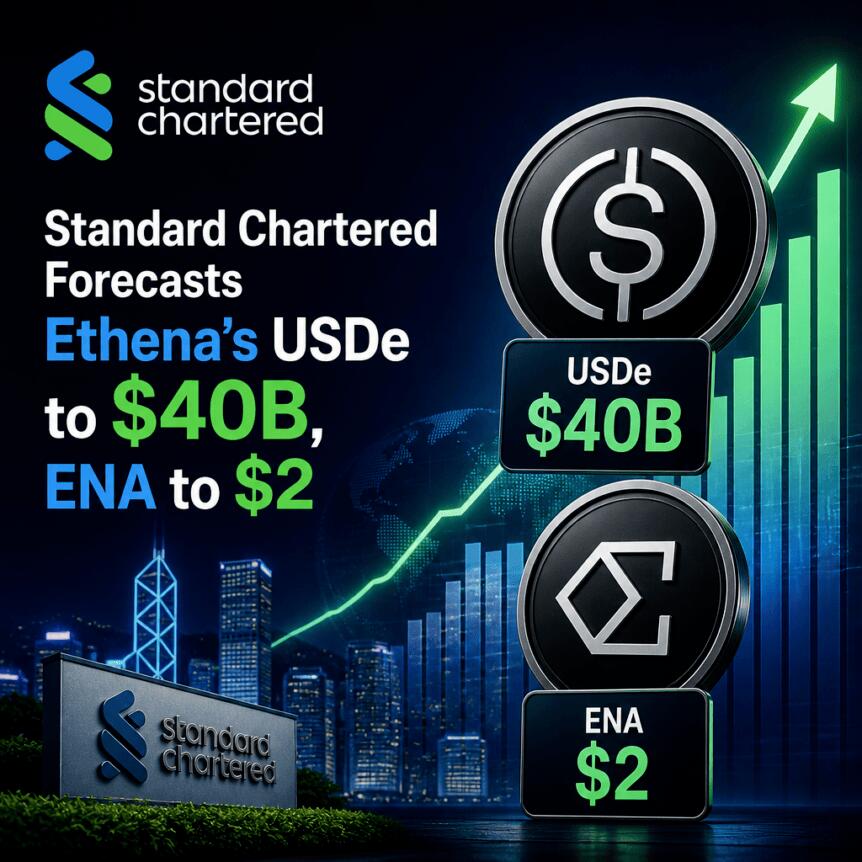
Standard Chartered has initiated coverage of Ethena’s ENA token with a bullish set of long-range assumptions tied to the growth of its USDe stablecoin. In a research report shared with Cointelegraph, the bank projects USDe supply could expand eightfold to $40 billion by the end of 2028—driven by yield strategies that go beyond the protocol’s traditional crypto basis trade.
Alongside its stablecoin forecast, Standard Chartered set a year-end 2028 price target for ENA of $2, a level it characterizes as significantly above the token price reference used in the report. The bank’s valuation model also hinges on an Ethena governance fee switch that routes a large share of net revenue toward ENA buybacks once USDe reaches specified milestones.
Key takeaways
- Standard Chartered expects Ethena’s USDe supply to rise to $40 billion by end-2028, outpacing overall stablecoin market growth slightly.
- The bank links its ENA valuation case to a governance-approved fee switch that directs 95% of net revenue to ENA buybacks after certain USDe supply thresholds are hit.
- Standard Chartered forecasts USDe’s yield expansion by broadening sources of return beyond the crypto basis trade, including DeFi, institutional lending, real-world assets, and other basis strategies.
- The report implies ENA could outperform Bitcoin and Ether over the same horizon, with Standard Chartered also projecting $300,000 for BTC and $18,000 for ETH by 2028.
Why the stablecoin runway matters for ENA
Standard Chartered’s thesis starts with the idea that USDe’s scaling capacity has improved, even as returns from the protocol’s core approach—holding spot crypto while shorting perpetual futures to capture the “basis”—have faced headwinds. According to the bank, declining returns in that traditional strategy have pushed Ethena to look for additional yield channels.
Those expansion efforts, as outlined by Standard Chartered, include moving into DeFi and institutional lending, as well as pursuing yield tied to real-world assets and basis trades linked to equities and commodities. The bank argues these diversifications currently produce a blended yield of 5.2%, which it views as giving USDe more room to grow.
In its broader framing, Standard Chartered expects the addressable market for tokenized assets to expand sharply—from roughly $350 billion today to $4 trillion by end-2028. The implication is that Ethena’s potential to source yield could rise as more asset types become eligible for tokenization and institutional participation.
ENA buybacks tied to a governance fee switch
The key mechanism behind Standard Chartered’s ENA target is a link between USDe growth and token buybacks. The bank points to an Ethena governance decision made in early September that activates a fee switch: 95% of net revenue from Ethena’s business lines is intended to be directed toward ENA buybacks once USDe reaches specific supply milestones.
Standard Chartered estimates what that could mean under different scenarios. For example, it cites Ethena’s own calculations suggesting that when USDe reaches $25 billion in supply, the mechanism could support about $375 million in annual ENA buybacks—based on assumptions of a 6% gross protocol yield and a 25% net revenue take rate.
Looking specifically at its end-2028 forecast, Standard Chartered assumes USDe reaches $40 billion. If ENA’s price were unchanged in that scenario, the bank estimates buybacks could reach roughly 23% of ENA’s circulating market capitalization on an annual basis. Standard Chartered cautions that such a buyback intensity is likely unsustainable, and therefore it expects ENA’s price to increase until buybacks represent a lower proportion of market value.
To support that intuition, the bank compares the dynamic to Uniswap. It notes that UNI’s annualized buyback rate has stabilized around 3% to 4% as the token’s price increased—an analogy used to suggest how buyback-driven demand may translate into token price adjustments until a new equilibrium forms.
Standard Chartered’s 2028 valuation framework
In initiating coverage, Standard Chartered also laid out broader price targets across major digital assets, presenting a comparative outlook that implies ENA would outperform established crypto benchmarks over the same period. The bank forecast Bitcoin (BTC) at $300,000 and Ether (ETH) at $18,000 by the end of 2028.
Within that context, it set ENA’s year-end 2028 price target at $2. The report describes ENA’s target as roughly seven times a $0.28 price reference cited in the bank’s own report. Separately, it referenced current token levels using market data: ENA was trading around $0.27 on Wednesday, according to CoinGecko data, up about 28% over the prior week and 77% over the prior month, with a market capitalization of roughly $2.65 billion.
Standard Chartered further expects USDe’s growth to slightly outpace overall stablecoin market growth over the period to 2028. If its assumptions hold—that USDe can scale to $40 billion and that the yield strategies can maintain attractive blended returns—then the downstream effect for ENA would be amplified by the buyback schedule triggered by supply thresholds.
What to watch next
Investors watching Ethena’s trajectory should focus on whether USDe’s yield mix remains robust as it scales, and on the timing and impact of the governance-driven buyback mechanism as supply milestones approach. The interplay between USDe growth, the sustainability of protocol yields, and how quickly ENA’s market cap adjusts to buyback intensity will be central to whether Standard Chartered’s 2028 expectations prove conservative or overly optimistic.