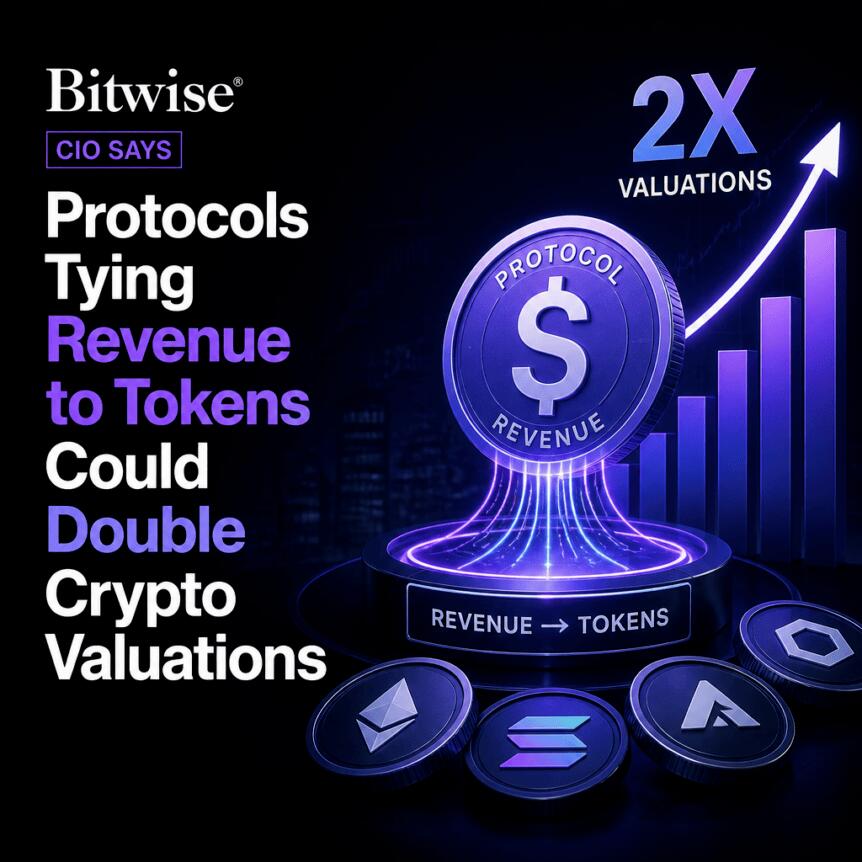
Crypto’s valuation framework may be due for an update as more networks turn protocol revenue into token buybacks and burns, a shift that Matt Hougan, Chief Investment Officer at Bitwise, argues the market has not fully priced in. In a Wednesday memo, Hougan described a growing “revenue-driven” model for crypto assets outside Bitcoin, where real usage and activity can translate into native-token value—potentially supporting much higher valuation expectations than today’s metrics imply.
Hougan went further, suggesting that if decentralized finance (DeFi) and layer-1 networks continue adopting fee-to-token mechanisms over the next 12 to 24 months, investors could begin to see token economics resemble more familiar valuation logic. The catch, he noted, is that token holders do not have the same legal rights to cash flows as traditional shareholders, and many tokenomics structures can be modified by communities.
Key takeaways
- Bitwise CIO Matt Hougan says the market is underpricing crypto assets that increasingly use protocol revenue for buybacks and burns.
- He expects more DeFi and layer-1 networks to add revenue-capture features within 12 to 24 months.
- Hyperliquid reported second-quarter revenue of $169 million and directed $141 million toward HYPE buybacks, according to the protocol.
- Uniswap’s fee “UNIfication” plan is designed to fund UNI burns through fee collection mechanisms approved for activation in late 2025.
- Aave DAO’s token repurchase program has already accumulated over 205,000 AAVE in its first 10 months, with automation plans in development.
Why protocol revenue is changing the token-value story
Hougan’s core argument is that native-token value is increasingly tied to network activity rather than being driven purely by speculation. He frames the shift as a transition toward models where fees and revenue can flow back into token supply management—either by buying tokens or removing them through burns.
For investors, the practical implication is that some assets may start to look more like income-producing businesses, at least in terms of the economic link between use and token scarcity. Hougan highlighted that this matters because traditional valuation approaches rely heavily on how cash flow is distributed to owners. Tokens, by contrast, typically do not grant a direct legal claim to revenues, and community-controlled tokenomics can evolve over time.
Still, Hougan’s memo suggests the market’s current pricing may not reflect the growing frequency with which fees are being routed back into token buy-and-burn structures.
Examples from DeFi: fees routed to buybacks and burns
Hougan pointed to several protocols already implementing revenue-to-token mechanisms, each offering a different method for turning activity into changes in token supply.
Hyperliquid: buybacks and a large allocation of revenue
Hyperliquid—described as a decentralized exchange—reported that it generated more than $800 million in revenue last year and uses roughly 99% of that revenue to buy and burn HYPE. On Aug. 6, the protocol reported $169 million in second-quarter revenue and said it directed $141 million toward HYPE buybacks, based on coverage referenced by Hougan’s memo.
Uniswap: UNI burns tied to fee activation
Uniswap’s path to revenue-based token supply changes centers on its “UNIfication” overhaul. Earlier reporting noted that the activation of protocol fees was approved with UNI burns in mind, with the mechanism designed so that collected fees can be claimed by burning UNI. The memo’s referenced update states that this approach is scheduled to take effect via activation for burns on Dec. 22, 2025.
Aave: repurchases backed by protocol revenue
Aave provides a more explicit example of a buyback program funded by protocol performance. According to the cited governance and founder statements, Aave DAO’s buyback program purchased more than 205,000 AAVE during its first 10 months. On June 25, Aave founder Stani Kulechov said the team was designing an automated, non-discretionary buyback mechanism.
In related remarks, Kulechov stated that “100% of Aave Protocol and GHO revenue goes to the $AAVE token,” referencing an “Aave Will Win” proposal that established the policy framework.
What regulatory change could unlock—and what remains uncertain
Hougan connected the broader shift toward revenue-sharing style token economics to a potentially more supportive regulatory environment in the United States. His view is that projects may increasingly be willing to implement structures that resemble traditional revenue alignment, after years when many steered clear of certain designs due to securities-law concerns.
As referenced in the memo, Hougan suggested that regulatory guidance could allow crypto to keep expanding even without passage of a specific federal framework—pointing to earlier coverage of whether the industry can “keep expanding” regardless of broader legislative timelines.
For readers, the key question is not whether revenue-to-token mechanisms can work—they already do in several cases—but whether regulation will encourage more networks to replicate these models at scale, and whether investors can reliably forecast token economics when token holders lack the same enforceable cash-flow rights that exist in equity markets.
Why this could affect valuation—and how to watch the next phase
Hougan argued that stronger links between protocol revenue and token value could help make crypto easier to evaluate using more conventional tools. That does not mean tokens become identical to stocks; rather, the memo’s thrust is that markets may be underestimating how much fee-driven buybacks and burns can alter expected token supply dynamics over time.
At the same time, investors should be alert to the details that determine whether buybacks or burns are sustainable: how revenues are calculated, how consistently fees flow to token holders (or token supply management), and whether automation or governance processes can be relied on through market cycles. Hougan’s emphasis on community-set tokenomics is a reminder that these mechanisms can change, sometimes quickly, depending on governance outcomes.
Over the coming months, investors will likely want to track whether additional DeFi protocols and major layer-1 ecosystems follow the same playbook—especially in how they commit protocol revenue to token supply actions—and whether regulators provide clearer guidance that reduces uncertainty for projects considering revenue-capture designs.